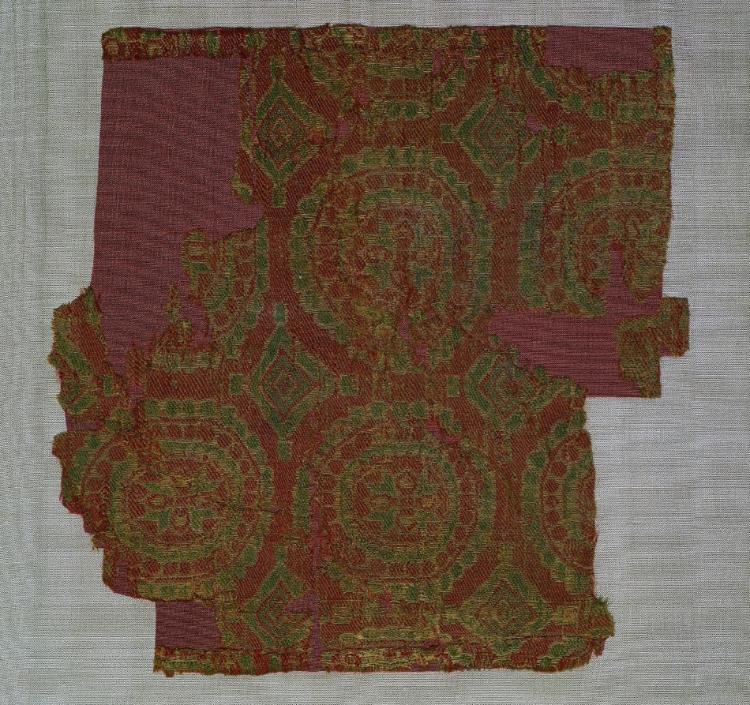
The Samite with Roundels of Rosettes: A Study in Imperial Silk Weaving and Material Legacy
Introduction: The Fabric of Power and Prestige
In the annals of textile history, few artifacts embody the confluence of artistry, technology, and imperial ambition as profoundly as the Samite with roundels of rosettes. This silk, woven with meticulous precision, is not merely a textile; it is a testament to the enduring legacy of imperial silk weaving—a craft that defined dynasties, shaped trade routes, and established standards of luxury that resonate in London’s Savile Row tailoring tradition today. As Senior Heritage Specialist at the Lauren Fashion Heritage Lab, I present this artifact as a cornerstone of material culture, where the interplay of silk’s materiality, the geometric discipline of rosette roundels, and the historical weight of imperial patronage converge.
Materiality: The Silk as a Conduit of Heritage
Silk—the very word evokes a sense of opulence, durability, and tactile refinement. In the context of this samite, silk is not a passive substrate but an active participant in the narrative of power. Samite, a heavy, twill-weave silk fabric, was historically reserved for ecclesiastical vestments, royal regalia, and ceremonial adornments. Its density and sheen, achieved through the use of high-twist silk filaments, allowed for intricate patterns to emerge with a luminous quality that caught the light and the eye. The roundels of rosettes—a motif of concentric, stylized floral forms—are woven into the fabric’s structure, not merely printed or embroidered. This technique, known as compound weave, required master weavers to manipulate multiple warp and weft threads, often incorporating gold or silver threads to amplify the textile’s prestige. The result is a fabric that whispers of courtly rituals, diplomatic gifts, and the silent authority of empire.
From a materiality perspective, the silk’s fiber composition is critical. Imperial silk weaving, particularly during the Tang and Byzantine eras, demanded the finest raw silk from sericulture centers like China’s Jiangnan region or Persia’s Khorasan. The samite’s weave density—often exceeding 100 threads per centimeter—ensured both structural integrity and a surface that could withstand repeated handling, folding, and display. This durability aligns with the Savile Row ethos of longevity: a garment or textile should not merely serve a season but endure as an heirloom. The rosettes, with their radial symmetry, are not decorative whims; they are mathematical constructs that reflect the weaver’s understanding of tension, repetition, and balance—principles that underpin the bespoke tailoring of London’s finest houses.
The Legacy of Imperial Silk Weaving: A Global Exchange
The samite with roundels of rosettes cannot be divorced from the broader context of imperial silk weaving, which functioned as a diplomatic currency and a marker of civilization. From the Silk Road caravans to the workshops of Constantinople, silk weaving was a state-sponsored enterprise. Emperors and caliphs established imperial looms, known as khass or palace workshops, where artisans were forbidden from replicating designs for private use. This exclusivity elevated the samite into a symbol of sovereignty. The rosette motif, in particular, carried layered meanings: in Persian and Byzantine iconography, the rosette represented the sun, eternity, and the divine order of the cosmos. For a ruler to wear or gift such a fabric was to assert their alignment with cosmic and temporal authority.
The legacy of this weaving tradition extends beyond its original contexts. When the samite reached European courts through trade or crusade, it inspired local weavers in Lucca, Venice, and later, Lyon. The roundels of rosettes were adapted into Renaissance damasks and brocades, influencing the aesthetic vocabulary of Western luxury. By the 19th century, the British Empire’s own textile industries, including the silk mills of Macclesfield and Spitalfields, drew upon these historical patterns to create fabrics for aristocratic and royal clientele. This lineage is palpable on Savile Row, where the heritage of imperial silk informs the choice of materials for evening wear, ceremonial uniforms, and bespoke accessories. The samite’s rosettes, though centuries old, find resonance in the subtle patterns of a tailored waistcoat or the lining of a dinner jacket.
Design Analysis: The Rosette Roundel as a Structural Motif
The roundel—a circular frame enclosing the rosette—is a design element that demands technical mastery. In this samite, the roundels are typically arranged in staggered rows, creating a rhythm that guides the eye across the fabric’s surface. Each rosette consists of four or eight petals radiating from a central point, often with a smaller inner circle. The symmetry is not merely aesthetic; it serves a functional purpose in the weaving process. The roundel’s circular form requires the weaver to adjust thread tensions continuously, as the pattern shifts from warp-dominant to weft-dominant areas. This complexity is a hallmark of imperial workshops, where weavers underwent years of apprenticeship to achieve such precision.
From a heritage perspective, the rosette roundel is a microcosm of cultural exchange. The motif appears in Sassanian Persian textiles, Byzantine church silks, and Tang dynasty Chinese brocades, each culture infusing it with local symbolism. In the samite under study, the rosettes are likely derived from Persian or Central Asian prototypes, later adopted by Byzantine and Islamic weavers. This cross-pollination underscores the samite’s role as a global artifact—a material witness to the interconnectedness of pre-modern economies. For the modern fashion scholar, this design offers a lesson in timelessness: the rosette roundel, stripped of its imperial context, remains a potent symbol of elegance and order, adaptable to contemporary design without losing its historical weight.
Conservation and Contemporary Relevance
Preserving a samite of this nature requires an understanding of its fragility. Silk fibers, while strong, degrade under light, humidity, and handling. The Lauren Fashion Heritage Lab employs climate-controlled storage, minimal exposure to ultraviolet light, and specialized mounting techniques to ensure the fabric’s longevity. Yet, conservation is not merely about physical preservation; it is about maintaining the narrative. Each thread of this samite carries the story of the weaver, the patron, and the empire. By studying its weave structure, dye composition (often derived from madder, indigo, or kermes), and pattern repeat, we reconstruct the technical knowledge of lost workshops.
In the context of Savile Row, the samite’s legacy informs contemporary practice. Bespoke tailors, such as those at Huntsman or Anderson & Sheppard, often reference historical textiles for inspiration, commissioning reproductions from mills like the Vanners in Sudbury. The rosette roundel, reimagined in a worsted wool or silk-wool blend, appears in linings, pocket squares, or as a jacquard pattern in a dinner jacket. This is not mere nostalgia; it is a deliberate engagement with heritage as a source of quality and distinction. The samite teaches us that luxury is not about novelty but about mastery—a principle that defines the Savile Row tradition.
Conclusion: The Enduring Thread
The Samite with roundels of rosettes is more than a historical artifact; it is a living document of imperial ambition, technical ingenuity, and aesthetic refinement. Its silk materiality, woven into a fabric of power, continues to inspire and inform the highest standards of tailoring and textile design. As we preserve and study this piece, we honor the weavers who transformed thread into empire, and we ensure that their legacy—like the rosette’s eternal circle—remains unbroken. In the hushed ateliers of Savile Row, where every stitch is a statement, the samite’s whisper endures: true luxury is woven, not worn.