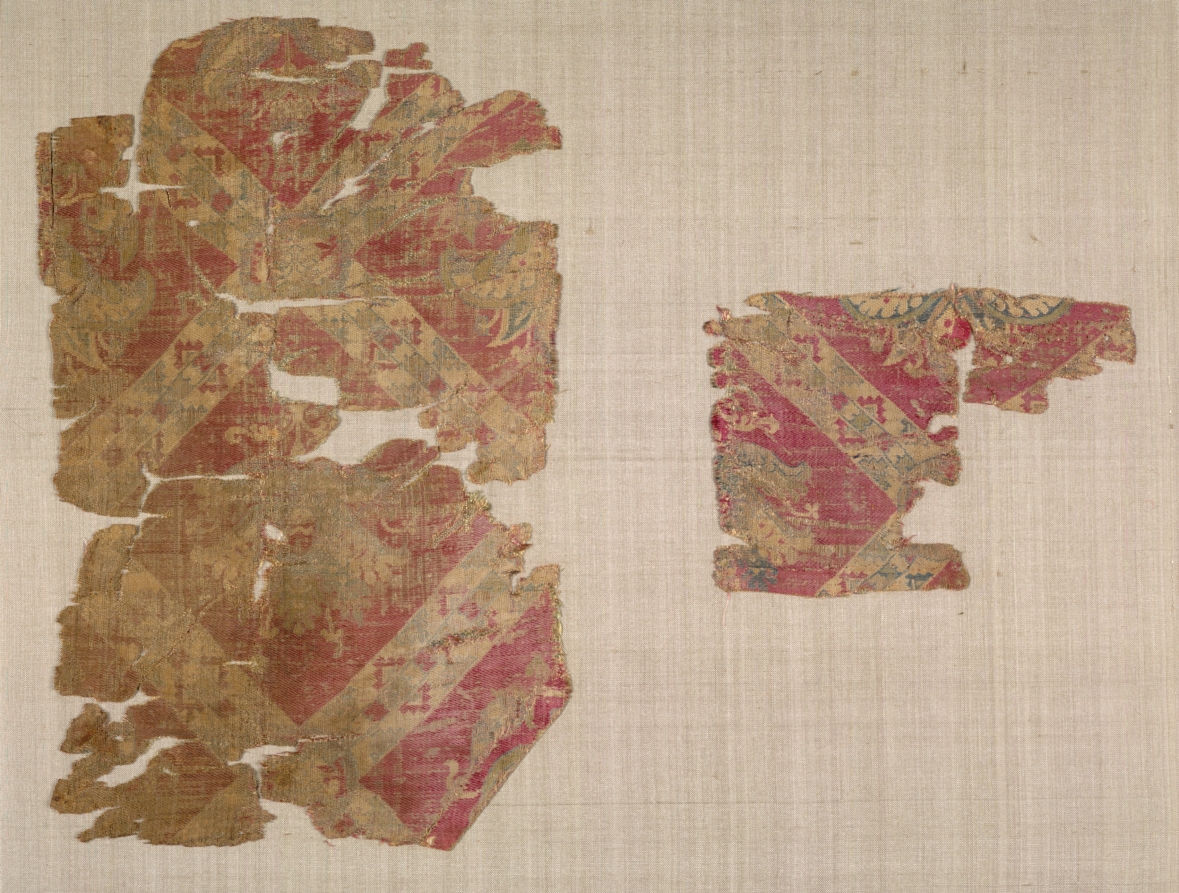
An Examination of Fragments: Palmette Blossoms & The Grammar of Imperial Weave
To the untrained eye, they are mere remnants: a series of silk fragments, their edges frayed by the relentless passage of centuries, their once-vibrant palette softened to a lexicon of ochre, madder, and indigo ghosts. Yet, to the connoisseur of material legacy, these artefacts—specifically, a grouping showcasing the palmette blossom motif—constitute a profound and eloquent testament. They are the foundational syntax in the grammar of imperial power, woven not merely on looms, but within the very apparatus of the state. Their materiality, silk, is the first and most critical point of interrogation; it was never a simple fabric, but a controlled substance, a currency of diplomacy, and the ultimate canvas upon which dynastic authority was rendered visible.
The Substrate of Sovereignty: Silk as a Controlled Substance
One must first apprehend the context of production to appreciate the fragment. Imperial silk weaving was seldom an exercise in mere aesthetics; it was a vertical integration of power. From the mulberry groves, whose cultivation was often a state-mandated activity, to the secretive, regimented workshops—the jiangzuo of China, the gynaecea of the Byzantine Empire, the later manufactures royales of Europe—every stage was overseen. The silk thread itself, a continuous filament of prodigious strength and luminous sheen, was a metaphor for unbroken lineage and permanence. To clothe oneself in such material was to announce one’s position within a privileged network of distribution, a system designed to create and reinforce hierarchy. The fragment, therefore, is a physical shard of that system, its very existence proof of the complex bureaucracy that birthed it.
The Motif as Mandate: Decoding the Palmette Blossom
Upon this rarefied substrate, we encounter the palmette blossom. This is no casual decorative whim. The motif, with its radiating fronds or petals emerging from a central core, is an ancient and persistent visual trope, migrating along the very trade routes the finished silks would later travel. Its power lies in its symbiotic relationship with the weave structure. In a damask or a lampas, the play of light across the contrasting faces of warp and weft allows the palmette to emerge and recede, to declare itself with a turn of the cloth or a shift in the observer’s position. This inherent dynamism—this dialogue between light, structure, and pattern—elevates the motif from ornament to emblem.
The arrangement of these palmettes is where imperial ideology becomes manifest. They are seldom presented in isolation. More commonly, they are organized within rigorous frameworks: repeated in endless rapport within a lattice, or positioned as the majestic heart of a larger, scrolling vine. This systematic repetition speaks of order, of a universe governed by predictable, beautiful rules—a mirror of the well-ordered state. The blossom becomes a unit of imperial currency, its replication a signal of control over both the technical means of production and the aesthetic language of prestige.
The Fragment as Forensic Evidence: A Narrative of Exchange & Adaptation
Our specific fragments, however, tell a more nuanced story than one of monolithic control. Close examination of the weave density, the twist of the yarn, and the specific rendering of the palmette’s form—does it lean towards a lotus, a pomegranate, an acanthus?—allows one to begin a process of forensic attribution. Was it woven in a Tang dynasty workshop for a patron on the Silk Road? Or is it a Sassanian interpretation, later influencing the early Islamic tiraz workshops? Perhaps it is a Byzantine silk, where the palmette was absorbed into a Christian iconographic schema, or a later Italian samitum where the Eastern motif was translated for a burgeoning mercantile aristocracy.
Each fragment, in its material and stylistic particulars, captures a moment of cultural transmission and adaptation. The very presence of such motifs in far-flung archaeological sites—a church treasury in the Rhineland, a burial mound in the Caucasus—charts the pathways of diplomacy, trade, and tribute. These silks were the ultimate portable wealth, their value and meaning recognized across linguistic and political boundaries. A fragment found beyond its place of origin is not merely an export; it is a silent witness to an alliance sealed, a faith embraced, or a commercial ambition fulfilled.
Conclusion: The Legacy Woven into the Present
To hold such a fragment is to hold a node in a vast network. It represents the culmination of agricultural policy, technological mastery, artistic convention, and geopolitical ambition. The palmette blossom, frozen in its silk matrix, is a compact symbol of a world where beauty was inseparable from authority, and where the flow of patterns was as consequential as the flow of armies or silver. The legacy of imperial silk weaving is, at its core, the legacy of using material culture to articulate power in its most refined and persuasive form.
In the contemporary ateliers of Lauren Fashion Heritage Lab, this legacy is not treated as a relic, but as a living dialogue. The understanding of how a structured repeat conveys authority, how the fall of light on a raised texture can command attention, and how a motif carries a deep cultural memory—these are the lessons extracted from the fragment. They inform a modern grammar of luxury, one where heritage is not copied, but decoded, its principles re-engineered for a new lexicon of distinction. The palmette, therefore, is never merely a pattern; it is a precedent.