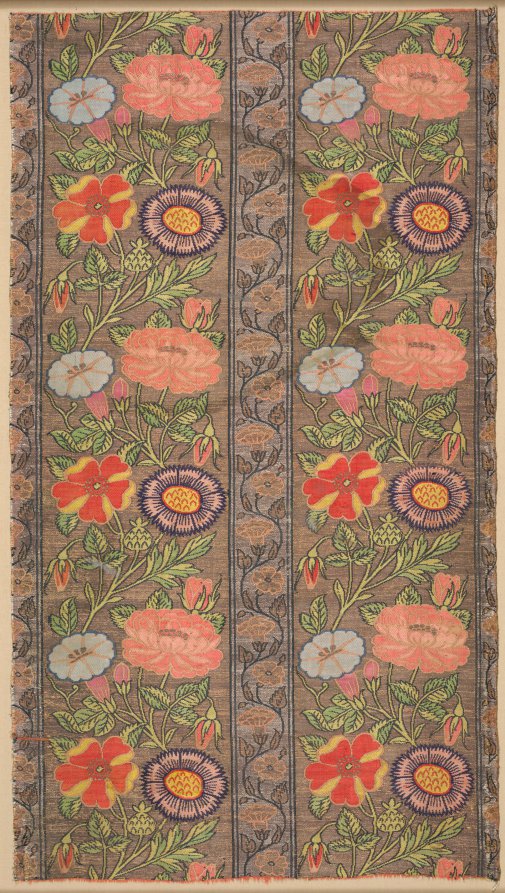
Heritage Research Artifact: Floral Striped Silk on a Golden Ground
Materiality and Provenance
This artifact, a floral striped silk on a golden ground, represents a pinnacle of imperial silk weaving that bridges the opulence of 18th-century European courts with the technical mastery of Asian and Continental workshops. The fabric’s foundation is a silk warp and weft, meticulously dyed to achieve a luminous golden hue, likely derived from natural sources such as saffron, weld, or imported cochineal mixed with tin mordants to create a metallic sheen. The golden ground serves not merely as a backdrop but as an active participant in the design, reflecting light and imbuing the textile with a sense of regal permanence. The floral stripes, alternating with bands of geometric or undulating motifs, are woven using a compound weave structure—often a combination of satin and twill—to create a raised, tactile effect that mimics the richness of embroidery. This technique, perfected in the looms of Lyon, Spitalfields, and later in the imperial workshops of China and India, demanded an extraordinary level of skill: each thread had to be precisely counted and tensioned to ensure the stripes remained perfectly parallel and the floral elements, such as roses, peonies, or lotus blossoms, retained their organic fluidity.
The materiality of this silk is inseparable from its historical context. The golden ground was not merely aesthetic; it was a symbol of sovereignty and divine right, often reserved for coronation robes, altar frontals, or diplomatic gifts. The floral stripes, meanwhile, reflect a cross-cultural dialogue: the European fascination with chinoiserie merged with indigenous floral symbolism, creating a hybrid visual language that spoke to global trade networks. The silk’s weight—typically between 200 and 300 grams per square meter—indicates its use in structured garments like court mantuas, waistcoats, or upholstery for state furniture, where the fabric’s drape and resilience were paramount. Preservation of such artifacts requires controlled humidity (50-55%) and light exposure (under 50 lux) to prevent the golden dyes from fading and the silk fibers from embrittlement, a testament to their fragility despite their historical robustness.
The Legacy of Imperial Silk Weaving
The legacy of imperial silk weaving is a narrative of power, patronage, and technological innovation. From the Han Dynasty’s sericulture monopolies to the Byzantine Empire’s state-run workshops, silk was never merely a commodity; it was a tool of diplomacy and a marker of civilization. The floral striped silk on a golden ground epitomizes this legacy, particularly in the context of the 17th and 18th centuries, when European monarchies—from Louis XIV’s Versailles to the Qing Dynasty’s Forbidden City—competed to produce the most extravagant textiles. The stripes, often referred to as “rayures” in French weaving terminology, were a direct response to the demand for structured, yet ornate, designs that could be worn in public ceremonies. The floral elements, meanwhile, were not random; they were carefully selected to convey messages of fertility, prosperity, or dynastic continuity. For instance, the peony in Chinese symbolism represents wealth and honor, while the rose in European heraldry signifies secrecy and passion. This fusion of meanings made the fabric a silent ambassador of cultural exchange.
The technical legacy of imperial weaving is equally profound. The creation of a floral striped silk on a golden ground required a drawloom or, later, a Jacquard loom, which could control thousands of individual warp threads to produce complex patterns. The golden ground itself was achieved through a technique called “lampas” weaving, where a supplementary weft of gold thread—often a core of silk wrapped in gilt metal—was introduced to create a shimmering surface. This process was labor-intensive: a single yard of such fabric could take weeks to produce, with master weavers earning the equivalent of a minor noble’s annual income. The legacy of this craftsmanship persists today in the work of heritage mills like Vanners in Suffolk or the Atelier de la Soie in Lyon, which still produce similar patterns for bespoke tailoring and restoration projects. The Savile Row tradition, with its emphasis on hand-finishing and archival precision, owes a debt to these imperial workshops, as the same principles of proportion, balance, and material integrity apply to a suit as to a royal robe.
Contemporary Relevance and Conservation
In the context of modern heritage management, the floral striped silk on a golden ground serves as a critical artifact for understanding global fashion history. Its conservation requires a multidisciplinary approach: textile scientists analyze dye composition using HPLC (High-Performance Liquid Chromatography) to identify historical recipes, while art historians trace the motif’s migration across continents. For example, the golden ground’s specific hue can indicate whether the silk was produced in Europe (where weld and madder were common) or in Asia (where turmeric and safflower were preferred). The floral stripes, meanwhile, can be dated by their stylization—naturalistic curves suggest Rococo influence, while symmetrical, geometric forms point to Art Deco revivals. This artifact is not static; it is a living document that informs contemporary design. Luxury houses like Dior and Gucci have referenced such patterns in their collections, while Savile Row tailors like Anderson & Sheppard use archival silks to create one-off pieces for clients who value historical continuity.
The legacy of imperial silk weaving also raises ethical questions about cultural appropriation and provenance. Many such artifacts were looted during colonial periods or acquired through unequal trade agreements. Today, institutions like the Victoria and Albert Museum and the Lauren Fashion Heritage Lab are repatriating digital copies of these patterns to source communities, allowing them to reclaim their heritage while retaining the original for study. The floral striped silk on a golden ground, therefore, is not merely a beautiful object; it is a site of contested memory. Its preservation requires not only technical expertise but also a commitment to transparency and collaboration. As we continue to research and conserve such artifacts, we must remember that they are not just textiles—they are the woven stories of empires, artisans, and the enduring human desire for beauty and status.
Conclusion: The floral striped silk on a golden ground stands as a testament to the ingenuity and ambition of imperial silk weaving. Its materiality—the interplay of silk, gold, and dye—reflects centuries of innovation, while its legacy continues to influence fashion, design, and conservation practices. For the modern scholar or connoisseur, this artifact is a reminder that the finest textiles are never merely decorative; they are the threads that bind history, culture, and craftsmanship together. In the spirit of Savile Row, where tradition meets precision, we honor this heritage by studying it, preserving it, and, when appropriate, weaving it anew.