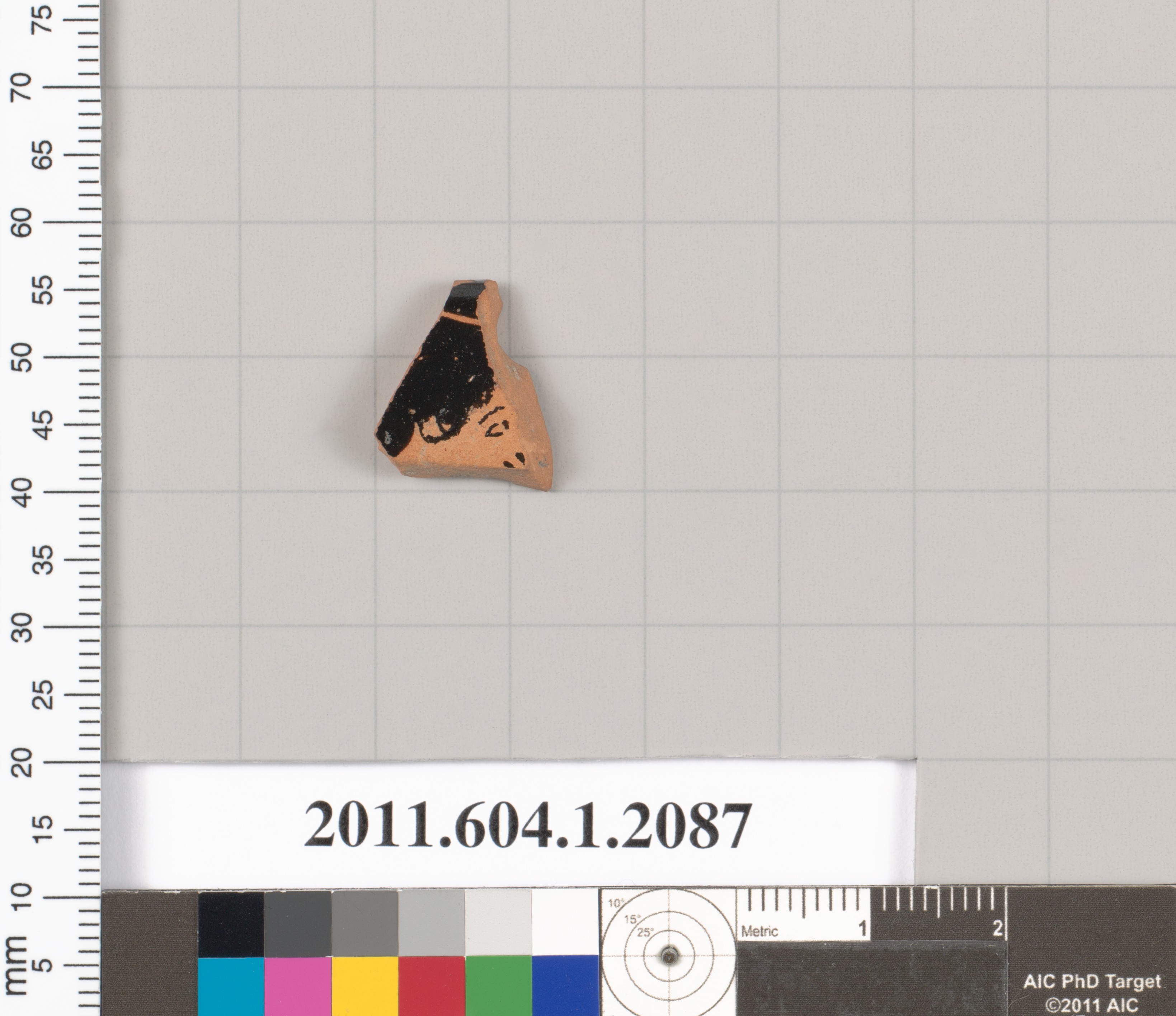
The Kylix Fragment and the Architecture of Restraint: Recasting Attic Pottery for the 2026 Old Money Silhouette
The Terracotta rim fragment of an Attic kylix—a drinking cup central to the Greek symposium—appears, at first glance, to belong to a world utterly alien to the quiet opulence of Old Money aesthetics. Yet, when examined through the lens of “器以载道” (the vessel as the bearer of the Way), this shard of fired clay reveals a profound dialogue with the Heritage-Black codes that define the 2026 Lauren Fashion silhouette. Just as the Wangchuan Villa scroll and the Three-Pierced Ritual Dagger embody opposing yet complementary poles of Chinese aesthetic philosophy—the soft, inhabitable vessel of the spirit versus the hard, ritualized vessel of power—this Greek artifact occupies a third position: the vessel of communal ritual and civic identity. Its terracotta warmth, its geometric precision, and its fragmentary state offer a masterclass in how restraint, material honesty, and the patina of time can be translated into the architecture of a garment.
From Symposium to Silhouette: The Kylix as a Social Container
The kylix was not merely a drinking vessel; it was a social instrument of the Athenian symposium, a ritualized space where men of status debated philosophy, politics, and poetry while reclining on couches. The shallow bowl, the wide rim, and the two horizontal handles were designed for a specific choreography: the drinker would hold the cup by its stem, tilt it to drink, and then pass it to the next participant. This act of passing—of shared consumption and collective discourse—imbued the kylix with a communal soul. Its terracotta body, fired to a warm, earthy orange-red, was not a precious metal but a humble, accessible material that spoke to the democratic ideals of the polis, even as its painted decorations (often scenes of myth, sport, or eroticism) elevated it to an object of cultural significance.
For the 2026 Old Money silhouette, the kylix fragment teaches us that luxury is not about ostentation but about the integrity of the ritual. The Old Money aesthetic, in its purest form, rejects the flashy logos and aggressive tailoring of new wealth. Instead, it favors garments that function as containers for the self—jackets that shape the posture, trousers that define the stride, coats that create a private, interior world. The kylix’s wide, open rim, which invites the drinker to lean in and participate, can be read as the generous lapel of a double-breasted blazer or the soft, unconstructed shoulder of a cashmere overcoat. These are not aggressive, padded forms; they are invitations to inhabit, to move, to engage. The terracotta’s warm, matte finish—neither shiny nor dull—finds its analogue in the Heritage-Black of a vicuña wool suit or a heavy, unlined linen jacket: a color that absorbs light rather than reflecting it, that whispers rather than shouts.
Geometric Restraint and the Patina of Use
The fragment’s defining feature is its geometric precision. The rim’s curve is not arbitrary; it is the product of a potter’s wheel, a tool that enforces a perfect, radial symmetry. This is not the organic, flowing line of the Wangchuan Villa scroll, but a controlled, mathematical elegance that echoes the Three-Pierced Ritual Dagger’s insistence on order. The kylix’s shape is a statement of civic discipline: the symposium’s rules of conduct—how much to drink, when to speak, how to recline—were as rigid as the cup’s geometry. In the 2026 silhouette, this translates into architectural tailoring that is never stiff but always deliberate. Think of a single-breasted peak-lapel jacket with a suppressed waist, its lines clean and unbroken, or a pair of high-waisted trousers with a precise, straight leg. These are not garments that follow the body; they create a new body, a silhouette that signals belonging to a tribe that values form, tradition, and self-control.
Equally important is the fragment’s patina. The terracotta is not pristine; it is chipped, worn, and darkened by centuries of burial. This is not a flaw but a narrative. It tells us that the kylix was used, passed from hand to hand, perhaps broken in a moment of revelry or discarded after a feast. In the Old Money lexicon, this patina is the equivalent of a well-worn leather elbow patch, a slightly frayed collar, or the soft, lived-in feel of a cashmere sweater that has been lovingly hand-washed for decades. The 2026 silhouette must embrace imperfection as a sign of authenticity. A garment that looks too new, too perfect, is a garment that has not yet been lived in. The Heritage-Black palette—deep charcoal, ink, obsidian—allows for subtle variations in texture: a matte wool flannel, a slightly lustrous silk twill, a brushed cashmere. These variations create a visual patina that mimics the kylix’s aged surface, suggesting a wardrobe that has been curated over a lifetime, not purchased in a season.
The Fragment as a Design Principle: Incompleteness and Suggestion
Perhaps the most radical lesson from the kylix fragment is its incompleteness. We do not have the entire cup; we have only a rim. Yet this fragment is enough to evoke the whole. It is a synecdoche—a part that stands for the whole—and it demands an active imagination from the viewer. For the 2026 Old Money silhouette, this principle translates into minimalism that suggests rather than declares. A jacket might have no visible buttons, only a hidden closure; a coat might be cut with such clean lines that its construction becomes invisible; a pair of trousers might have no belt loops, relying on perfect fit alone. The garment does not need to shout its details; it needs only to hint at its lineage. The kylix fragment also teaches us about negative space. The missing bowl, the absent handles, the lost stem—these are as important as what remains. In fashion, this is the unconstructed shoulder, the open collar, the unlined jacket. These are not omissions; they are deliberate choices that allow the wearer’s body and movement to complete the garment.
Conclusion: The Vessel as a Bridge Between Worlds
The Terracotta kylix fragment, like the Wangchuan Villa scroll and the Three-Pierced Ritual Dagger, is a vessel that carries meaning beyond its material form. It is a social vessel, designed for communal ritual; a geometric vessel, embodying civic order; and a temporal vessel, bearing the patina of use and history. For the 2026 Old Money silhouette, it offers a blueprint for how to create garments that are inhabitable, restrained, and authentic. The Heritage-Black palette, the precise tailoring, the embrace of imperfection—these are not trends but timeless principles that echo the kylix’s quiet authority. In a world of fast fashion and fleeting logos, the Old Money aesthetic, informed by this ancient shard, reminds us that true luxury is not about what you own, but about how you inhabit what you own. The kylix fragment, broken and worn, still holds the memory of the symposium. A well-cut coat, in Heritage-Black, can hold the memory of a life well lived.