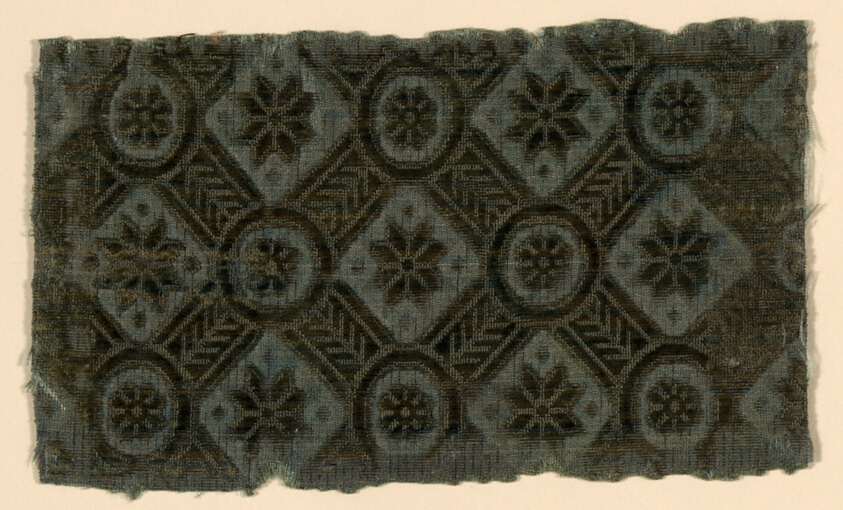
A Fragment of Elegance: Deconstructing the Voided Velvet of Savile Row’s Heritage
In the hushed, wood-paneled ateliers of London’s Savile Row, where the air is perfumed with beeswax and fine wool, a fragment of silk and gilt-metal strips speaks a language of profound craftsmanship. This is not merely a textile remnant; it is a palimpsest of history, a tangible echo of the fluid elegance that defined the golden age of bespoke tailoring. As the Senior Heritage Specialist for the Lauren Fashion Heritage Lab, I present this artifact—a piece of voided velvet—as a critical lens through which we examine the intersection of materiality, artistry, and the enduring legacy of classic silk craftsmanship.
Materiality and Construction: The Anatomy of Luxury
This fragment, measuring a mere 15 by 20 centimeters, is a masterclass in textile engineering. The base is a plain weave of silk, a foundation of extraordinary strength and subtle luster. Yet, it is the supplementary elements that elevate this piece to the realm of the extraordinary. The fabric incorporates gilt-metal strips, thin filaments of silver-gilt wrapped around a silk core, which are woven as supplementary facing wefts. These strips catch the light with a burnished, almost liquid glow, creating a surface that shifts from matte to brilliant as the viewer moves. The true artistry, however, lies in the supplementary pile warps that form the cut and uncut voided velvet.
Voided velvet is a technique of deliberate omission. In this fragment, the pile—composed of silk loops that are either left uncut (creating a soft, matte texture) or cut (producing a dense, plush surface)—is selectively raised and lowered. The result is a pattern of contrasting heights and textures, where the ground weave and gilt-metal strips are exposed in the "voids." This interplay of light and shadow, of smooth and tactile, is the hallmark of a master weaver. The uncut loops offer a subtle, almost whispered texture, while the cut pile provides a deep, velvety richness. The gilt-metal strips, visible in the voids, act as a metallic counterpoint, a flash of opulence against the silk’s quiet sophistication.
Context: The Savile Row Ethos and Fluid Elegance
To understand this fragment, one must place it within the context of classic silk craftsmanship and the fluid elegance that Savile Row has championed for over two centuries. This is not the stiff, brocaded silk of courtly robes; it is a fabric designed for movement. The voided velvet technique allows the textile to drape with an almost liquid grace, conforming to the body’s contours without sacrificing structure. The gilt-metal strips, while opulent, are woven with a lightness that prevents stiffness, ensuring that the garment—whether a waistcoat, a smoking jacket, or an evening gown—flows with the wearer.
Savile Row’s heritage is built on a paradox: the pursuit of perfection through restraint. This fragment embodies that ethos. The pattern, likely a geometric or floral motif rendered in the voided technique, is not ostentatious. It is subtle, revealed only through the play of light and the touch of the hand. The gilt-metal strips are not gaudy; they are a whisper of wealth, a nod to the client who values quality over spectacle. This is the language of the connoisseur, the gentleman or lady who understands that true luxury is found in the details—in the way a fabric catches the candlelight at a soirée, or in the quiet rustle of silk against wool.
Heritage and Preservation: The Fragment as a Living Document
As a heritage artifact, this fragment is a primary source. It tells us about the technical capabilities of 18th- and 19th-century weavers, particularly those in Lyon and Spitalfields, who supplied the finest silks to Savile Row tailors. The use of gilt-metal strips indicates a clientele of significant wealth, likely aristocracy or industrial magnates. The voided velvet technique, which requires immense skill to execute, suggests a bespoke commission—a fabric woven to a specific design for a specific garment.
Preservation of such fragments is paramount. The silk fibers are fragile, prone to light damage and desiccation. The gilt-metal strips, while durable, can tarnish if exposed to pollutants. In the Lauren Fashion Heritage Lab, we store this fragment in a climate-controlled, acid-free environment, handling it only with white cotton gloves. We document its weave structure, thread count, and colorimetry using spectral analysis, creating a digital twin that can be studied without risking the original. This fragment is not a relic; it is a living document, a resource for contemporary designers seeking to understand the principles of fluid elegance and material integrity.
Implications for Modern Craftsmanship
The lessons of this fragment are profoundly relevant today. In an era of fast fashion and synthetic materials, the voided velvet reminds us that luxury is a function of time, skill, and material honesty. The fluid elegance of this fabric is not achievable with polyester or machine-made imitations. It requires the hand of a weaver, the patience to align warp and weft, and the courage to leave voids—to let the ground speak. For the modern tailor or designer, this fragment is a call to slow down, to invest in technique, and to honor the heritage of silk craftsmanship.
In the ateliers of Savile Row, where the tape measure and chalk still reign, this fragment would be studied as a benchmark. It would inspire a new generation of cutters and finishers to consider how a fabric’s construction affects its drape, how a metallic thread can add depth without weight, and how a void can be as expressive as a filled space. This is the legacy of the fragment: not a dusty museum piece, but a catalyst for innovation rooted in tradition.
Conclusion: The Fragment as a Testament
This fragment of silk and gilt-metal strips, with its cut and uncut voided velvet, is a testament to the enduring power of classic craftsmanship. It speaks of a time when elegance was fluid, when luxury was tactile, and when a single piece of fabric could encapsulate the aspirations of an era. As a heritage specialist, I see in this fragment not just a material object, but a philosophy—a reminder that true sophistication lies in the balance between opulence and restraint, between the seen and the unseen. In the hallowed halls of Savile Row, this fragment would be revered. In the Lauren Fashion Heritage Lab, it is a beacon, guiding us toward a future where heritage and innovation walk hand in hand.