An Heirloom of the Loom: Deconstructing the Legacy of a Silk Fragment
In the hushed, wood-panelled ateliers of Savile Row, where the scent of beeswax and fine wool hangs in the air, the conversation often turns to provenance. A gentleman’s wardrobe is not merely a collection of garments; it is a chronicle of taste, of lineage, of the very fibres that have clothed empires. Among these, silk holds a singular, almost sacred, position. It is the thread of diplomacy, the fabric of coronations, and the silent witness to history. The artifact under examination—a single, unassuming fragment of imperial silk—is not a mere scrap. It is a condensed archive, a tangible whisper from the looms of a bygone era, demanding the meticulous attention of a heritage specialist.
Materiality: The Physical Testament of Imperial Craft
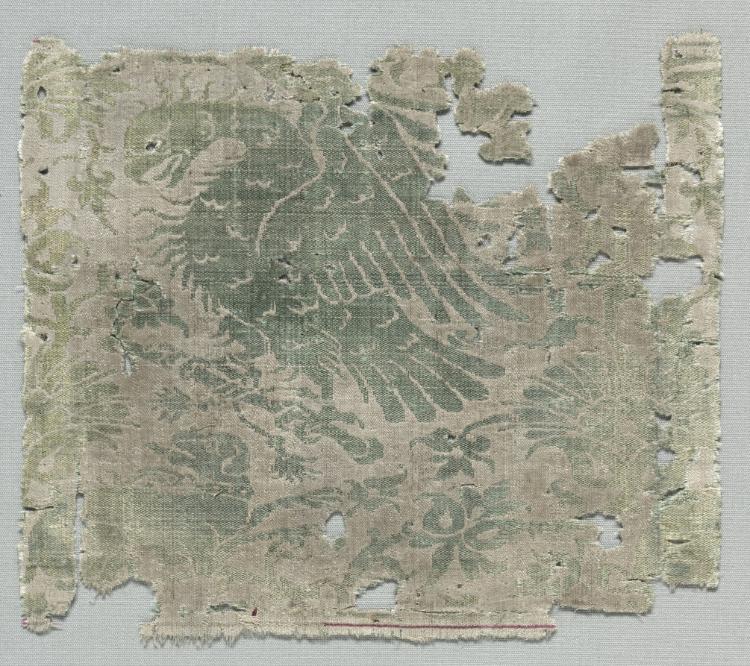
To the untrained eye, this fragment, measuring approximately 18 by 24 centimetres, might appear as a faded, brittle piece of textile. To the trained specialist, however, its materiality speaks volumes. The silk itself is of a weight and density that immediately distinguishes it from the lighter, commercial silks of the 20th century. This is a damask weave, a structure of such complexity that it required a master weaver operating a drawloom, a technology that was the apex of pre-industrial engineering. The ground weave is a fine, tightly packed warp-faced satin, while the pattern—a repeating motif of stylised peonies and interlocking cloud scrolls—is formed by a supplementary weft of a slightly thicker, lustrous filament. This is not a printed design; it is a structural one, woven into the very soul of the cloth.
The condition of the fragment is, in itself, a narrative. The edges are frayed, not from careless handling, but from a clean, sharp cut, suggesting it was deliberately excised from a larger piece, perhaps a robe, a hanging, or a ceremonial banner. The colour, once a vibrant imperial yellow—the colour reserved for the Emperor and his highest-ranking consorts—has now mellowed to a deep, honeyed ochre. This patina is not a flaw; it is the result of centuries of exposure to light, to the subtle chemistry of the air, and to the gentle, respectful touch of generations. There are faint, almost ghostly, traces of a darker pigment in the recesses of the weave, likely a mineral-based red or blue used for the original ground, now oxidised. This is the authentic patina of age, a quality that no modern reproduction can replicate. It is the physical evidence of a life lived, of a cloth that has been present at moments of profound significance.
Context: The Legacy of Imperial Silk Weaving
To understand this fragment, one must look beyond the loom to the vast, intricate ecosystem of the imperial silk industry. This is not a product of a cottage industry; it is the output of a state-controlled monopoly, centred in cities like Suzhou, Hangzhou, and Nanjing, where the Imperial Silk Workshops operated under the direct patronage of the Ming and Qing dynasties. The production of such a damask was a project of immense scale and precision. The raw silk, sourced from the finest mulberry-fed silkworms in the Jiangnan region, was meticulously reeled, twisted, and dyed using natural pigments derived from plants, minerals, and insects. The dyeing process alone could take weeks, requiring multiple immersions to achieve the precise, sanctioned hue.
The design of the fragment is not arbitrary. The peony, known as the “king of flowers,” symbolises wealth, honour, and spring. The cloud scrolls, or xiangyun, represent good fortune and the celestial realm. Together, they form a visual language of auspicious symbolism, a code that was strictly regulated by sumptuary laws. Only the Emperor and his immediate family were permitted to wear the five-clawed dragon; the peony and cloud motifs, while less restricted, were still reserved for the highest echelons of the court. This fragment, therefore, is not just a piece of cloth; it is a credential, a marker of rank and proximity to the throne. It was woven for a purpose—to be seen, to be revered, and to convey the authority of the state through the very threads of the garment.
Weaving the Narrative: From Loom to Legacy
The journey of this fragment from the imperial loom to the Lauren Fashion Heritage Lab is a story of survival. It likely passed through the hands of a court eunuch, a merchant, a missionary, or a diplomat during the tumultuous period of the late 19th century, when the Qing dynasty was in decline and many palace treasures were dispersed. It may have been part of a larger textile that was cut up and sold as souvenirs, a common practice during the Boxer Rebellion or the fall of the imperial city. The fragment’s survival is a testament to the enduring value placed upon such objects, even in times of upheaval. It was not discarded; it was preserved, perhaps as a sample, a talisman, or a piece of evidence for a future historian.
For the modern heritage specialist, this fragment serves as a critical reference point. It informs our understanding of historical weaving techniques, colour palettes, and design vocabularies that are increasingly lost to industrial homogenisation. In the context of the Lauren Fashion Heritage Lab, it is a primary source for research into textile conservation, material science, and the cultural history of luxury. It challenges us to consider how we, in the 21st century, can honour such a legacy. The answer lies not in mere replication, but in informed interpretation. A Savile Row tailor, for instance, might study the weight and drape of this silk to inspire a modern overcoat lining, or a designer might extract the peony motif for a contemporary print, understanding its weight of meaning.
Conclusion: The Thread That Binds
This silk fragment is more than an artifact; it is a conduit. It connects the disciplined hands of the imperial weaver to the discerning eye of the modern curator. It reminds us that the finest garments are not merely made; they are woven with intention, with history, and with a reverence for the material. In the world of Savile Row, where the bespoke is the ultimate expression of individuality, this fragment stands as a quiet, powerful reminder that the most profound luxury is not in the new, but in the authentic, the storied, and the enduring. It is a fragment of an empire, yes, but also a fragment of a universal human story—the desire to clothe ourselves in beauty, meaning, and permanence. And that, gentlemen, is a legacy worth preserving, thread by precious thread.