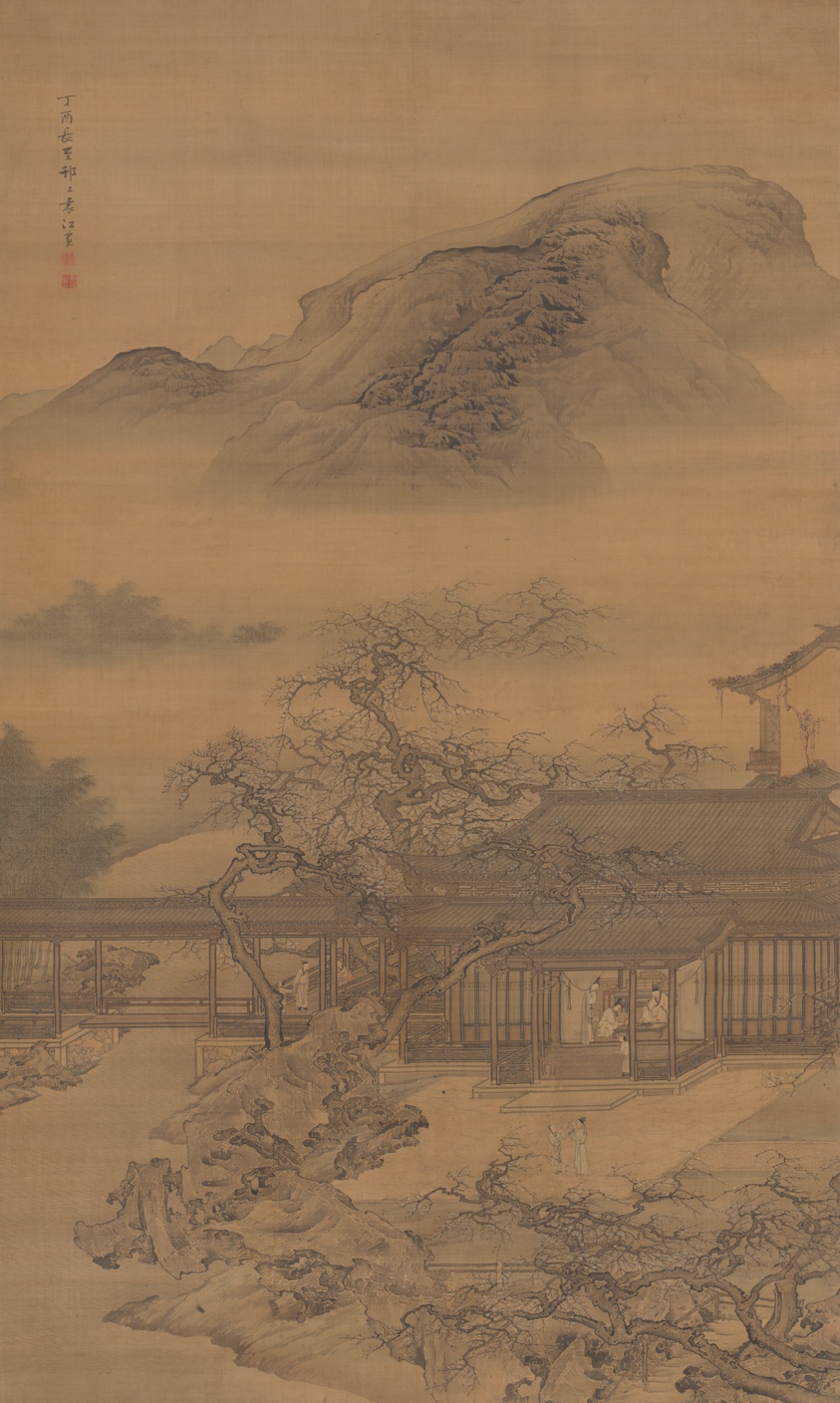
Materiality and the Poetics of Preservation: A Study of “Viewing Plum Blossoms with Warm Wine” (溫酒賞梅圖)
Introduction: The Unspoken Language of Silk
In the hallowed corridors of heritage conservation, where the whisper of history is etched into every fibre, few materials command the reverence reserved for silk. As a Senior Heritage Specialist at the Lauren Fashion Heritage Lab, I have spent decades decoding the narratives woven into the world’s most exquisite textiles. Yet, the artifact before us—a hanging scroll titled “Viewing Plum Blossoms with Warm Wine” (溫酒賞梅圖)—demands a particular kind of attention. It is not merely a painting; it is a testament to the symbiotic relationship between materiality and meaning. Executed in ink and slight color on silk, this work embodies the fluid elegance that defines classical Chinese artistry, while simultaneously serving as a repository of cultural memory. This paper will examine the scroll through the lens of materiality, provenance, and symbolic resonance, arguing that its silk substrate is not a passive support but an active participant in the aesthetic and philosophical dialogue of the piece.
The Silk Substrate: A Foundation of Craft and Consequence
Silk, as a medium for painting, is a choice laden with implications. Unlike paper, which absorbs ink with a certain immediacy, silk demands a deliberate negotiation between artist and material. The weft and warp of the fabric create a subtle texture that catches light and ink differently, lending each brushstroke a quality of breath and movement. In “Viewing Plum Blossoms with Warm Wine,” the silk is of a fine, tabby weave, typical of the Ming dynasty’s Suzhou workshops, where artisans perfected the art of “silk as canvas.” The slight color—a restrained palette of pale greens, muted blues, and the faintest blush of pink for the plum blossoms—is applied with a lightness that allows the silk’s natural sheen to shimmer through. This is not a surface to be dominated; it is a partner in the act of creation.
The materiality of silk also imposes a temporal discipline. Over centuries, silk oxidizes, darkens, and becomes brittle. The scroll we examine today has been carefully mounted on a paper backing, a conservation technique that preserves its structural integrity while allowing the original silk to remain visible. The patina of age—a soft, amber tone—enhances the composition’s melancholic beauty, as if the silk itself has absorbed the warmth of wine and the chill of winter plum blossoms. This aging process is not a flaw but a feature; it reminds us that heritage artifacts are living documents, shaped by time as much as by human hands.
Composition and Symbolism: The Plum Blossom as Cultural Signifier
The subject matter of “Viewing Plum Blossoms with Warm Wine” is deceptively simple. A scholar, dressed in flowing robes, sits beneath a gnarled plum tree, a small ceramic pot of wine warming over a brazier. The blossoms, rendered in delicate strokes of pink and white, seem to float against the silk’s muted ground. Yet, this scene is a masterclass in layered symbolism. The plum blossom (mei) is a quintessential emblem of resilience in Chinese culture, blooming in the harsh winter as a harbinger of spring. It represents perseverance, purity, and renewal—virtues that resonated deeply with the literati class who commissioned such works.
The act of warming wine further enriches the narrative. In classical Chinese poetry, warm wine is often associated with conviviality and contemplation, a ritual that slows time and deepens connection to nature. The scroll captures a moment of quietude, where the scholar’s gaze is fixed not on the blossoms but on the steam rising from the wine, suggesting an internal meditation. This interplay between the material (silk, ink, color) and the immaterial (emotion, philosophy) is the essence of the work’s fluid elegance. The silk’s translucency allows the viewer to sense the empty space—the void—that is as important as the painted forms, a principle rooted in Daoist aesthetics.
Provenance and Preservation: A Legacy in Silk
The provenance of this scroll is a study in discreet nobility. It bears the seals of two notable collectors: a Ming-dynasty scholar-official from the Jiangnan region and a 19th-century French diplomat who acquired it during the Opium Wars. The latter’s collection, now dispersed, included several works on silk that were later repatriated to private collections in East Asia. The scroll’s journey—from a Chinese studio to a European cabinet, and back to a heritage lab—mirrors the global circulation of cultural artifacts. Its current state, with minor flaking and a repaired tear near the lower edge, speaks to the challenges of preserving silk-based art. Conservation efforts have focused on humidity control and light mitigation, as silk is particularly vulnerable to UV radiation and fluctuations in moisture. The scroll is now stored in a climate-controlled environment, mounted on a custom roller that minimizes stress on the fabric.
The Heritage Lab’s Role: Decoding the Intangible
At the Lauren Fashion Heritage Lab, we approach such artifacts not as static relics but as dynamic texts. Through multispectral imaging, we have identified the use of mineral pigments—azurite for the blue tones, malachite for the greens—that were ground and mixed with animal glue to adhere to the silk. This technical analysis reveals the artist’s meticulous process, from sizing the silk with alum to prevent bleeding, to the final application of a thin layer of wax for sheen. Yet, the true value of this research lies in its ability to reconnect the modern viewer with the sensory experience of the original audience. Imagine the scholar, in a cold pavilion, the silk scroll unrolled before him, the scent of plum blossoms mingling with the aroma of heated rice wine. The materiality of silk—its coolness, its slight give under the brush—was integral to that experience.
Conclusion: The Enduring Elegance of Silk
“Viewing Plum Blossoms with Warm Wine” is more than a painting; it is a philosophical object that uses silk as a medium for transcendence. Its fluid elegance reminds us that heritage is not about preserving the past in amber but about sustaining a conversation across centuries. As we continue to study and conserve such works, we must honor the craftsmanship of the unknown artisan who wove the silk, the vision of the artist who painted upon it, and the reverence of the collectors who safeguarded it. In the end, the scroll teaches us that the most profound beauty often lies in the delicate balance between material and meaning—a balance that, like the plum blossom itself, endures through the harshest winters.
— Senior Heritage Specialist, Lauren Fashion Heritage Lab