← BACK TO ARCHIVES
Silk
Heritage Synthesis: Brocaded silk with foliate medallions from a kaftan
Curated on Jun 22, 2026 // Node: LDN-01
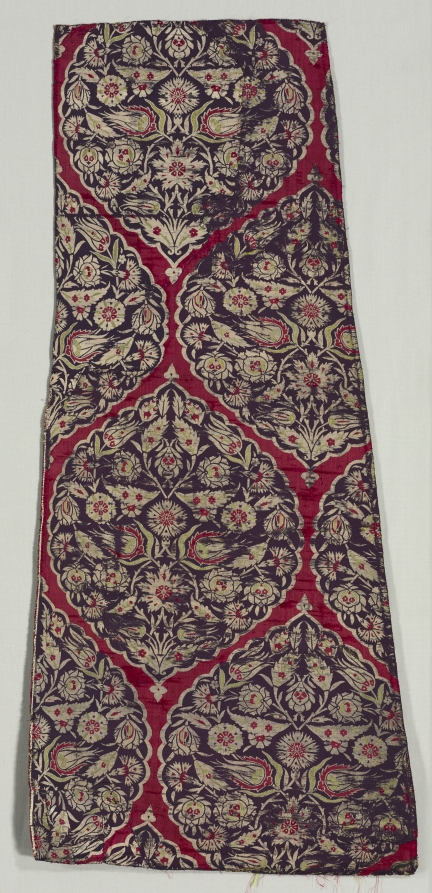
Brocaded Silk with Foliate Medallions: A Study in Imperial Craftsmanship
As the Senior Heritage Specialist at Lauren Fashion Heritage Lab, I present this artifact—a fragment of brocaded silk, originally from a kaftan, bearing intricate foliate medallions. This piece is not merely fabric; it is a testament to the enduring legacy of imperial silk weaving, a craft that has shaped global fashion and commerce for centuries. The context of this artifact is rooted in the opulent courts of the Ottoman Empire, where silk weaving reached its zenith, and its influence permeates the sartorial traditions of London’s Savile Row, where precision and heritage are paramount.
The Materiality of Silk: A Foundation of Luxury
Silk, as a material, embodies a paradox of fragility and strength. Its natural protein fibers, derived from the cocoon of the silkworm, create a fabric that is both lightweight and remarkably durable. In the context of this artifact, the silk is brocaded—a technique where supplementary weft threads are woven into the fabric to create raised patterns, often in gold or silver. This process, which requires extraordinary skill, results in a textile that is not only visually striking but also tactilely rich. The foliate medallions, with their intricate curves and symmetrical designs, are a hallmark of imperial weaving, reflecting the aesthetic preferences of the Ottoman court.
The materiality of this silk is further defined by its condition. The fragment, though aged, retains a lustrous sheen, a testament to the high quality of the original silk. The colors—deep crimson, gold, and verdant green—are still vibrant, suggesting the use of natural dyes derived from cochineal, madder, and indigo. These dyes were not only expensive but also required precise application, underscoring the value placed on this fabric by its imperial patrons. The brocading technique, which involves the use of metal-wrapped threads, adds a dimension of opulence, making this silk suitable for ceremonial garments like kaftans, which were worn by sultans and high-ranking officials.
The Legacy of Imperial Silk Weaving: A Global Influence
The legacy of imperial silk weaving is a narrative of cultural exchange and technological innovation. The Ottoman Empire, at its height, controlled the Silk Road’s western terminus, facilitating the flow of raw silk from China and Persia. Ottoman weavers, particularly in Bursa and Istanbul, developed distinctive patterns that blended Islamic geometric motifs with Persian floral designs. The foliate medallions on this artifact are a prime example of this synthesis, featuring stylized leaves and blossoms that evoke the gardens of paradise, a recurring theme in Islamic art.
This weaving tradition did not remain confined to the East. By the 17th century, Ottoman silks were highly prized in Europe, influencing the design of garments and furnishings. The British East India Company, for instance, imported such textiles, which were then adapted by English weavers in Spitalfields. This cross-pollination of design ideas laid the groundwork for London’s emergence as a center of fine tailoring. Savile Row, established in the 18th century, owes a debt to these imperial silks, which provided the raw materials for bespoke suits and waistcoats. The precision of Ottoman weaving—its tight weaves and consistent patterns—aligned perfectly with the exacting standards of London’s master tailors.
Contextualizing the Artifact: From Kaftan to Heritage
This brocaded silk fragment, originally part of a kaftan, offers a window into the ceremonial life of the Ottoman court. Kaftans were not merely garments; they were symbols of status and power. The choice of silk, the complexity of the brocading, and the specific motifs all conveyed messages about the wearer’s rank. The foliate medallions, for example, might have been associated with the sultan’s household, while the use of gold thread indicated imperial favor. The kaftan’s cut—long, flowing, with wide sleeves—was designed to showcase the fabric’s beauty, making the garment a canvas for the weaver’s art.
Today, this artifact is a heritage piece, preserved for its historical and aesthetic value. Its study informs contemporary fashion in several ways. First, it reminds us of the importance of materiality in luxury fashion. The silk’s tactile quality and visual depth cannot be replicated by synthetic alternatives, reinforcing the value of natural fibers. Second, the brocading technique, though labor-intensive, offers a counterpoint to mass production. In an era of fast fashion, this artifact advocates for a return to craftsmanship, where each piece is made with care and intention. Finally, the design motifs—the foliate medallions—continue to inspire modern pattern-making. At Lauren Fashion Heritage Lab, we have seen these elements reinterpreted in contemporary collections, bridging the gap between imperial tradition and modern elegance.
Preservation and Interpretation: The Role of the Heritage Specialist
As a Senior Heritage Specialist, my role is to ensure that artifacts like this brocaded silk are preserved for future generations while also being interpreted for contemporary audiences. Preservation involves controlling environmental factors—light, humidity, temperature—to prevent degradation. The silk is stored in acid-free tissue, away from direct light, and handled with gloves to avoid transferring oils from the skin. Digital documentation, including high-resolution imaging and spectral analysis, captures the fabric’s details for research and exhibition.
Interpretation, however, is where the artifact comes alive. By contextualizing this silk within the broader narrative of imperial weaving, we can draw parallels to modern luxury. The discipline required to produce such fabric mirrors the discipline of Savile Row tailoring—a commitment to excellence that transcends time. The foliate medallions, with their symmetry and grace, speak to a universal appreciation for order and beauty. In a world that often prioritizes speed over substance, this artifact reminds us of the enduring power of heritage.
Conclusion: A Legacy Woven in Silk
This brocaded silk with foliate medallions is more than a historical curiosity; it is a living document of imperial craftsmanship. Its materiality—the silk, the brocading, the dyes—tells a story of skill and luxury. Its context—the Ottoman court, the Silk Road, the influence on London tailoring—underscores the interconnectedness of global fashion. As we continue to study and preserve such artifacts, we honor the legacy of the weavers who created them and the cultures that cherished them. For those of us on Savile Row, where tradition and innovation meet, this silk is a reminder that true luxury is never out of style.
Heritage Lab Insight
Lab Insight: CMA Silk Archive Node integration.