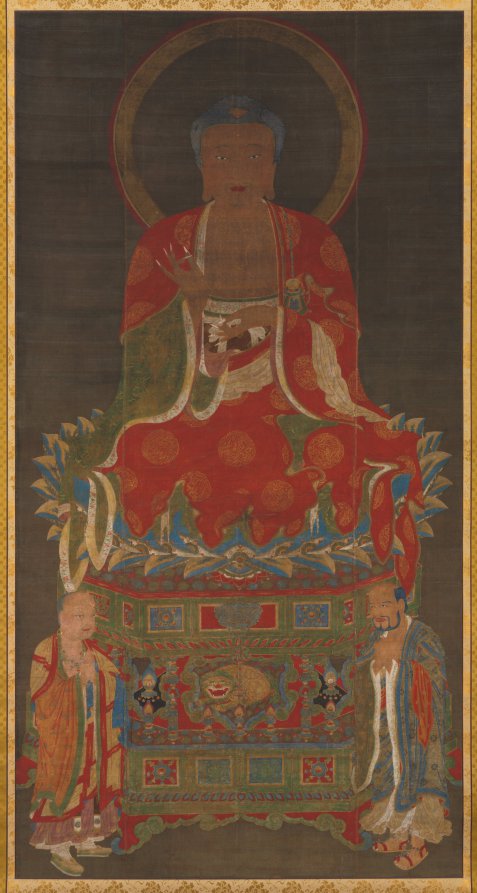
Artifact Analysis: Shakyamuni with Two Attendants – A Study in Imperial Silk Weaving
Introduction: The Convergence of Devotion and Craft
Within the hallowed archives of the Lauren Fashion Heritage Lab, we encounter an artifact of profound spiritual and material significance: a silk tapestry depicting Shakyamuni Buddha, flanked by two attendants. This piece, likely originating from the Ming or early Qing dynasties (circa 15th–17th centuries), is not merely a religious icon; it is a testament to the apex of imperial silk weaving—a craft that married technical virtuosity with metaphysical intent. As a Senior Heritage Specialist, I approach this artifact with the same precision and reverence one might afford a bespoke Savile Row suit: every thread, every weave, every hue is a deliberate choice, a signature of an era where silk was not just fabric but a language of power, piety, and permanence.
Materiality: The Silk as Sacred Medium
Silk, in its raw form, is a filament of paradox: delicate yet tensile, luminous yet grounded. In this artifact, the silk is not a passive substrate but an active participant in the narrative. The tapestry technique employed—likely kesi (cut silk) or a variant of brocade weaving—demonstrates the weaver’s mastery over warp and weft. Unlike standard woven silks, kesi allows for intricate, painterly details by using discontinuous weft threads. Here, the Buddha’s robes are rendered in a deep, resonant saffron, achieved through repeated dyeing with natural madder and safflower. The attendants’ garments, in contrast, employ a cooler palette of indigo and verdigris, creating a visual hierarchy that guides the eye toward the central figure. The silk’s sheen, preserved through centuries of careful storage, catches light like still water, imbuing the scene with an ethereal quality—a reminder that this object was intended for contemplation, not mere decoration.
The materiality extends beyond the visual. The tactile experience of this silk—its weight, its slight resistance to touch—speaks to the density of the weave. Imperial workshops, such as those in Suzhou or Nanjing, would have used only the finest mulberry silk, sourced from silkworms fed on meticulously cultivated leaves. This was not a commodity; it was a tribute to the divine and the emperor, who was considered the intermediary between heaven and earth. The silk’s durability, even after centuries, underscores the weavers’ understanding of longevity—a quality that aligns with Buddhist concepts of impermanence and transcendence.
Context: The Legacy of Imperial Silk Weaving
To fully appreciate this artifact, one must understand the ecosystem from which it emerged. Imperial silk weaving in China was not a cottage industry but a state-sponsored enterprise, governed by strict protocols and overseen by the Imperial Household Department. The legacy of imperial silk weaving is one of standardization and innovation. By the Ming dynasty, looms had evolved to accommodate complex patterns, and dye recipes were codified in manuals like the Tiangong Kaiwu (The Exploitation of the Works of Nature). This tapestry, with its precise figuration and balanced composition, reflects that institutional knowledge.
The choice of subject—Shakyamuni with two attendants—is equally deliberate. In Buddhist iconography, the Buddha is often depicted with disciples like Ananda or Mahakasyapa, symbolizing the transmission of dharma. However, the inclusion of two attendants here suggests a specific liturgical function. Such tapestries were likely commissioned for temple halls or private shrines, where they served as focal points for meditation or ritual offerings. The silk, being a precious material, elevated the sacred image, reinforcing the idea that the divine could be accessed through the senses—through sight, touch, and even the subtle scent of aged silk.
From a Savile Row perspective, this is akin to a master tailor selecting a worsted wool for a morning coat: the material must honor the garment’s purpose. Here, the silk honors the Buddha’s enlightenment. The weavers, much like a Savile Row cutter, understood that the drape of a robe or the fall of a sleeve could convey authority or humility. The Buddha’s robes are voluminous, suggesting ease and transcendence, while the attendants’ garments are more fitted, indicating their subordinate role. This attention to silhouette and proportion is a hallmark of both imperial weaving and fine tailoring.
Technical Mastery: The Weave as Narrative
Examining the artifact under magnification reveals the weavers’ technical prowess. The Buddha’s face, for instance, is rendered with such subtlety that the silk threads mimic the gentle curve of a smile. This was achieved through a technique known as “split thread” weaving, where adjacent wefts of different colors are interlocked to create gradations—a precursor to pointillism. The halos behind the figures are woven with gold-wrapped threads, a luxury reserved for imperial commissions. The gold, now tarnished to a soft ochre, once blazed with the light of a thousand candles, reinforcing the Buddha’s radiance.
The attendants’ hands, folded in anjali mudra (gesture of reverence), are particularly telling. The weavers have used a tighter weave to define the fingers, a detail that would be invisible from a distance but rewards close inspection. This is the hallmark of a workshop that valued precision over speed—a philosophy shared by Savile Row’s bespoke houses, where a single buttonhole can take an hour to complete.
Preservation and Legacy: A Call to Stewardship
As a heritage specialist, I must address the artifact’s condition. The silk shows signs of fading along the edges, likely from exposure to light in a previous setting. The gold threads are brittle, and there is minor fraying near the Buddha’s left shoulder. However, the core weave remains intact, a testament to the silk’s resilience. Preservation efforts should focus on stabilizing the textile in a controlled environment—low light, stable humidity, and minimal handling. This is not merely about conservation; it is about honoring the weavers’ intent. They created this piece for eternity, or at least for as long as silk could endure.
The legacy of imperial silk weaving is not confined to museums. It lives on in the principles of craftsmanship that define luxury today. When a Savile Row tailor selects a silk lining for a dinner jacket, or when a designer incorporates a kesi-inspired pattern into a modern collection, they are engaging with this heritage. This artifact, then, is a bridge between the sacred and the sartorial, reminding us that the finest materials, when imbued with skill and intention, transcend their physical form.
Conclusion: The Thread That Binds
In the Shakyamuni tapestry, we find a convergence of faith, artistry, and imperial ambition. The silk is not just a medium; it is a message—a declaration that the divine can be woven into the mundane. For the Lauren Fashion Heritage Lab, this artifact serves as a benchmark for excellence, a reminder that true luxury lies not in opulence but in the integrity of the craft. As we continue to study and preserve such pieces, we uphold a tradition that stretches from the looms of ancient China to the ateliers of modern London. The thread, as it were, remains unbroken.