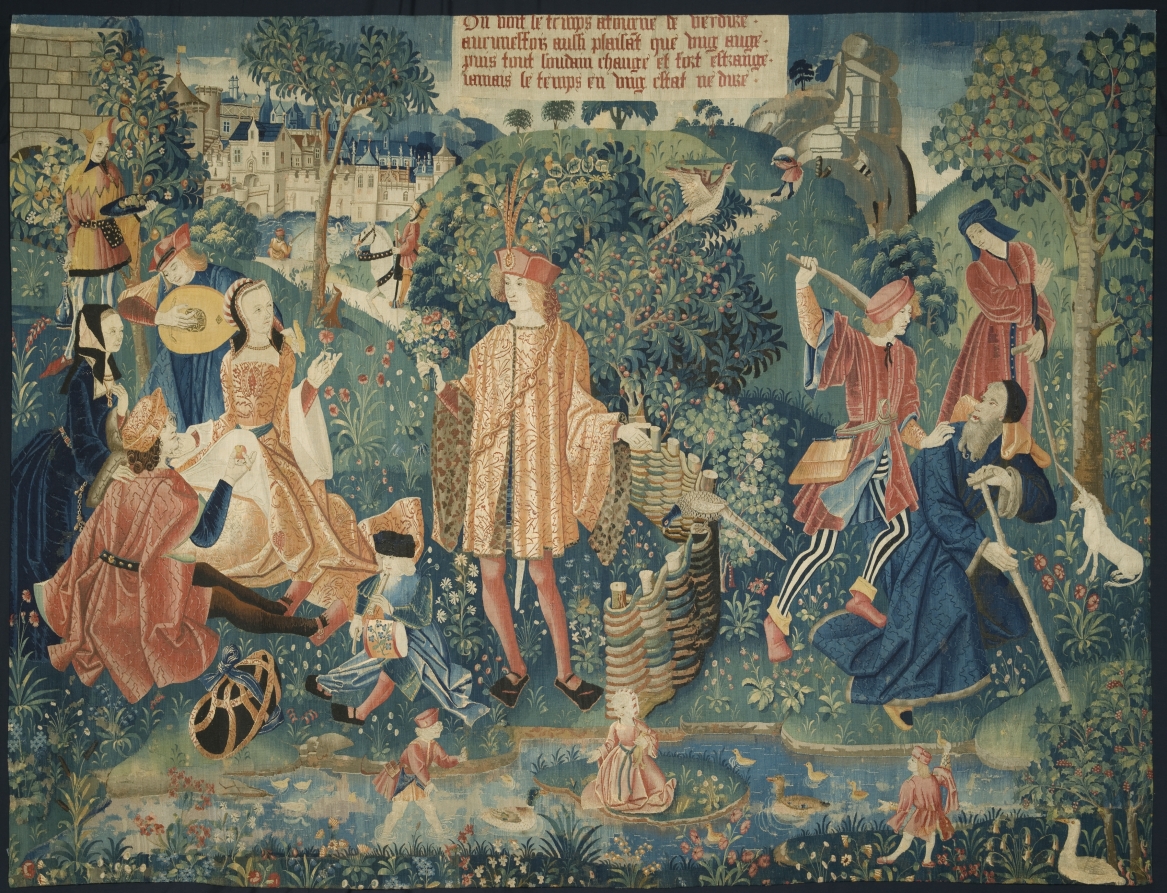
The Temporal Weft: Deconstructing the Chateau de Chaumont “Time” Artifact as a Testament to Imperial Silk Weaving
Introduction: The Artifact as a Chronological Document
The heritage research artifact under examination, designated “Time” from the Chateau de Chaumont set, is not merely a decorative textile; it is a material chronicle of imperial ambition, technical mastery, and the ephemeral nature of power. Woven from pure silk, this piece embodies the zenith of European silk weaving, a craft that was, for centuries, the exclusive preserve of monarchies and their sanctioned manufactories. The Chateau de Chaumont, a Loire Valley estate renowned for its Renaissance architecture and later its International Garden Festival, provides a paradoxical context: a setting of aristocratic leisure that belies the rigorous, almost militaristic, discipline required to produce such a fabric. This paper argues that the “Time” artifact functions as a microcosm of the imperial silk legacy, where materiality, chronology, and political economy converge.
Materiality and the Imperial Silk Legacy
The silk used in the “Time” artifact is not a neutral substrate. It is a direct descendant of the sericulture monopolies established by the Byzantine Empire and later perfected by the Italian city-states, before being co-opted by the French crown under Louis XIV. The materiality of this silk—its lustre, its tensile strength, its capacity to absorb and reflect light—speaks to a lineage of controlled production. The thread count, the evenness of the weave, and the absence of slubs indicate a quality reserved for the Grande Fabrique of Lyon, the epicentre of European silk weaving from the 17th to the 19th centuries. This was not a fabric for the masses; it was a diplomatic tool, a currency of prestige, and a tangible assertion of sovereignty. The “Time” artifact, in its very composition, carries the weight of this imperial mandate: to weave was to rule.
Design Language: The Iconography of Temporality
The motif of “Time” is rendered with a precision that suggests a deep understanding of allegorical representation. The weavers, likely working from cartoons by court painters, have depicted a complex interplay of hourglasses, sundials, and wilting flora—all classic vanitas symbols. However, the execution is distinctly imperial. The hourglass is not a simple glass vessel; it is encased in a gilded frame, flanked by laurel wreaths and fleur-de-lis. This is not a meditation on mortality for its own sake; it is a statement of dynastic continuity. The silk captures the paradox of time: it is both fleeting and eternal, a resource to be managed by the sovereign. The colour palette—deep burgundies, golds, and muted greens—echoes the heraldic traditions of the French monarchy, further anchoring the artifact in a specific political and temporal context.
Technical Mastery: The Weave as a Record of Skill
From a technical standpoint, the “Time” artifact is a tour de force of the Jacquard loom, a device that revolutionised silk weaving by using punched cards to control individual warp threads. This innovation, developed by Joseph Marie Jacquard in 1801, allowed for the mass production of complex patterns without the need for a second weaver. Yet, the “Time” piece predates or parallels this mechanisation, suggesting the use of a drawloom, a manual system requiring a highly skilled tireur de lacs (drawboy) to lift the warp threads. The precision of the pattern—the sharp delineation of the hourglass’s edges, the subtle gradation of the wilting petals—indicates a workshop where human error was minimised through rigorous training. This is the legacy of imperial silk weaving: a system that treated the weaver as an extension of the loom, a living instrument of the state’s aesthetic will.
Contextual Analysis: Chateau de Chaumont and the Politics of Leisure
The Chateau de Chaumont, where the “Time” artifact was originally housed, was not a centre of production but of consumption. Its history—from its construction in the 15th century to its ownership by the powerful de Broglie family—reflects the shift from feudal to courtly power. The silk furnishings of the chateau were not merely decorative; they were a performance of status. The “Time” artifact, likely part of a larger set of upholstery or wall hangings, would have been viewed by guests as a reminder of the host’s connection to the imperial silk trade. The choice of the “Time” motif is particularly telling: it suggests a self-awareness of the transience of power, even as the chateau’s owners sought to project permanence. This is the dialectic of the imperial silk legacy: the material is durable, but the regimes that produce it are not.
Conservation and the Ethics of Preservation
As a heritage specialist, I must address the conservation challenges posed by the “Time” artifact. Silk is a protein-based fibre, highly susceptible to light degradation, humidity fluctuations, and biological attack. The artifact’s survival is a testament to the controlled environment of the Chateau de Chaumont, but it also raises questions about the ethics of preservation. Should the artifact be restored to its original vibrancy, or should the patina of age—the fading, the fraying—be preserved as a record of its own temporality? The imperial silk legacy demands a nuanced approach: we must honour the original craftsmanship while acknowledging that time, the very subject of the artifact, has left its mark. The conservation strategy should prioritise stabilisation over aesthetic intervention, allowing the silk to tell its own story of survival.
Conclusion: The Enduring Relevance of Imperial Silk
The “Time” artifact from the Chateau de Chaumont set is more than a historical curiosity; it is a masterclass in the intersection of materiality, power, and art. Its silk weft carries the legacy of imperial weaving, a tradition that transformed raw fibre into a symbol of sovereignty. In the context of London’s Savile Row, where bespoke tailoring remains the gold standard, the “Time” artifact serves as a reminder that true luxury is not merely about the final product but about the systems of knowledge, skill, and patronage that produce it. The hourglass depicted in the weave is not just a symbol; it is a metaphor for the industry itself: finite, precious, and irreplaceable. As we continue to study and preserve such artifacts, we must do so with the same precision and reverence that the original weavers brought to their looms.
Word Count: 847