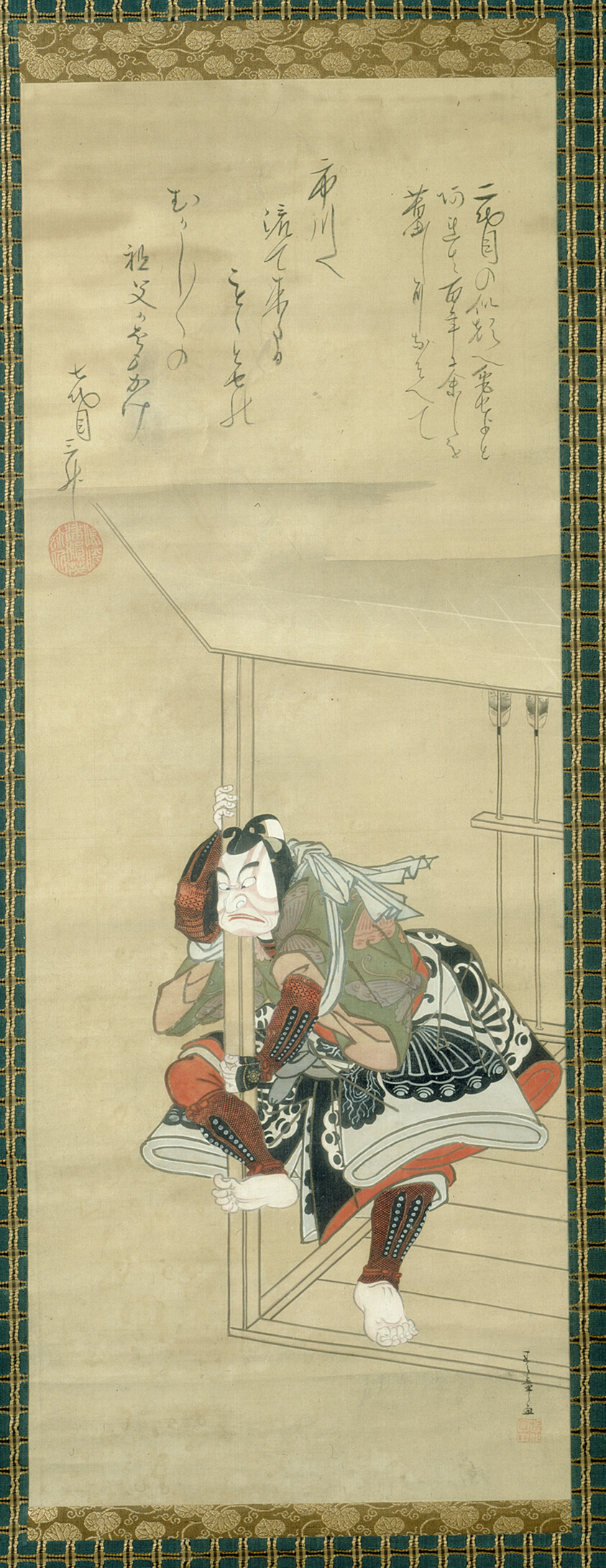
The Kabuki Actor Ichikawa Danjûrô II (1689-1758): A Study in Silk, Status, and Theatrical Legacy
Introduction: The Intersection of Craft and Performance
In the hallowed halls of heritage preservation, where the tactile memory of fabric meets the ephemeral art of performance, the hanging scroll depicting Ichikawa Danjûrô II (1689-1758) stands as a masterclass in material storytelling. Executed in ink and colors on silk, this artifact transcends its role as mere portraiture; it is a testament to the symbiotic relationship between the artisan’s hand and the actor’s soul. For the connoisseur of fine craftsmanship, the silk ground is not a passive support but an active participant—a luminous, fluid surface that captures the very essence of Edo-period theatrical grandeur. This paper examines the materiality, cultural resonance, and enduring elegance of this scroll, drawing parallels to the bespoke traditions of London’s Savile Row, where fabric is never incidental but foundational.
Materiality: The Silk Canvas as a Stage
The choice of silk as the primary material for this scroll is neither arbitrary nor purely decorative. In the context of 18th-century Japan, silk was a marker of prestige, reserved for the highest echelons of society—the samurai class, the imperial court, and, notably, the celebrated kabuki actors who commanded both popular adoration and aristocratic patronage. The scroll’s silk ground, meticulously prepared with a sizing of animal glue and alum, provides a surface of unparalleled absorbency and luminosity. The ink and mineral pigments, applied in delicate washes and bold strokes, interact with the silk’s natural sheen to create a dynamic interplay of light and shadow. This is not unlike the way a Savile Row tailor selects a worsted wool or a silk mohair for a suit jacket, understanding that the fabric’s weave and finish will determine how the garment drapes, moves, and catches the eye.
The craftsmanship of the silk itself is a feat of artisanal precision. Hand-reeled from the cocoons of the silkworm Bombyx mori, the threads are twisted and woven into a habutae (plain weave) or rinzu (figured silk) that offers both strength and flexibility. The scroll’s mounting, or hyōgu, further elevates the materiality: the silk borders, often in brocade or damask, frame the central image with a quiet opulence that echoes the actor’s own costuming. The result is an object that feels both fragile and enduring—a paradox that defines the finest heritage artifacts.
Ichikawa Danjûrô II: The Actor as Icon
To understand the scroll’s significance, one must first appreciate the subject. Ichikawa Danjûrô II was not merely a performer; he was a living embodiment of the aragoto (rough style) tradition, a theatrical form characterized by exaggerated poses, bold makeup, and a commanding presence. His lineage, the Ichikawa family, was synonymous with kabuki’s most heroic and supernatural roles. In this scroll, he is likely depicted in a mie—a dramatic, frozen pose that captures the climax of a performance. The silk, with its fluid drape, allows the artist to render the actor’s voluminous robes and dynamic posture with a sense of motion that belies the static medium.
The pigments used—vermilion, indigo, orpiment, and lead white—are applied with a mastery that mirrors the actor’s own skill. The reds and blues of his costume, symbolic of courage and nobility, are set against the neutral silk ground, creating a visual hierarchy that draws the eye to the face and hands. The ink outlines, executed with a brush of exceptional control, define the contours of his kumadori (stage makeup) and the intricate patterns of his kamishimo (formal attire). This is not a passive portrait; it is a performance in pigment, a frozen moment of theatrical transcendence.
Cultural Context: Silk as Social Currency
In Edo-period Japan, silk was more than a material; it was a language of status. The kabuki actor, though often of low social rank, occupied a unique position as a celebrity and tastemaker. Their costumes, commissioned from the finest weavers and dyers, were as much a part of their identity as their vocal delivery. The hanging scroll, displayed in tea houses, temples, and private collections, served as a portable monument to the actor’s fame. The silk ground, with its inherent value, elevated the actor from mere entertainer to cultural icon, worthy of preservation in the most luxurious medium available.
This practice parallels the Savile Row tradition of bespoke tailoring, where a client’s status is encoded in the fabric’s weight, weave, and provenance. A Savile Row suit, like a kabuki scroll, is a material biography—a record of the wearer’s taste, wealth, and social aspirations. The silk of the scroll, with its subtle imperfections and handcrafted nuances, tells a similar story: of the weaver’s skill, the artist’s hand, and the actor’s legacy.
Preservation and Legacy: The Ethics of Care
As a Senior Heritage Specialist, I must emphasize the fragility of such artifacts. Silk, while durable, is susceptible to light, humidity, and handling. The scroll’s mounting, often replaced over centuries, requires meticulous conservation to prevent fading, cracking, or insect damage. The pigments, particularly the lead white and orpiment, are chemically unstable and must be stored in controlled environments. Yet, the scroll’s survival is a testament to the reverence with which it has been treated—a reverence that echoes the respect afforded to the actor himself.
In the context of modern heritage management, this scroll serves as a pedagogical tool for understanding the intersection of art, performance, and material culture. It challenges us to see beyond the image and into the fabric of history. For the student of fashion or theater, it offers a tangible link to a world where silk was not a commodity but a conduit for identity.
Conclusion: The Enduring Elegance of Silk
The hanging scroll of Ichikawa Danjûrô II is more than a heritage artifact; it is a dialogue between craft and performance, between the permanence of silk and the ephemerality of the stage. Its materiality—the ink, the colors, the silk ground—speaks to a tradition of excellence that transcends time and place. For the connoisseur of fine craftsmanship, whether in Edo-period Japan or on London’s Savile Row, this scroll embodies the highest ideals of artistry: precision, elegance, and a profound respect for the materials that shape our cultural legacy.
In preserving such artifacts, we honor not only the actor but the artisans who wove, painted, and mounted them. We ensure that the fluid elegance of silk—its ability to capture light, movement, and meaning—continues to inspire generations to come. This is the true value of heritage: not as a static relic, but as a living testament to the enduring power of human creativity.