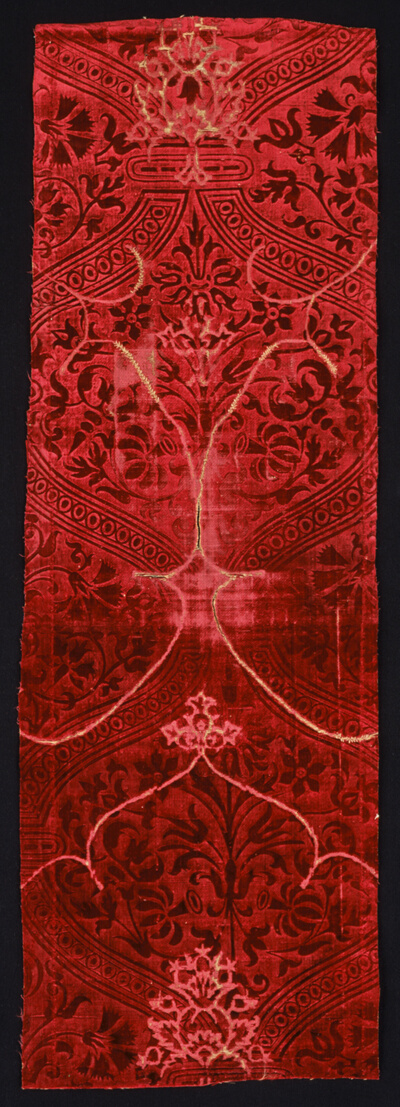
The Panel: A Study in Voided Velvet and the Lexicon of Luxury
Introduction: The Artifact as Archive
Within the hallowed corridors of Lauren Fashion Heritage Lab, we approach the study of heritage artifacts not merely as objects of aesthetic delight, but as primary documents of material culture. The subject of this paper—a silk panel, woven in satin weave with supplementary pile warps forming cut, voided velvet, and subsequently stamped—represents a pinnacle of classic silk craftsmanship. It is a testament to the fluid elegance that has defined the most discerning houses of London’s Savile Row and the ateliers of the haute couture. This artifact, though a fragment, speaks volumes about the technical mastery, the economic imperatives, and the philosophical pursuit of beauty that have shaped the heritage of luxury textiles. In the language of Savile Row, this is not simply a piece of fabric; it is a bespoke narrative, a record of a transaction between weaver, designer, and the enduring human desire for distinction.
Materiality and Technical Mastery
The panel’s foundation is a silk satin weave, a structure renowned for its lustrous surface and exceptional drape. Satin, with its long floats of warp yarns, creates a smooth, reflective plane that captures and plays with light. This is the canvas upon which the velvet narrative is inscribed. The velvet itself is not a separate fabric but an integral part of the weave, achieved through the insertion of supplementary pile warps. These extra warps are woven over wires, which are then cut to create the dense, plush pile. The term “voided velvet” is critical here. It denotes a technique where the pile is selectively omitted, leaving areas of the underlying satin ground exposed. This creates a deliberate, rhythmic contrast between the soft, tactile depth of the velvet and the sleek, reflective surface of the satin. The result is a choreography of texture—a play of light and shadow, of touch and sight.
The subsequent stamping process adds a final layer of complexity. After the velvet is woven and cut, a heated metal die is pressed into the pile, permanently flattening and compressing specific areas. This creates a subtle, almost imperceptible relief pattern, a watermark of light and shade within the velvet itself. This technique, often referred to as “stamped velvet” or “embossed velvet,” is a hallmark of the most refined decorative arts. It demonstrates a profound understanding of material behavior—the silk’s ability to be permanently deformed under heat and pressure, yet retain its inherent beauty. The stamping does not destroy the pile; it re-forms it, adding a layer of architectural precision to the organic softness of the fabric. In the context of Savile Row, such a finish would be reserved for the most exclusive evening wear or interior appointments, where the interplay of texture is a silent language of status and discernment.
Context: The Savile Row Ethos and Fluid Elegance
To understand this panel, one must appreciate the philosophical underpinnings of London’s Savile Row. This is not a tradition of mass production or fleeting trends. It is a tradition of bespoke service, where every garment is a unique collaboration between tailor and client. The choice of a voided velvet panel, with its stamped details, is a deliberate act of curation. It speaks to a client who understands that true luxury is not about loud branding, but about the quiet authority of material and technique. The “fluid elegance” referenced in the brief is not a casual description; it is a technical and aesthetic principle. The satin ground provides the fluidity—the ability of the fabric to move, to drape, to follow the body’s contours without resistance. The velvet, in its cut and voided form, adds the elegance—a structured, deliberate beauty that commands attention without shouting.
Historically, such panels were often used for waistcoats, cravats, or as decorative inserts in formal coats. The voided velvet allowed for intricate patterns—floral motifs, geometric arabesques, or heraldic devices—to be rendered with extraordinary precision. The stamping might then be used to add a secondary pattern, a subtle texture that only reveals itself upon close inspection. This layering of techniques is a hallmark of the haute époque of silk weaving, particularly in the 18th and 19th centuries, when Spitalfields and Lyon were the epicenters of this art. The panel in our collection likely dates from this period, a time when silk was not just a fabric but a medium for artistic expression, a symbol of wealth, and a tool for social communication.
Heritage and the Modern Lexicon
For the Lauren Fashion Heritage Lab, this panel is more than a historical curiosity. It is a pedagogical tool and a source of inspiration. It teaches us that true innovation in fashion is often a dialogue with the past. The techniques of voided velvet and stamping are not obsolete; they are simply rare, requiring a level of skill and investment that few modern manufacturers are willing to undertake. Yet, they offer a unique value proposition in an era of homogenized luxury. A contemporary designer who understands this heritage can reinterpret these techniques—perhaps using a lighter-weight silk, or a more abstract pattern—to create a garment that feels both timeless and modern.
The fluid elegance of the panel also speaks to the ergonomics of luxury. A garment made from such a fabric does not simply cover the body; it moves with it, enhancing the wearer’s natural grace. This is the ultimate goal of Savile Row tailoring: to create a garment that feels like a second skin, yet possesses the structural integrity to hold its shape. The voided velvet, with its interplay of dense pile and smooth ground, achieves this balance. It provides warmth and texture where needed, and breathability and movement where required. The stamping adds a final note of tactile sophistication, a whisper of pattern that rewards the attentive observer.
Conclusion: The Enduring Value of Craft
In conclusion, this silk panel is a masterclass in materiality and intention. It is a product of a time when the slow hand of the artisan was valued over the speed of the machine. The satin weave, the cut and voided velvet, the stamping—each step required patience, precision, and a deep respect for the material. For the heritage scholar, it is a primary source that illuminates the technical and aesthetic priorities of a bygone era. For the designer, it is a challenge to uphold these standards in a contemporary context. And for the connoisseur, it is a reminder that true elegance is never loud, never rushed, and always, always a matter of informed choice. This panel, in its silent, textured beauty, embodies the very essence of classic silk craftsmanship and fluid elegance—a legacy that the Lauren Fashion Heritage Lab is privileged to preserve and interpret for future generations.