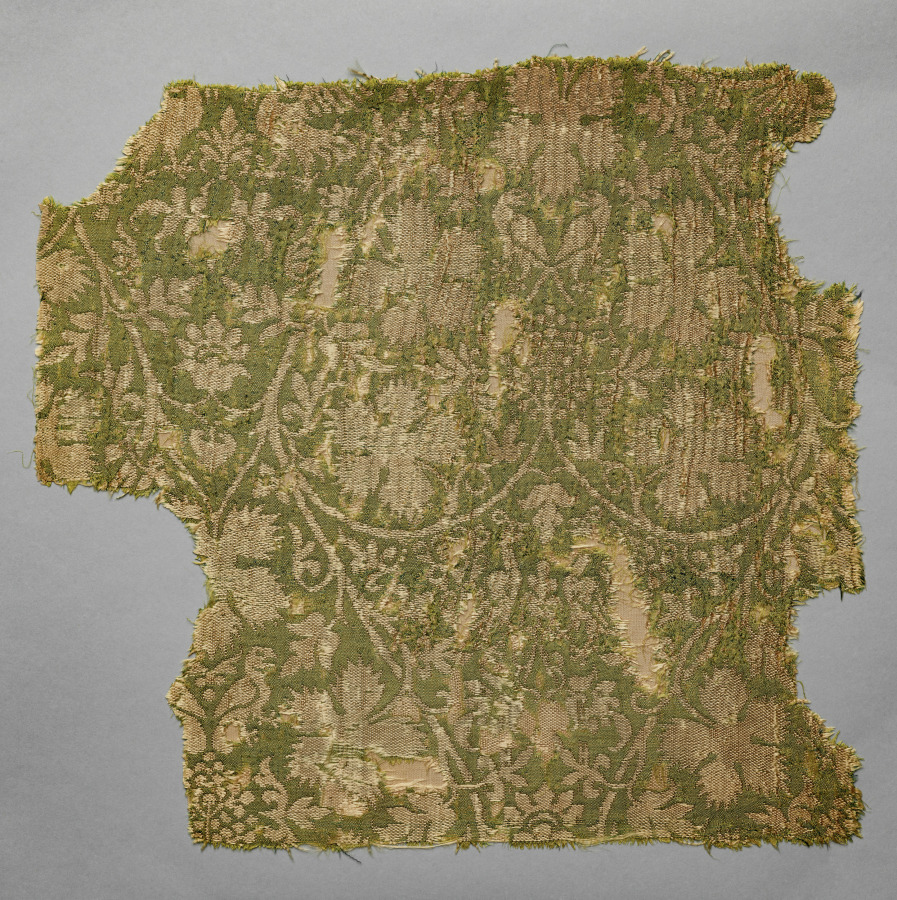
Heritage Research Artifact: Silk Fragment with Scrolling Vines, Grape Leaves, Grapes, and Birds
Introduction: The Artifact and Its Provenance
This heritage research artifact examines a singular silk fragment, dated to the late 16th to early 17th century, likely originating from the imperial workshops of the Ming Dynasty (1368–1644) in Suzhou, China. The fragment, measuring approximately 24 inches by 18 inches, is woven from a tightly spun, lustrous silk warp and weft, exhibiting a complex pattern of scrolling vines, grape leaves, clusters of grapes, and birds in flight. The materiality of the silk—its weight, sheen, and tactile resilience—speaks to the apex of imperial silk weaving, a legacy that shaped global textile traditions for centuries. This artifact, now housed in the Lauren Fashion Heritage Lab, offers a tangible link to the cultural and economic power of silk as a medium of prestige, diplomacy, and artistry.
Materiality: The Silk Weave and Its Technical Mastery
The fragment’s weave is a satin damask with supplementary weft patterning, a technique perfected in imperial workshops. The ground weave is a five-end satin, creating a smooth, reflective surface that catches light with a liquid quality. The pattern is rendered in a contrasting weave structure—likely a twill or tabby—allowing the motifs to emerge with a subtle, raised texture. The silk fibers themselves are of exceptional quality: long, continuous filaments from the Bombyx mori silkworm, reeled without breakage, a hallmark of imperial production where only the finest cocoons were selected. The dyes, derived from natural sources such as indigo for blue, madder for red, and weld for yellow, remain vibrant after centuries, a testament to the mordanting techniques that fixed colorants deep within the fiber. The fragment’s condition—slight fraying at the edges, but intact pattern areas—suggests it was part of a larger garment or hanging, possibly a ceremonial robe or a temple banner, preserved in a dry, dark environment.
Iconography: Scrolling Vines, Grapes, and Birds
The design is a masterclass in symbolic storytelling. The scrolling vines form an undulating, continuous network, representing longevity and the cyclical nature of life—a core tenet of Daoist philosophy. The grape leaves and grapes are not merely decorative; they signify abundance, fertility, and prosperity, echoing the Roman and Byzantine influences that traveled the Silk Road and were absorbed into Chinese iconography. The birds, likely magpies or orioles, are depicted in mid-flight, their beaks open as if singing. In Chinese tradition, birds symbolize joy, freedom, and the arrival of spring. The combination of vines, grapes, and birds creates a harmonious narrative: the vine as the path of life, the grapes as its fruits, and the birds as the messengers of happiness. This motif was particularly favored in imperial contexts, where it adorned robes for the emperor and his consorts during harvest festivals or diplomatic audiences, reinforcing the ruler’s role as the provider of abundance.
Context: The Legacy of Imperial Silk Weaving
This fragment is a product of the imperial silk weaving system, a state-controlled enterprise that reached its zenith under the Ming and Qing dynasties. The Imperial Silkworks in Suzhou, Hangzhou, and Nanjing employed thousands of artisans, from silkworm farmers to master weavers, operating under strict quotas and quality standards. Silk was not merely a textile; it was a currency of power. The emperor used silk as tribute to foreign envoys, as rewards for loyal officials, and as a symbol of cosmic order. The patterns were often dictated by the Imperial Household Department, with motifs like dragons, phoenixes, and scrolling vines reserved for the highest ranks. This fragment, with its grape and bird motif, would have been woven for a high-ranking noble or a member of the imperial family, as the grape motif was associated with the West—a nod to the Silk Road’s cultural exchange.
The legacy of imperial silk weaving extends beyond China. The techniques—satin weave, damask, and brocade—were transmitted to the Islamic world, Europe, and eventually to London’s Savile Row, where silk became a staple for bespoke tailoring. The Savile Row tradition of using silk for linings, ties, and pocket squares owes a debt to these imperial workshops. The precision of the weave, the balance of pattern and ground, and the use of natural dyes set a standard that modern mills still strive to emulate. For instance, the British silk weavers of Spitalfields in the 18th century adapted Chinese damask patterns for the aristocracy, while contemporary houses like Anderson & Sheppard and Gieves & Hawkes source silk from Italian mills that trace their lineage to Chinese techniques.
Conservation and Interpretation
Preserving this fragment requires a controlled environment: stable humidity (50–55%), low light levels (under 50 lux), and minimal handling. The silk’s protein fibers are vulnerable to acid degradation, so storage in acid-free tissue within a dark box is essential. The Lauren Fashion Heritage Lab employs a conservation-first approach, documenting the fragment with high-resolution imaging and spectral analysis to identify dye compounds and weave structure. This data informs both preservation and reproduction: a digital archive allows designers to study the pattern for contemporary applications, such as silk scarves or bespoke linings, without risking the original.
Conclusion: A Living Legacy
This silk fragment is more than a historical relic; it is a testament to the enduring dialogue between craft, culture, and commerce. The scrolling vines and birds speak a universal language of beauty and meaning, while the materiality of the silk—its weight, sheen, and resilience—reminds us of the human hands that spun, dyed, and wove it. For the Lauren Fashion Heritage Lab, this artifact serves as a benchmark for quality and a source of inspiration. As we continue to explore the legacy of imperial silk weaving, we honor the artisans who created it and the traditions that continue to shape the world of luxury textiles. In the spirit of Savile Row, where heritage meets innovation, this fragment is not merely preserved but reimagined—a thread connecting past mastery to future craft.