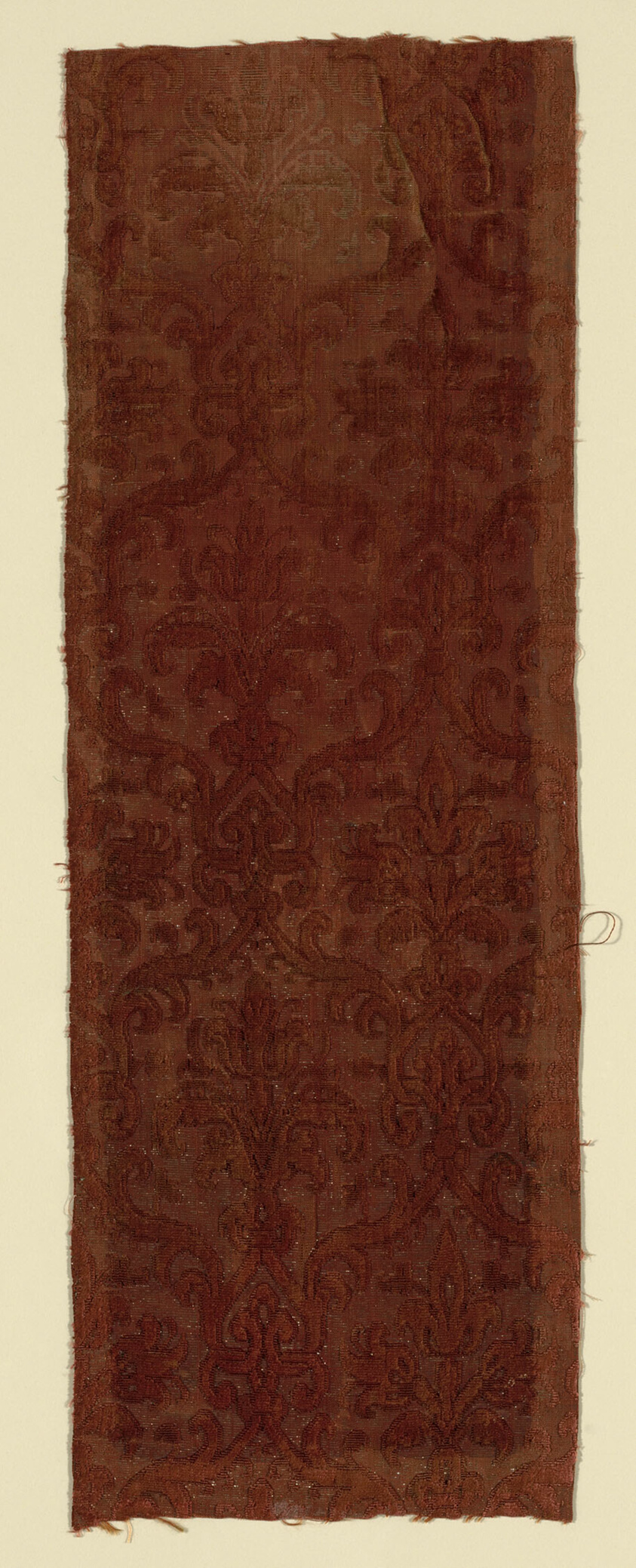
Heritage Research Artifact: The Fragment as a Testament to Craftsmanship
Introduction: The Fragment’s Narrative Power
In the rarefied world of heritage textiles, the fragment is not a remnant of loss but a concentrated archive of mastery. At the Lauren Fashion Heritage Lab, we approach each fragment as a primary source—a tangible witness to the hands, looms, and aesthetic sensibilities that shaped an era. The subject of this artifact is a silk fragment of exceptional complexity: a voided velvet with cut and uncut pile, enriched by additional patterning wefts in gold foil against a plain weave foundation. This piece, likely originating from a 17th- or 18th-century European weaving center such as Lyon or Venice, embodies the pinnacle of classic silk craftsmanship and fluid elegance. Its materiality speaks to a time when silk was not merely a fabric but a statement of power, artistry, and cultural identity.
Materiality: Deconstructing the Weave
Silk Foundation and Plain Weave Structure
The foundation of this fragment is a plain weave, the simplest and most stable of textile structures. Yet, in the hands of a master weaver, this base becomes a canvas for opulence. The silk threads, likely degummed and dyed with natural pigments, provide a lustrous ground that catches light with subtle shifts. The plain weave ensures durability, allowing the fabric to drape with a fluidity that Savile Row tailors would later prize for its ability to follow the body’s contours without stiffness.
Voided Velvet: Cut and Uncut Pile
The defining feature of this fragment is its voided velvet technique, where areas of pile are deliberately omitted to create a pattern against the ground. Here, the weaver employed both cut and uncut pile. The cut pile—loops sheared open—produces a dense, plush surface that absorbs light, creating deep shadows and a tactile richness. The uncut pile, left as loops, offers a contrasting texture: a subtle, ribbed surface that catches light in a softer, more reflective manner. This interplay of cut and uncut velvet is a hallmark of Baroque and Rococo design, where contrast was used to simulate depth and movement, much like chiaroscuro in painting.
Gold Foil Patterning Wefts
The additional patterning wefts in gold foil elevate this fragment from luxury to opulence. Gold foil—thin sheets of beaten metal—was often wound around a silk or linen core to create a thread that could be woven into the fabric. In this fragment, the gold wefts are introduced selectively, forming motifs that likely include floral arabesques or geometric medallions. The gold does not merely embellish; it creates a dynamic surface that shifts with the viewer’s angle, reflecting light in a way that suggests both wealth and celestial radiance. This technique required extraordinary skill, as the metal threads are brittle and prone to breakage under tension. The survival of these gold wefts, even in fragmentary form, attests to the weaver’s precision and the fragment’s careful preservation.
Context: Classic Silk Craftsmanship and Fluid Elegance
The Cultural and Economic Significance of Silk
Silk has long been a marker of civilization itself. From the Silk Road to the courts of Europe, it represented not only material wealth but also technological sophistication. The production of voided velvet with gold foil was a monopoly of a few elite weaving centers, where guilds guarded techniques as state secrets. In 17th-century France, for instance, the manufacture of such fabrics was regulated by royal decree, with patterns often dictated by the court of Louis XIV. This fragment, therefore, is not just a textile; it is a document of political economy, trade routes, and the intersection of art and industry.
Fluid Elegance in Design and Drape
The term “fluid elegance” is central to understanding this fragment’s aesthetic. Unlike the stiff brocades of earlier periods, voided velvet with cut and uncut pile achieves a suppleness that allows it to move with the body. This quality was particularly prized in garments such as mantuas, waistcoats, and ecclesiastical vestments, where the fabric’s ability to cascade and fold created a living sculpture. The gold foil patterning, while opulent, is integrated into the weave in a way that does not compromise the fabric’s drape. Each motif is carefully spaced, ensuring that the fabric retains its flexibility. This balance between ornament and function is a lesson that modern luxury houses, including those on Savile Row, continue to honor: true elegance is never sacrificed for decoration.
Preservation and the Fragment’s Role in Heritage
As a heritage artifact, this fragment serves multiple purposes. It is a teaching tool for understanding historical weaving techniques, a source of inspiration for contemporary designers, and a tangible link to the past. The fragment’s condition—its edges frayed, its gold wefts tarnished in places—does not diminish its value. On the contrary, these signs of age authenticate its journey through time. In the Lauren Fashion Heritage Lab, we treat such fragments with the reverence they deserve, using them to reconstruct lost patterns, analyze dye compositions, and educate future generations about the artistry of silk.
Conclusion: The Fragment as a Living Legacy
This silk fragment, with its voided velvet, cut and uncut pile, and gold foil patterning, is a microcosm of classic silk craftsmanship. It embodies the technical mastery, cultural significance, and aesthetic fluidity that define the finest heritage textiles. For the Lauren Fashion Heritage Lab, it is not merely an object of study but a source of enduring inspiration. In the tradition of Savile Row, where precision and elegance are paramount, this fragment reminds us that the past is not a relic but a foundation upon which we continue to build. Its threads, though broken, still speak—of looms, of hands, of an era when silk was the language of luxury. And in that language, the fragment is a complete sentence.