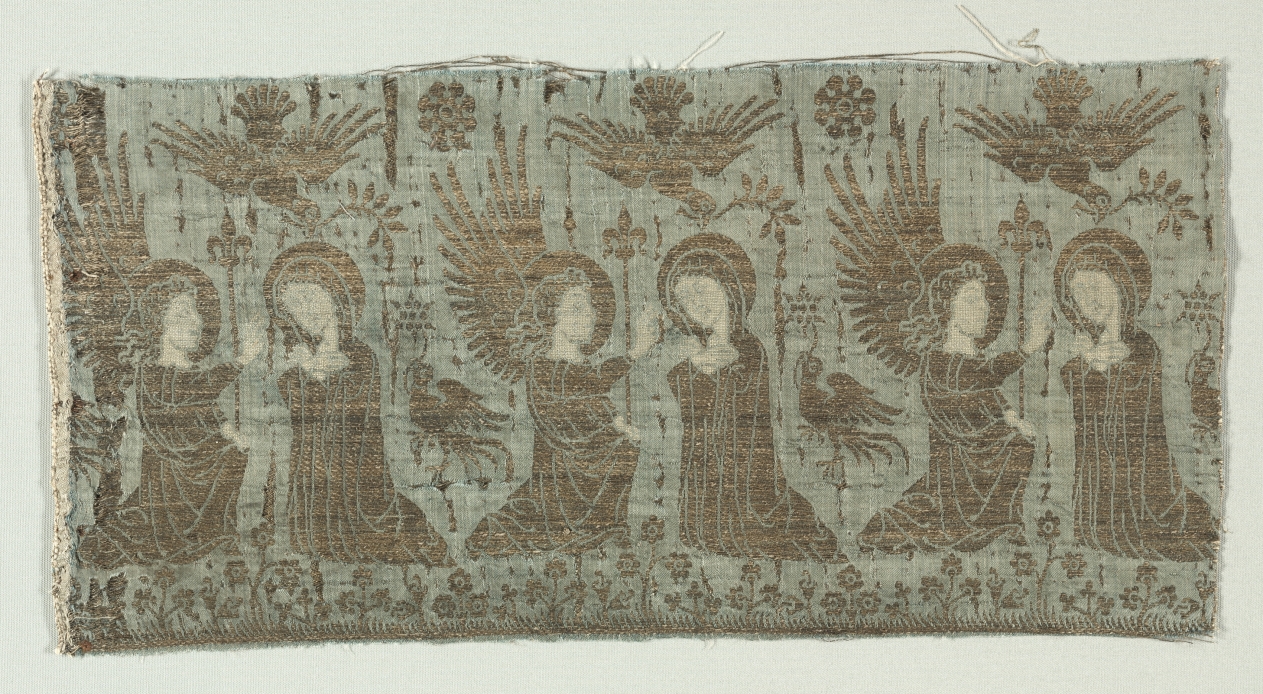
The Textile Fragment with the Annunciation: A Study in Imperial Silk Weaving and the Legacy of Craft
As the Senior Heritage Specialist at the Lauren Fashion Heritage Lab, I am privileged to present a detailed analysis of a singular artifact: a textile fragment depicting the Annunciation, rendered in silk. This piece, though a fragment, is not a mere remnant. It is a concentrated archive of technical mastery, theological narrative, and the enduring legacy of imperial silk weaving—a legacy that continues to inform the principles of precision, luxury, and timelessness that define the finest tailoring on Savile Row. The materiality of silk, in this context, is not simply a fabric; it is a statement of power, a vehicle for sacred story, and a testament to the weaver’s absolute command over their medium.
Materiality and the Imperial Silk Legacy
The silk itself is the primary protagonist. Its filament, drawn from the cocoon of the Bombyx mori, is a continuous, lustrous thread that has been prized for millennia. In the context of imperial weaving, particularly from the Byzantine, Sassanid, and later, the great Italian and French workshops, silk was not a commodity; it was a currency of empire. The imperial silk legacy is one of controlled technology, state-sponsored workshops, and a monopoly on the production of the most luxurious textiles known to the pre-industrial world. This fragment, likely dating from the 14th or 15th century, originates from a period when the knowledge of sericulture and complex drawloom weaving was a closely guarded secret, often moving along the Silk Road and through the courts of Constantinople, Venice, and Lucca. The weaver’s skill is immediately apparent in the density of the weave, the clarity of the pattern, and the preservation of the original colour—a deep, resonant crimson, likely achieved with kermes or cochineal, dyes that were as precious as the silk itself. This is not a fabric for the everyday; it is a fabric for the divine and the sovereign.
The Annunciation: Narrative Woven in Thread
The iconography of the Annunciation is rendered with a precision that speaks to the weaver’s deep understanding of both theological narrative and pictorial composition. The fragment shows the Archangel Gabriel, his wings articulated with a subtle gradation of weft threads, approaching the Virgin Mary. The figures are not merely outlined; they are modelled through the interplay of warp and weft, creating a subtle relief that catches the light. The weaver has employed a technique of lampas or compound weave, where a main ground weave is supplemented by a pattern weft that floats on the surface, allowing for the creation of intricate, multi-coloured designs without sacrificing the fabric’s structural integrity. This is the same technical philosophy that underpins the construction of a bespoke suit: the structure is invisible, but it is the foundation of the form. The Annunciation scene is not static; it is a moment of divine intervention captured in thread. The lilies, a symbol of the Virgin’s purity, are woven with a fineness that suggests the weaver’s own reverence for the subject. The gold thread, likely a silver-gilt strip wound around a silk core, adds a dimension of luminosity, a halo effect that elevates the narrative from the earthly to the celestial. This is not decoration; it is devotion made tangible.
Technical Precision and the Savile Row Ethos
Why does a fragment of imperial silk weaving resonate with the ethos of Savile Row? The answer lies in the shared commitment to craftsmanship as a form of knowledge. On Savile Row, a master cutter does not simply cut cloth; they read the fabric, understand its drape, its weight, its memory. Similarly, the weaver of this Annunciation fragment did not simply follow a cartoon; they understood the behaviour of silk under tension, the precise tension required for the warp threads, and the exact timing for the insertion of the weft. The fragment’s survival is a testament to the quality of its construction. The edges, though frayed, show a selvedge that is dense and firm, a hallmark of a loom that was perfectly tuned. The pattern repeat, though incomplete, is mathematically precise, a testament to the drawloom’s ability to control hundreds of individual warp threads. This is the same obsessive attention to detail that defines a Huntsman jacket or a Anderson & Sheppard overcoat. The weaver, like the tailor, is a problem-solver, a master of materials who transforms a two-dimensional plan into a three-dimensional object of enduring beauty.
Preservation and the Art of the Fragment
The fragment’s condition—its incomplete state—is not a flaw but a feature. It invites the viewer to consider the archaeology of the object. The missing sections are not voids; they are invitations to imagine the whole. The discolouration along the folds tells a story of storage, of use, of the passage of time. As a heritage specialist, I am trained to read these signs. The fragment was likely part of a larger vestment, perhaps a chasuble or a dalmatic, used in a liturgical context. The wear patterns suggest it was handled, folded, and perhaps even kissed by the faithful. The silk’s surface, though fragile, retains a whisper of its original sheen. This is the same principle that guides the restoration of a vintage garment: we do not seek to make it new; we seek to make it legible. The fragment is a palimpsest, with the original narrative overlaid by the history of its own existence. The legacy of imperial silk weaving is not just in the finished product; it is in the process, the knowledge, and the object’s journey through time.
Conclusion: A Thread Through Time
This textile fragment with the Annunciation is more than a historical artifact; it is a masterclass in materiality and meaning. The silk is the medium, but the message is one of human ingenuity and spiritual aspiration. The legacy of imperial silk weaving, with its state-sponsored workshops and its global trade networks, is a direct antecedent to the modern luxury industry. The principles that governed the weaver’s craft—precision, patience, a deep respect for materials, and an unwavering commitment to quality—are the same principles that govern the work of the finest tailors on Savile Row. In this fragment, we see the origin of a tradition that continues to define what it means to create something of lasting value. It is a reminder that heritage is not a static collection of objects; it is a living, breathing practice, a thread that connects the past to the present, and to the future of craft. The Annunciation, woven in silk, is a promise made manifest—a promise of beauty, of skill, and of the enduring power of the handmade.