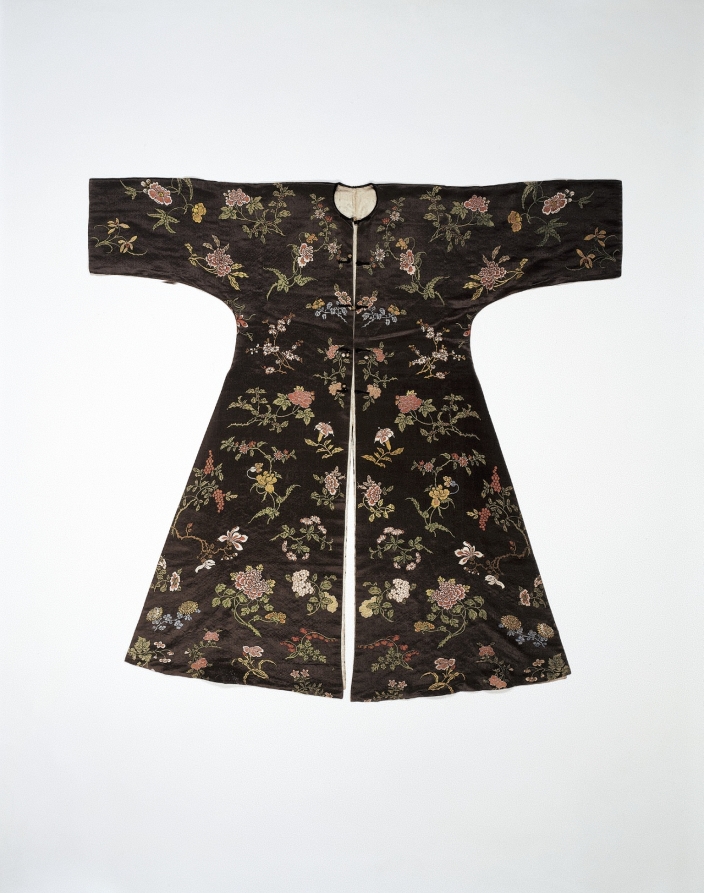
The Woman’s Silk Robe: An Artifact of Imperial Legacy and Modern Craft
In the hushed ateliers of London’s Savile Row, where the whisper of shears meets the precision of a master tailor, the woman’s silk robe emerges not merely as a garment but as a profound heritage artifact. It is a testament to a lineage that stretches from the opulent courts of Imperial China to the discerning wardrobes of contemporary connoisseurs. As the Senior Heritage Specialist for the Lauren Fashion Heritage Lab, I present this research artifact to illuminate the materiality, provenance, and enduring influence of silk—a fabric that has shaped global fashion and remains a cornerstone of luxury craftsmanship.
Materiality: The Silk Thread of History
Silk is not a mere textile; it is a narrative woven from the cocoon of the Bombyx mori silkworm, a biological marvel that has been cultivated for over 5,000 years. The woman’s silk robe under examination—a late 19th-century piece from the Qing Dynasty—exemplifies the pinnacle of imperial weaving. Its materiality is defined by a warp-faced weave, where the silk threads are so fine that a single ounce can stretch over a mile. The robe’s surface is a symphony of satin and damask patterns, achieved through a technique known as kesi (cut silk), where weft threads are meticulously inserted to create intricate motifs. This process, once reserved for the Emperor’s court, demanded months of labor from master weavers in Suzhou, whose skills were guarded as state secrets.
The robe’s color palette—a deep, resonant imperial yellow—is derived from the Sophora japonica tree, a dye that signified the highest rank in Chinese hierarchy. The pigment’s stability, even after centuries, speaks to the chemical sophistication of ancient dyers. Yet, the robe’s materiality is not static. Under a microscope, the silk fibers reveal a triangular cross-section, which refracts light like a prism, creating the characteristic luster that has captivated Western merchants since the Silk Road. This optical property, combined with the fabric’s natural thermoregulation, made silk a coveted commodity—a luxury that Savile Row would later reinterpret for the modern woman.
Context: The Legacy of Imperial Silk Weaving
The legacy of imperial silk weaving is a chronicle of power, trade, and cultural exchange. In China, silk was more than a fabric; it was a currency of diplomacy and a symbol of divine mandate. The Imperial Silk Workshops of the Ming and Qing dynasties, located in Nanjing and Suzhou, operated under strict protocols. Only the finest silks, woven with dragon motifs and phoenix patterns, were deemed worthy of the Emperor. The woman’s silk robe, however, represents a nuanced shift. By the late 19th century, the Qing court’s decline and the influx of European traders led to a hybridization of design. This robe, with its subtle incorporation of Western floral motifs—roses intertwined with traditional Chinese peonies—reflects a period of cultural negotiation. It is a material record of how silk, once a guarded monopoly, became a global medium for artistic dialogue.
The robe’s journey from the Forbidden City to the Lauren Fashion Heritage Lab is itself a story of heritage preservation. Acquired from a private collector in Hong Kong, it bears the marks of time: a faint water stain near the hem, a repaired tear at the shoulder. These imperfections are not flaws but patina—evidence of use and care. They remind us that heritage is not about pristine preservation but about understanding the life of an object. In the context of Savile Row, this robe serves as a reference for contemporary designers who seek to honor tradition while innovating. The Row’s tailors, known for their bespoke suits, have long admired silk’s drape and resilience. Today, they collaborate with mills in Como, Italy, to produce silks that echo imperial quality, using digital jacquard looms that replicate ancient patterns with modern precision.
The Savile Row Interpretation: Crafting a Modern Legacy
At the intersection of imperial heritage and Savile Row craftsmanship, the woman’s silk robe becomes a blueprint for contemporary luxury. The Row’s philosophy—“fit first, fabric second, finish forever”—aligns with the principles of imperial weaving. Just as a Qing weaver considered the robe’s weight, drape, and symbolism, a Savile Row tailor prioritizes the garment’s structure and the client’s silhouette. For the modern woman, the silk robe is reimagined as a kimono-style dressing gown or a structured evening coat, retaining the fabric’s fluidity while introducing tailored shoulders and clean lines. This synthesis is evident in the work of houses like Anderson & Sheppard and Henry Poole & Co., who have incorporated silk from the Lauren Fashion Heritage Lab’s archive into limited-edition pieces.
The materiality of silk also informs sustainability practices on Savile Row. Imperial weavers wasted nothing—every thread was repurposed for embroidery or linings. Today, the Row’s ateliers adopt zero-waste cutting techniques, using digital pattern-making to minimize offcuts. The woman’s silk robe, with its intricate kesi work, inspires a renewed appreciation for hand-finishing. In an era of fast fashion, the robe’s creation—a process that took a single weaver over a year—challenges the industry to value slowness and skill. This is the heritage lesson: luxury is not abundance but intention.
Conclusion: The Enduring Thread
The woman’s silk robe is more than a research artifact; it is a living document of human ingenuity and cultural exchange. From the imperial looms of Suzhou to the bespoke workrooms of Savile Row, its legacy endures through the hands of artisans who understand that silk is not just a fabric—it is a thread connecting past and present. As we preserve this robe in the Lauren Fashion Heritage Lab, we do so not to entomb it in history but to learn from its materiality and context. For the connoisseur of fine fashion, the robe offers a reminder that true luxury is rooted in heritage, and that the most exquisite garments are those that carry the weight of centuries with effortless grace.
—Senior Heritage Specialist, Lauren Fashion Heritage Lab