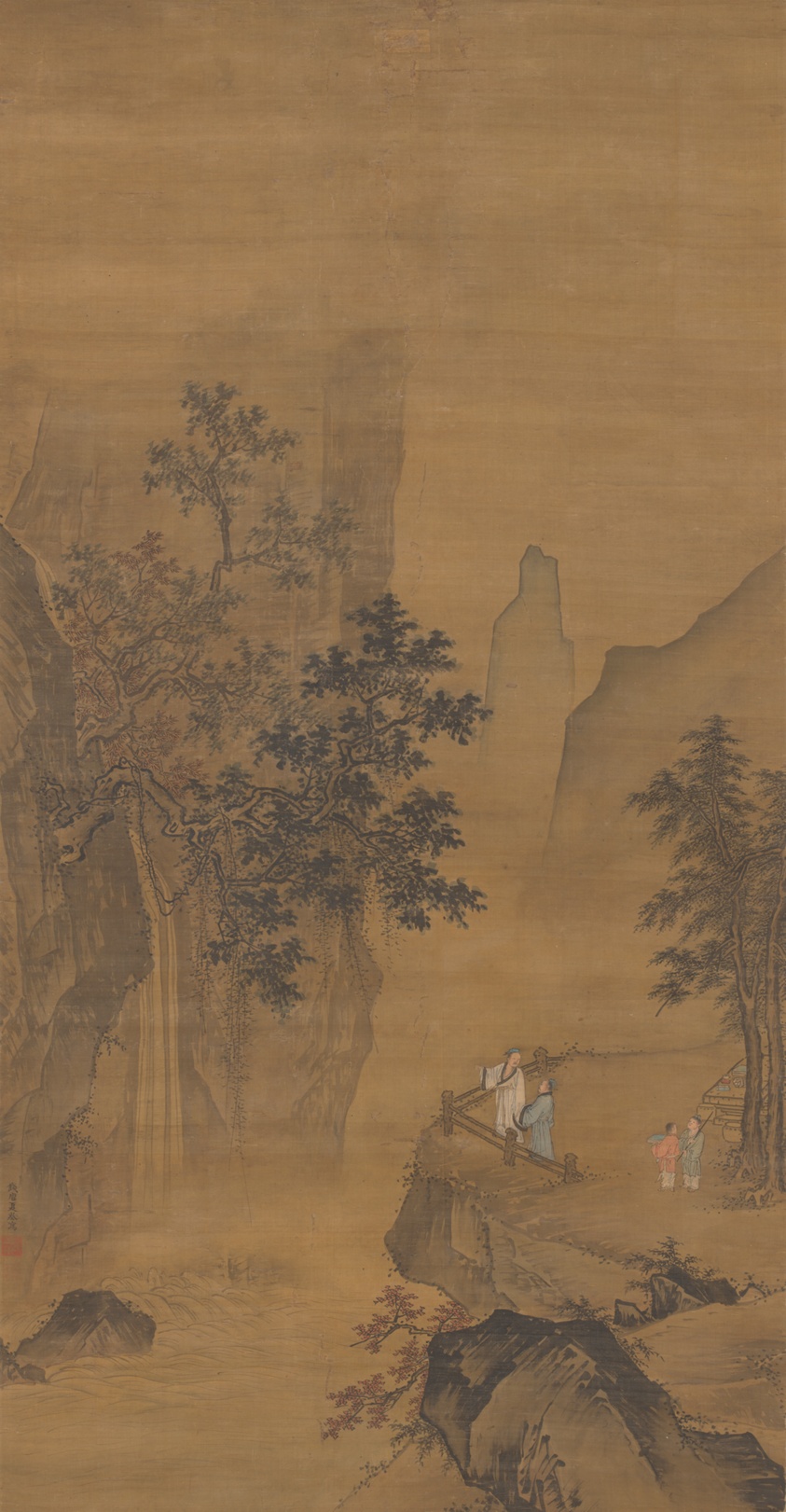
Watching the Waterfall: A Study in Materiality and Metaphor
Introduction: The Silk as Narrative
In the rarefied world of heritage fashion, where provenance and precision are paramount, the materiality of an artifact speaks with a voice as distinct as the brushstroke that graces it. Watching the Waterfall (高士觀瀑圖), a hanging scroll executed in ink and slight color on silk, is not merely a painting; it is a testament to the symbiotic relationship between medium and message. The silk, a fabric of unparalleled refinement, does not passively receive the artist’s vision—it actively shapes it. This artifact, preserved within the Lauren Fashion Heritage Lab, offers a profound case study in how materiality informs aesthetic legacy, much like the bespoke tailoring of Savile Row, where the cloth dictates the cut, the drape, and the final silhouette of a garment.
The Craft of Silk: A Foundation of Elegance
Silk, as a substrate for painting, demands a level of mastery that transcends the mere application of pigment. The fabric’s inherent luminosity, its ability to catch and diffuse light, creates a surface that is both receptive and resistant. In Watching the Waterfall, the silk is woven with a precision that speaks to centuries of Chinese textile tradition. The warp and weft are fine, almost imperceptible to the naked eye, yet they provide a structural integrity that allows the ink to settle without bleeding. This is not a canvas of coarse linen or a sheet of absorbent paper; it is a material that requires the artist to work with a deliberate, controlled hand. The slight color—a whisper of mineral green for the pines, a touch of ochre for the scholar’s robe—is applied with a restraint that mirrors the silk’s own understated elegance. The result is a surface that breathes, where the negative space is as significant as the positive forms.
The craftsmanship of this silk is akin to the construction of a Savile Row jacket. Just as a master tailor selects a worsted wool for its drape and resilience, the artist chose a silk of specific weight and weave to capture the ephemeral quality of water and mist. The scroll’s mounting, a later addition but executed with equal care, uses a silk brocade of a complementary hue, framing the painting as a bespoke lining might frame a garment’s interior. This attention to detail is not decorative; it is functional. The silk’s flexibility allows the scroll to be rolled and unrolled, stored and displayed, without cracking or flaking—a durability that has preserved the scholar’s contemplative gaze for centuries.
Fluid Elegance: The Artist’s Dialogue with Material
The subject of Watching the Waterfall is a solitary scholar, perched on a rocky outcrop, his gaze fixed upon the cascading water. The waterfall itself is rendered with a fluidity that echoes the silk’s own supple nature. The ink, diluted to a pale wash, flows across the fabric in long, unbroken strokes, mimicking the descent of water. The artist has not fought the silk’s tendency to absorb; instead, he has exploited it. The slight color—a faint blue-gray in the mist—is applied in layers, each one allowed to dry before the next is added, creating a depth that is both translucent and solid. This technique, known as gongbi (meticulous brushwork), is here tempered with a xieyi (freehand) spontaneity, a balance that only a master could achieve on such a demanding surface.
The scholar’s robe, rendered in a muted indigo, is a study in restraint. The folds are suggested with a single line, the fabric’s weight implied by the slight pooling of ink at the hem. This is not a portrait of opulence; it is a meditation on simplicity. The silk, with its natural sheen, elevates this simplicity to a form of luxury. The viewer is drawn not to the richness of the pigment but to the richness of the surface itself—the way the light plays across the scholar’s silhouette, the way the silk seems to glow from within. This is the essence of fluid elegance: a material that does not shout but whispers, that invites contemplation rather than spectacle.
The Scholar’s Gaze: A Metaphor for Craftsmanship
The act of watching a waterfall is, in Chinese literati tradition, a metaphor for the pursuit of wisdom. The scholar does not merely observe; he absorbs, he reflects. In the same way, the silk absorbs the ink, reflecting the artist’s intent with a fidelity that is almost spiritual. The waterfall, a symbol of nature’s relentless flow, is captured in a moment of stillness—a paradox that the silk, with its permanent yet pliable nature, embodies perfectly. The material becomes a vessel for the metaphysical, a reminder that true craftsmanship is never about the surface alone but about the dialogue between the maker, the medium, and the meaning.
For the Lauren Fashion Heritage Lab, this artifact serves as a touchstone for understanding how materiality informs heritage. In the world of fashion, we often speak of the “hand” of a fabric—its feel, its weight, its behavior. The silk of Watching the Waterfall has a hand that is both delicate and resilient, much like the finest silk charmeuse used in an evening gown. Yet, unlike a garment, this scroll is not worn; it is witnessed. Its materiality is not a backdrop but a protagonist, a participant in the narrative of the scholar’s quiet epiphany.
Conclusion: A Legacy of Refinement
In conclusion, Watching the Waterfall is more than a painting; it is a lesson in the power of material. The silk, with its classic craftsmanship and fluid elegance, is the unsung hero of this composition. It is the thread that connects the artist’s hand to the scholar’s gaze, the ink to the water, the past to the present. As we preserve and study this artifact within the Lauren Fashion Heritage Lab, we are reminded that heritage is not static—it is a living dialogue between tradition and innovation, between the tactile and the transcendent. Just as a Savile Row suit is never merely a garment but a statement of identity, this hanging scroll is never merely a painting but a testament to the enduring beauty of silk as a medium for the human spirit.