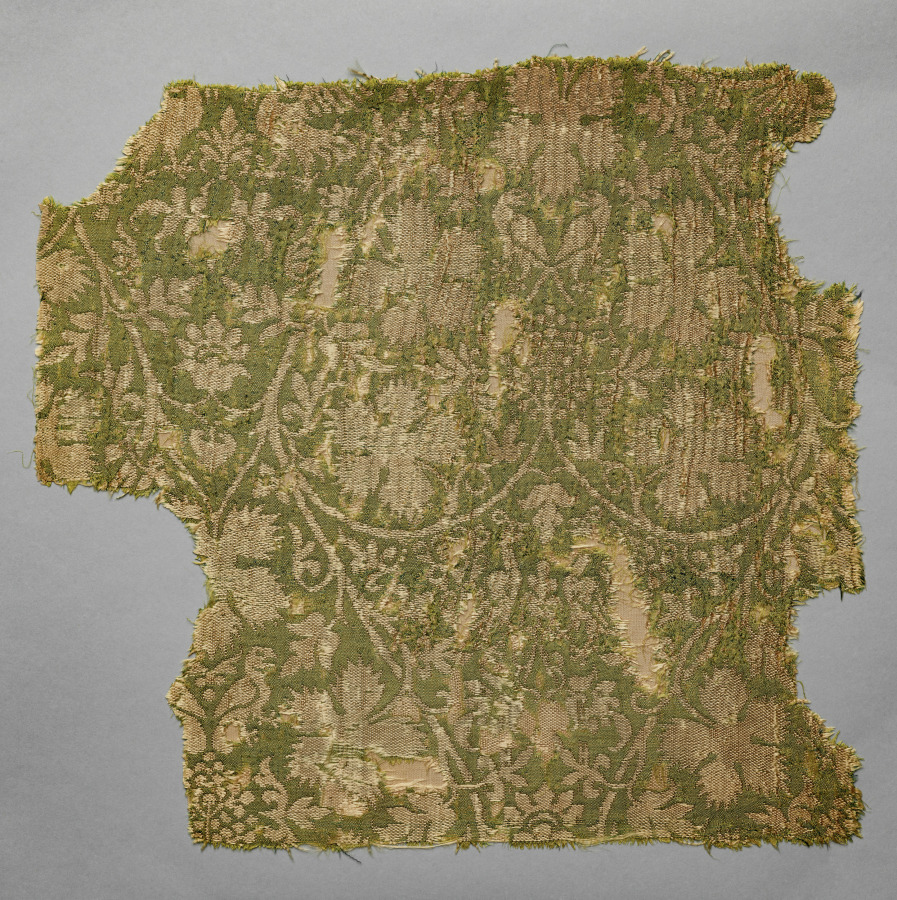
An Examination of Aesthetic Authority: The Imperial Silk Fragment
To engage with this fragment—a modest expanse of silk, perhaps no larger than a gentleman’s breast-pocket square—is to confront not merely a textile, but a profound statement of authority. The piece, though silent and still, speaks with the resonant clarity of a centuries-old institution. Its materiality, the very essence of its being, is silk: the ultimate substrate of imperial aspiration. This is not the silk of mere commerce or casual adornment; it is the silk of the loom as an instrument of state, a medium through which power was not simply worn, but woven into the very fabric of society. The legacy it carries is that of the imperial atelier, where technical mastery was inseparable from symbolic intent, and where every thread was imbued with a sense of ordained purpose.
The Grammar of the Loom: Decoding a Symbolic Lexicon
Observe, if you will, the precise articulation of its design. The scrolling vines are not haphazard tendrils; they are a masterclass in controlled rhythm. Each curve, each reciprocal turn, establishes a perpetual motion, a self-referential universe of growth that implies both natural abundance and impeccable order. This is nature not as found in the wild, but as edited and perfected by the imperial hand—a botanical syntax of boundless continuity and resilience, reflecting the desired perpetuity of the dynasty itself.
Upon this armature rests the specific vocabulary: the grape leaves and grapes. In the Western canon, this motif speaks of Bacchic revelry. Within the context of the Eastern imperial workshop, however, its resonance transforms. Here, it evokes notions of scholarly pursuit, of fruitful endeavour, and of auspicious abundance. The grape, with its myriad clustered seeds, becomes an emblem of prolificity and unity—a most suitable metaphor for a vast and populous empire. The leaves, with their deeply lobed and serrated edges, provide a complex counterpoint of texture, demonstrating the weaver’s ability to translate botanical minutiae into shimmering thread. This is not mere decoration; it is a heraldry of the natural world, co-opted into the service of the state.
The Avian Annotations: A Note of Transcendence
The introduction of birds amidst this fertile architecture elevates the composition from a pattern to a narrative. These are not generic fowl; their depiction, likely species-specific—perhaps phoenixes, paradise flycatchers, or mandarin ducks—carries a further stratum of meaning. They represent the celestial touching the terrestrial, the infusion of heavenly favour into the imperial domain. Their poised placement, often in harmonious pairs or poised in graceful flight, introduces a note of dynamic balance. They are the animate spirit within the ordered garden, symbolising everything from conjugal felicity and bureaucratic harmony to the emperor’s role as the conduit between heaven and earth. Their presence confirms that this silk was intended for a milieu where every visual element was an intentional, legible component of a broader cosmological and political dialogue.
The Substance of Supremacy: Materiality as Mandate
The foundation of this entire discourse is, irrevocably, the silk itself. In the imperial context, silk was a controlled substance. Its production, from the cultivation of mulberry groves to the operation of the monumental draw-looms within palace workshops, was a state monopoly. The quality evident here—the fineness of the yarn, the density of the weave, the luminosity and fastness of the dyes—serves as a tangible benchmark of imperial capability. This fragment is a product of a consummate supply chain, a triumph of agrarian policy, chemical expertise, and staggering mechanical ingenuity. The softness belies its strength; the sheen is a captured light, intended to illuminate the wearer as both a beneficiary and an embodiment of the empire’s refined might. To drape oneself in such fabric was to be enveloped in the physical manifestation of the realm’s technological and administrative supremacy.
Conclusion: The Enduring Cut of History
This fragment, therefore, stands as a peerless artifact of heritage. It transcends the ornamental to occupy the realm of the constitutional. It is a compact treatise on how a regime wove its ideology into being, using the shuttle and thread to articulate visions of eternal order, abundant prosperity, and heavenly mandate. The scrolling vines map a boundless territory; the grape leaves and grapes pledge its fertility; the birds sanctify its purpose. All is rendered upon the supreme authority of silk. To study it is to understand that true luxury is never simply about aesthetic pleasure; it is, at its apex, about the exquisite expression of power. The legacy of imperial silk weaving is the legacy of a world made coherent, ordered, and radiant through the discipline of the loom—a principle of bespoke creation that, in its pursuit of perfection, finds a distant but distinct echo in the craft traditions of the modern age. It is, in its essence, a most impeccably tailored ideology.