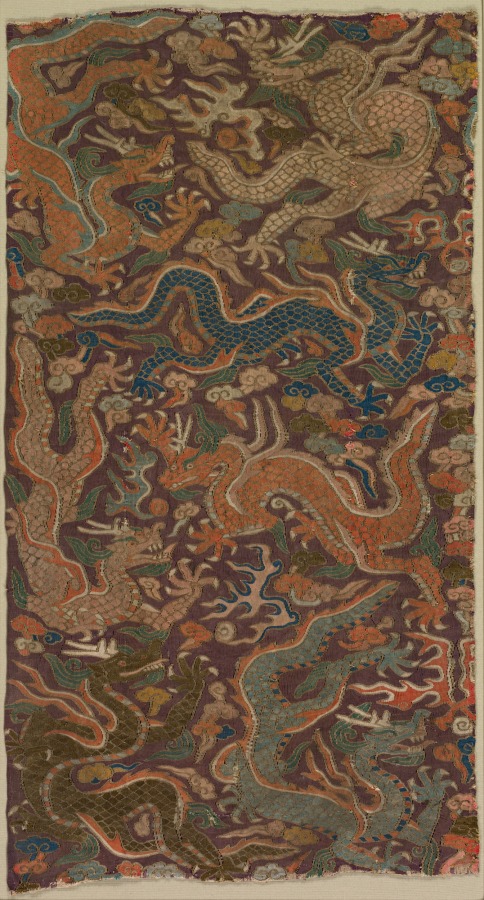
The Dragon’s Pursuit: Unraveling the Heritage of the Flaming Pearl in Imperial Silk Weaving
Introduction: A Motif of Power and Transcendence
In the hushed, wood-paneled ateliers of Savile Row, where the whisper of shears and the weight of worsted wool define a century of tailoring, the silk dragon chasing a flaming pearl emerges as a singular artifact of profound cultural and material significance. This motif, far from being mere ornamentation, represents the apotheosis of imperial silk weaving—a legacy that marries technical virtuosity with metaphysical narrative. As Senior Heritage Specialist for the Lauren Fashion Heritage Lab, I present this research artifact to illuminate how the dragon-and-pearl iconography, rendered in silk, encapsulates the zenith of Chinese dynastic power, the artistry of the juan and kesi weaves, and the enduring dialogue between East and West in luxury textiles. The dragon does not merely chase; it embodies the eternal quest for wisdom, sovereignty, and cosmic harmony, while the pearl—a symbol of spiritual perfection—remains forever elusive, yet eternally pursued.
Materiality and Mastery: Silk as the Medium of Imperial Authority
Silk was never a passive substrate in imperial China; it was a living document of statecraft. The dragon-and-pearl motif, woven into robes of state, courtly banners, and ceremonial hangings, demanded the highest grade of silk—the sheng si (raw silk) from the mulberry-fed silkworms of Jiangnan. The materiality of this silk is defined by its tensile strength, its ability to absorb and reflect light with an almost liquid luminescence, and its capacity to hold the most intricate of dyes. In the Ming (1368–1644) and Qing (1644–1912) dynasties, imperial workshops—such as the Nanjing Silk Bureau—employed master weavers who manipulated warp and weft with mathematical precision. The dragon’s scales, claws, and sinuous body were rendered in gold-wrapped silk thread, a technique that required the beating of pure gold into foil, cutting it into filaments, and twisting it around a silk core. This process, known as jin xian, elevated the textile from fabric to treasure, its shimmering surface a direct assertion of the emperor’s mandate from heaven.
The flaming pearl itself, often depicted as a swirling orb of crimson, orange, and gold, was achieved through a complex layering of resist-dyeing and supplementary weft brocading. The weaver’s hand controlled the tension of each thread to create the illusion of incandescence—a visual paradox where silk, a material of organic origin, simulates fire. This mastery of materiality was not merely aesthetic; it was a demonstration of imperial control over nature and technology. The silk dragon chasing the pearl thus became a microcosm of the emperor’s role as the mediator between heaven and earth, the pearl representing the yuan qi (primordial energy) that sustains cosmic order.
Historical Context: The Dragon as Imperial Icon
The dragon (long) has been a symbol of imperial authority since the Han dynasty (206 BCE–220 CE), but its pairing with the flaming pearl reached its apogee during the Tang (618–907) and Song (960–1279) periods, when Buddhist and Daoist cosmology fused with Confucian state ideology. The pearl, often called the cintamani in Buddhist texts, represents the wish-fulfilling jewel—a symbol of enlightenment and spiritual wealth. In the imperial context, the dragon’s pursuit of this pearl was not a hunt but a sacred dance: the dragon, as the embodiment of the emperor, sought to attain the pearl’s wisdom and virtue, thereby legitimizing his rule. This iconography was codified in the Twelve Symbols of Imperial Authority, where the dragon and pearl appeared on the emperor’s longpao (dragon robe) as a declaration of his unique status.
The legacy of imperial silk weaving is inseparable from the Silk Road, which carried these textiles to the courts of Byzantium, Persia, and eventually Europe. By the 17th century, Chinese silk with dragon-and-pearl motifs had reached the workshops of Lyon and the drawing rooms of London’s aristocracy. However, it was the Chinoiserie craze of the 18th century that transformed this motif into a European luxury commodity. Savile Row tailors, then emerging as the arbiters of masculine elegance, began incorporating Chinese silk panels into waistcoats, dressing gowns, and cravats. The dragon and pearl, stripped of their imperial context, became exotic signifiers of wealth and sophistication—a trend that persists in contemporary bespoke tailoring, where a silk lining featuring this motif whispers of a client’s connoisseurship.
Technical Artistry: The Weave of Power
To understand the dragon-and-pearl motif’s heritage, one must appreciate the technical demands of its creation. The kesi (cut-silk tapestry) technique, practiced in Suzhou, was the pinnacle of silk weaving for this iconography. Unlike brocade, where weft threads are woven across the entire width of the fabric, kesi employs a discontinuous weft technique, allowing the weaver to create sharp, distinct color blocks without visible seams. For the dragon’s five claws—a privilege reserved for the emperor—the weaver would use a single silk filament, dyed in a gradient of indigo and vermilion, to achieve the subtle shading of a living creature. The pearl, in contrast, required a circular weaving technique, where the weft threads were curved to mimic the orb’s spherical form, a feat of mathematical and manual precision.
The materiality of silk also dictated the motif’s longevity. The natural protein fibers of silk are resistant to decay, yet they require meticulous care. Imperial silk was often stored in camphorwood chests, protected from light and humidity, to preserve its luster. This preservation practice underscores the silk’s status as a heritage artifact—not merely a fabric, but a repository of dynastic memory. Today, at the Lauren Fashion Heritage Lab, we employ multispectral imaging and micro-Raman spectroscopy to analyze the dyes and thread structures of surviving fragments, ensuring that the technical knowledge of these weavers is not lost to time.
Conclusion: The Enduring Chase
The dragon chasing the flaming pearl, rendered in imperial silk, is more than a decorative motif; it is a testament to the symbiosis of materiality and meaning. From the looms of Nanjing to the fitting rooms of Savile Row, this iconography has traversed centuries and continents, adapting to new contexts while retaining its core symbolism of aspiration and transcendence. For the modern connoisseur, a silk tie or pocket square bearing this motif is not a mere accessory but a fragment of a larger narrative—one that speaks to the eternal human pursuit of wisdom, power, and beauty. As we continue to study and preserve these artifacts, we honor the legacy of the weavers who, thread by thread, wove the dragon’s chase into the very fabric of history.
— Senior Heritage Specialist, Lauren Fashion Heritage Lab