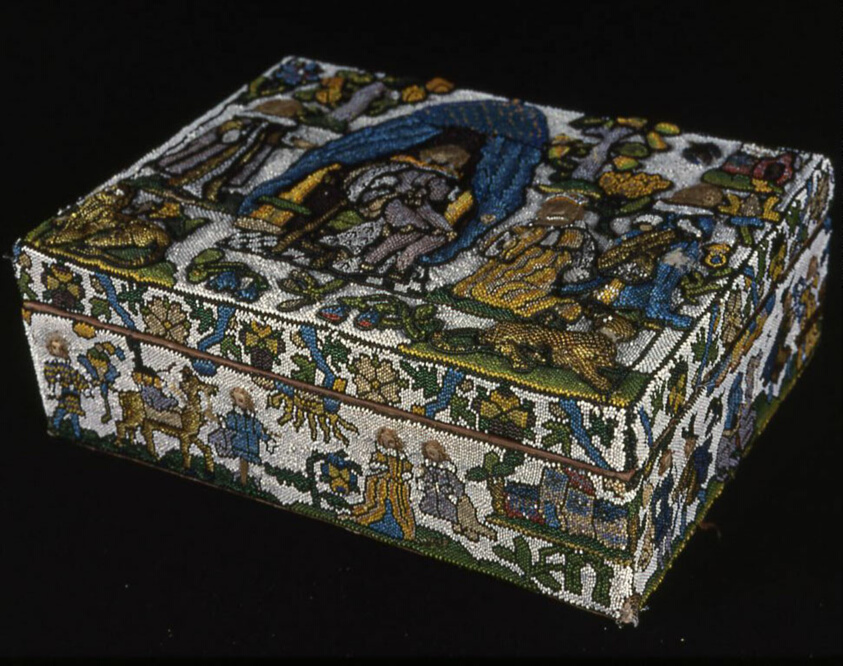
The Writing Box of King Solomon and the Queen of Sheba: A Heritage Artifact of Silk and Symbolism
Introduction: The Confluence of Craft and Narrative
In the rarefied world of heritage textiles, few artifacts command the reverence afforded to the Writing Box Depicting King Solomon and the Queen of Sheba. This object, a masterwork of silk craftsmanship, transcends its utilitarian purpose as a repository for correspondence. It is, instead, a narrative tableau, a testament to the enduring dialogue between materiality and myth. As a Senior Heritage Specialist at the Lauren Fashion Heritage Lab, I approach this artifact not merely as a decorative piece but as a complex document of cultural exchange, technical virtuosity, and the fluid elegance that defines the pinnacle of classic silk craftsmanship. The box, with its beaded figures and sumptuous embroidery, speaks in a language of luxury that resonates deeply with the ethos of Savile Row—where precision, heritage, and artistry converge to create objects of timeless significance.
Materiality: The Architecture of Opulence
The physical composition of the writing box is a study in deliberate opulence. Constructed from wood, it provides a sturdy foundation, yet its true character emerges through the layered application of textiles and embellishments. The surface is beaded with silk and glass beads, a technique that demands extraordinary patience and skill. Each bead is a discrete unit of light and color, meticulously placed to create a shimmering, tactile landscape. The appliquéd beaded figures, worked over cotton padding and silk, satin weave, introduce a three-dimensional quality that elevates the box from a flat surface to a sculptural object. This technique, akin to the bas-relief of textile art, allows the figures of King Solomon and the Queen of Sheba to emerge from the background with a lifelike presence, their garments and postures rendered in exquisite detail.
The silk satin weave serves as the canvas for this narrative. Satin, with its glossy face and matte reverse, is a fabric of contrasts—simultaneously luminous and subdued. Its smooth surface provides an ideal ground for the embroidered silk in satin and single satin stitches. These stitches, executed with surgical precision, create areas of unbroken sheen that mimic the play of light on water or the sheen of polished metal. The couching technique, where threads are laid on the fabric surface and secured with small stitches, adds structural definition to the figures and architectural elements, while seed pearls—tiny, luminous orbs—are interspersed to suggest jewels, crowns, and the opulence of the Solomonic court. The metal hinges, though functional, are themselves ornamental, their metallic gleam echoing the precious materials used throughout.
Context: The Silk Road and the Savile Row Ethos
To fully appreciate this writing box, one must situate it within the broader context of silk craftsmanship. Silk, as a material, has historically been a marker of status, diplomacy, and cultural exchange. The Classic silk craftsmanship evident in this artifact reflects a tradition that spans continents and centuries—from the looms of ancient China to the ateliers of Renaissance Europe. The box’s fluid elegance is not accidental; it is the result of a rigorous design philosophy that prioritizes harmony between material, technique, and narrative. This philosophy aligns seamlessly with the principles of London’s Savile Row, where tailoring is not merely the construction of garments but the articulation of identity through fabric and form.
On Savile Row, a bespoke suit is a dialogue between client and cutter, a process that honors tradition while embracing innovation. Similarly, the writing box is a dialogue between the artisan and the biblical narrative. The choice of King Solomon and the Queen of Sheba is significant. Their meeting, as recounted in the Hebrew Bible and the Quran, is a story of wisdom, wealth, and the exchange of gifts. The Queen’s journey to Jerusalem, laden with spices, gold, and precious stones, mirrors the journey of silk itself—a commodity that traversed vast distances, carrying with it the aspirations and artistry of entire civilizations. The box, therefore, is not just a depiction but a reenactment of this exchange, its materials echoing the treasures brought by the Queen.
Technical Analysis: The Art of Beading and Embroidery
The technical execution of the box’s decoration is a testament to the artisan’s mastery. The beaded figures are constructed using a technique known as appliqué, where pre-formed shapes are attached to the base fabric. The cotton padding beneath the silk satin creates a raised profile, giving the figures a sculptural volume that is both tactile and visual. The glass beads are not uniform; they vary in size, color, and opacity, allowing the artisan to create gradients of light and shadow. This is particularly evident in the depiction of King Solomon’s robe, where deep blues and golds are interwoven to suggest the richness of his court.
The silk embroidery further refines the narrative. The satin stitch, used extensively, creates smooth, unbroken surfaces that reflect light uniformly. In contrast, the single satin stitch—a variant where each stitch is placed independently—allows for finer detail, such as the Queen’s facial features or the intricate patterns on her garments. The couching of metal threads and seed pearls adds a final layer of luxury. The pearls, in particular, are a hallmark of high-status embroidery, their organic luster contrasting with the manufactured sheen of the beads. Together, these techniques create a surface that is rich with texture and meaning, inviting the viewer to look closer and discover new details with each encounter.
Symbolism and Cultural Resonance
Beyond its technical brilliance, the writing box is a vessel for symbolism. King Solomon, renowned for his wisdom, is often associated with the construction of the First Temple in Jerusalem—a structure of unparalleled beauty and sanctity. The Queen of Sheba, a figure of mystery and power, represents the allure of the exotic and the wisdom of the East. Their encounter is a metaphor for the union of opposites: male and female, wisdom and wealth, the sacred and the secular. The box, as a writing desk, is itself a symbol of communication and exchange, making it the perfect vehicle for this narrative.
In the context of the Lauren Fashion Heritage Lab, this artifact serves as a touchstone for understanding how luxury objects encode cultural values. The fluid elegance of its design—the way the figures seem to move across the surface, the way the beads catch the light—is a reminder that heritage is not static. It is a living dialogue between past and present, between the artisan’s hand and the viewer’s eye. This is the same dialogue that defines Savile Row, where a suit cut in 2024 carries the echoes of a tradition that began in the 19th century.
Conclusion: A Legacy in Silk and Beads
The Writing Box Depicting King Solomon and the Queen of Sheba is more than a historical artifact; it is a masterclass in the art of silk craftsmanship. Its materiality—the wood, the beads, the silk, the pearls—speaks to a world where objects were made to last, to be cherished, and to tell stories. Its context within the tradition of classic silk craftsmanship and its resonance with the ethos of London’s Savile Row underscore the enduring power of handmade luxury. As we preserve and study such artifacts, we are not merely cataloging the past; we are learning the language of excellence that continues to inspire the finest artisans today. In the hands of a skilled specialist, this writing box is not just a relic—it is a living testament to the beauty of human creativity, stitched in silk and sealed in time.