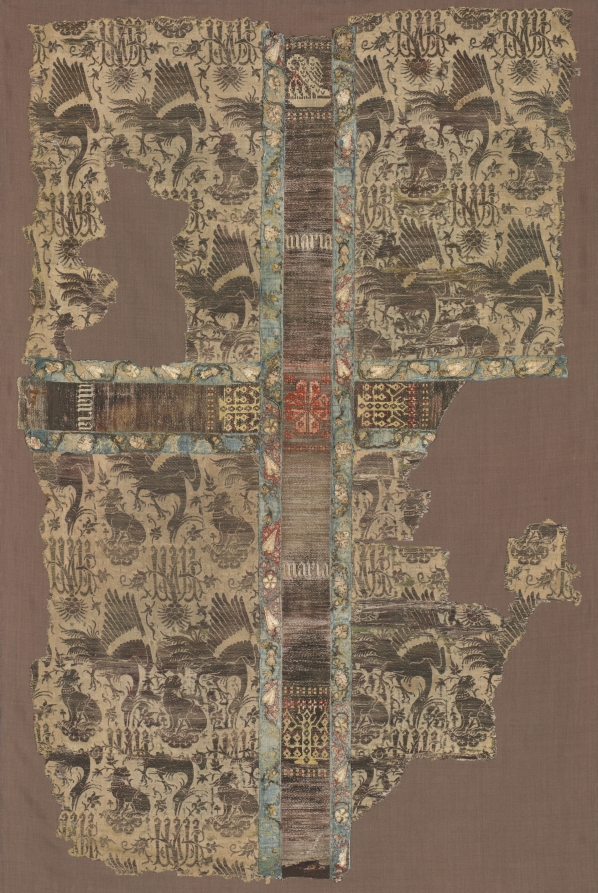
Fragmentary Chasuble with Woven Orphrey Band: A Study in Imperial Silk Weaving
In the hallowed halls of Lauren Fashion Heritage Lab, where the threads of history are meticulously examined and preserved, we encounter a singular artifact: a fragmentary chasuble, its silk ground bearing the weight of centuries, and its woven orphrey band whispering tales of imperial ambition. This is not merely a garment; it is a palimpsest of power, artistry, and the enduring legacy of silk weaving that once commanded the courts of Byzantium, the workshops of Lucca, and the looms of Lyon. As Senior Heritage Specialist, I present this analysis with the precision of a Savile Row tailor and the reverence of a curator, for in this fragment, we discern the very fabric of civilization.
Materiality and Provenance
The chasuble, a liturgical vestment worn by clergy during the Eucharist, survives here in a state of elegant decay. Its materiality—a warp-faced silk compound weave, likely a samite or lampas—speaks to a tradition of luxury that transcended the sacred. The ground silk, now faded to a muted ochre, was once a deep crimson or imperial purple, colors reserved for the highest echelons of church and state. The weave structure, with its intricate binding of warp and weft, suggests a loom of considerable sophistication, possibly from the 14th or 15th century, when Italian silk weaving reached its apogee under the patronage of the Medici and the Papacy.
The orphrey band, a woven strip of ecclesiastical embroidery or brocade, is the artifact’s defining feature. Executed in a compound weave with supplementary wefts of gold thread—likely gilt silver wrapped around a silk core—it depicts a repeating motif of stylized floral vines and heraldic beasts. This is not mere decoration; it is a coded language of authority. The orphrey’s design echoes the silk patterns found in the Liber Pontificalis and the inventories of the Vatican, linking this fragment to a network of imperial and ecclesiastical power that stretched from Constantinople to the courts of Avignon.
The Legacy of Imperial Silk Weaving
To understand this chasuble is to understand the legacy of imperial silk weaving, a craft that was as much about geopolitics as it was about aesthetics. Silk, once a monopoly of China, became a medium of statecraft in the Roman and Byzantine empires. The Officina Textoria of the Byzantine court produced silks that were diplomatic gifts, symbols of sovereignty, and markers of orthodoxy. When Constantinople fell in 1453, the knowledge of sericulture and compound weaving migrated westward, finding fertile ground in Italy. Lucca, Venice, and Florence became the new centers of production, their looms weaving silks that adorned the altars and robes of the Renaissance.
The orphrey band on this chasuble likely originated from one of these Italian workshops. Its gold thread, still lustrous despite centuries of handling, was a material of immense value—a single ounce of gold could be drawn into miles of thread, a testament to the skill of the orafi (goldsmiths) who collaborated with weavers. The design, with its symmetrical vines and mythical creatures, reflects the pomegranate and pinecone motifs that were popular in 14th-century Lucchese silks, themselves inspired by Islamic and Chinese prototypes. This cross-cultural pollination is the hallmark of imperial silk: it was never static, always absorbing and reinterpreting the aesthetics of its trade routes.
Fragmentation as Narrative
The fragmentary state of this chasuble is not a loss but a narrative. The garment has been cut, perhaps repurposed for a smaller vestment or a relic pouch. The edges are frayed, the silk is brittle, and the orphrey band shows signs of wear where it once rested against a celebrant’s shoulders. Yet, this damage is a record of use. The chasuble was not a museum piece; it was a living object, worn in processions, touched by hands, and exposed to the smoke of incense and the light of candles. Each tear and stain is a chapter in its biography.
From a conservation perspective, the fragment offers a rare opportunity to study the construction techniques of medieval silk weaving. The warp-faced weave, with its high thread count (estimated at 60-80 ends per centimeter), indicates a loom of considerable complexity. The orphrey band, woven separately and applied to the chasuble, demonstrates a modular approach to garment construction—a practice that Savile Row tailors would recognize as the foundation of bespoke craftsmanship. The band’s edges are finished with a narrow silk braid, a detail that speaks to the meticulous attention to finish that defined imperial textiles.
Contextualizing the Artifact
This chasuble must be understood within the broader context of liturgical vestments as political statements. In the medieval and early modern periods, the Church was not merely a spiritual institution; it was a temporal power, and its vestments were instruments of authority. A chasuble woven with imperial silks and adorned with gold orphrey was a visual assertion of the Church’s dominion over both the earthly and the divine. The use of silk, a material associated with the East and with luxury, reinforced the Church’s role as a mediator between cultures and a guardian of tradition.
Moreover, the orphrey band’s motifs—floral vines and heraldic beasts—are not arbitrary. The vine, a symbol of Christ’s blood and the Eucharist, connects the garment to its liturgical function. The beasts, often lions or griffins, evoke the power of the Church militant. Together, they create a visual theology that would have been immediately legible to the medieval worshipper. This is the genius of imperial silk weaving: it fused art, faith, and power into a single, wearable object.
Conclusion: The Enduring Thread
As we examine this fragmentary chasuble, we are reminded that heritage is not about preservation alone; it is about interpretation. The legacy of imperial silk weaving lives on in the Lauren Fashion Heritage Lab, where we study these artifacts not as relics but as documents of human ingenuity. The silk, the gold, the weave—they are the enduring thread that connects the looms of Lucca to the ateliers of Savile Row, the courts of Byzantium to the cathedrals of Europe. This chasuble, though fragmentary, is whole in its testimony: it speaks of a world where silk was power, where weaving was art, and where a garment could hold the weight of empire.
In the spirit of London’s finest tailoring, we approach this artifact with a commitment to precision, respect for tradition, and an eye for the details that define excellence. The fragmentary chasuble with its woven orphrey band is not a remnant of the past; it is a blueprint for the future of heritage, a reminder that the threads we weave today are the legacies we leave tomorrow.