The Fragment as Archive: Deconstructing Materiality in a Voided Velvet Brocade
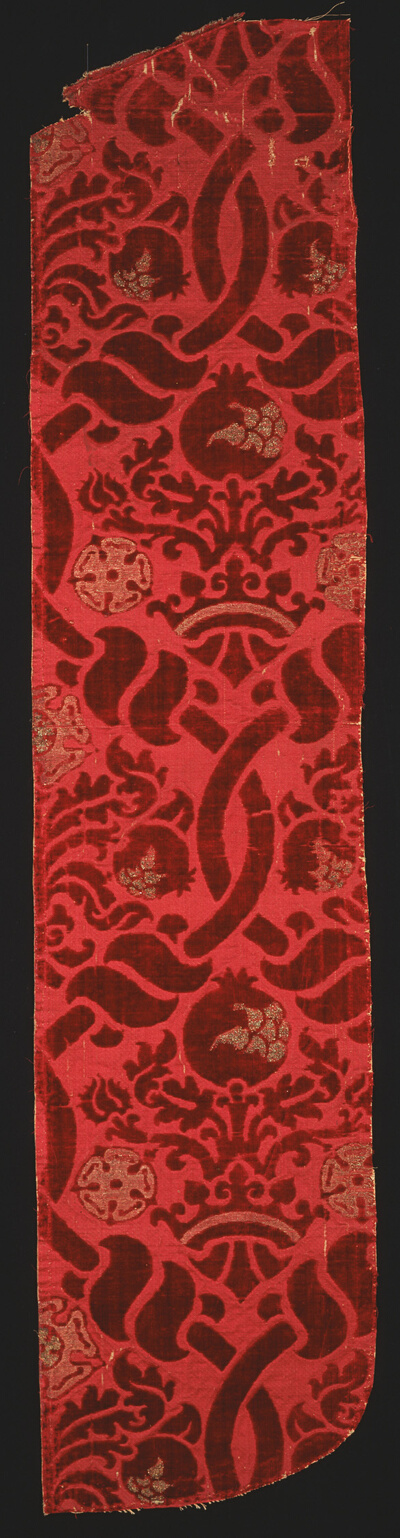
In the hushed ateliers of London’s Savile Row, where tailoring is a liturgy of precision, a fragment of silk is never merely a remnant. It is a condensed biography of technique, a whisper of a lost garment, and a testament to the enduring dialogue between material and maker. The artifact under examination—a fragment composed of silk and gilt-metal-strip-wrapped silk, executed in a satin weave with supplementary brocading wefts forming weft loops in specific areas, and further elevated by supplementary pile warps forming a cut voided velvet—represents a pinnacle of classic silk craftsmanship. It is a study in controlled opulence, where fluid elegance is not accidental but engineered through a complex hierarchy of threads. This paper deconstructs the fragment’s materiality, contextualizing its technical virtuosity within the traditions of luxury textile production and the discerning eye of the heritage connoisseur.
I. The Grammar of the Ground: Satin Weave as Foundation
The foundation of this fragment is a satin weave, a structure historically revered for its ability to maximize lustre. In a satin weave, the warp threads float over multiple wefts before interlacing, creating a smooth, unbroken surface that reflects light with a liquid sheen. This is not a weave of utility; it is a weave of display. The choice of silk for both warp and weft in the ground ensures a consistent, almost glassy finish. The satin ground provides the neutral, luminous stage upon which the more dramatic structural elements—the brocading wefts and the voided velvet—perform. In Savile Row terms, this is the bespoke canvas: impeccable, understated, and demanding of the highest thread count. The fluidity of the satin drape is essential; it allows the fabric to fall with a weightless grace, a quality prized in evening wear and ceremonial garments where movement is part of the aesthetic language.
II. The Gilt-Metal-Strip: Luminosity as Structure
The inclusion of gilt-metal-strip-wrapped silk elevates the fragment from luxury to regalia. This is not a metallic thread in the modern sense of a synthetic lamé; it is a traditional composite. A core of silk filament is tightly wrapped with a thin strip of gilded metal—typically silver gilt or gold leaf adhered to a substrate. The result is a thread that possesses both the tensile strength of metal and the supple hand of silk. In this fragment, these threads are employed as supplementary brocading wefts. They are not integral to the ground weave but are introduced selectively, forming patterns that rise above the satin plane. The weft loops, created by leaving the metal-wrapped thread slightly slack in specific areas, catch and scatter light in a manner that flat weaving cannot. These loops are deliberate imperfections, tiny, shimmering nodules that add a tactile and visual texture—a three-dimensional sparkle that suggests candlelight on a ballroom floor. The technical mastery lies in controlling these loops: too tight, and the effect is lost; too loose, and the fabric snags. This is the hallmark of a master weaver, one who understands that luminosity is a structural property, not an afterthought.
III. The Voided Velvet: Absence as Ornament
Perhaps the most sophisticated element of this fragment is the cut voided velvet. Voided velvet is a technique where the pile—the raised loops of supplementary warp threads—is cut to create a plush surface, but only in designated areas. The “voids” are the ground satin left exposed, creating a deliberate contrast between matte and sheen, between raised and flat. In this artifact, the pile warps are cut, meaning the loops have been severed to produce a soft, dense nap. The velvet areas are rich, almost fur-like in their depth, while the voided sections reveal the satin’s reflective gleam. This interplay is not merely decorative; it is a narrative device. The velvet suggests weight, warmth, and intimacy; the satin suggests lightness, distance, and elegance. The cut pile also introduces a directional quality—the nap catches light differently depending on the angle of viewing, giving the fabric a living, changing surface. In a heritage context, voided velvet of this quality was often reserved for ecclesiastical vestments or royal court dress, where the interplay of light and shadow underscored the wearer’s status. The fragment’s condition—the pile is partially compressed in some areas, the gilt loops show slight tarnish—speaks to a life lived, a garment that has been worn, touched, and admired.
IV. Craftsmanship and the Savile Row Ethos
The Savile Row sensibility is not about ostentation; it is about the quiet authority of impeccable construction. This fragment embodies that ethos. The complexity of its weave—a satin ground, supplementary brocading wefts with loops, and cut voided velvet—requires a loom of exceptional capability and a weaver of extraordinary patience. Each element must be coordinated: the ground weave must be stable enough to support the additional threads, the metal-wrapped wefts must be tensioned precisely to avoid breaking, and the pile warps must be cut with surgical accuracy. The result is a fabric that is both structurally robust and visually ethereal. For the heritage specialist, this fragment is a primary source. It tells us about the technical knowledge of its era—likely late 19th or early 20th century, when such compound weaves were at their zenith. It also speaks to the economic realities: silk, metal thread, and the labor required for voided velvet were prohibitively expensive, placing this fabric in the hands of an elite clientele. The fragment’s survival, even in a partial state, is a small miracle. It is a reminder that heritage is not only about intact garments but also about the fragments that allow us to study the DNA of craftsmanship.
V. Conclusion: The Fragment as a Living Document
This fragment of silk and gilt-metal-strip-wrapped silk, with its satin weave, brocading loops, and cut voided velvet, is more than a textile sample. It is a material archive of a lost world of making. It records the hands of the weaver, the preferences of the patron, and the aesthetic ideals of an age that valued fluid elegance as the highest form of sophistication. In the context of the Lauren Fashion Heritage Lab, this fragment serves as a pedagogical tool, a touchstone for understanding how materiality shapes design. It challenges us to see that luxury is not a surface effect but a deep structural commitment. As we preserve, study, and occasionally restore such fragments, we are not merely conserving the past; we are learning the grammar of excellence that can inform the future of fashion. And in that, there is no fragment too small to hold a world.