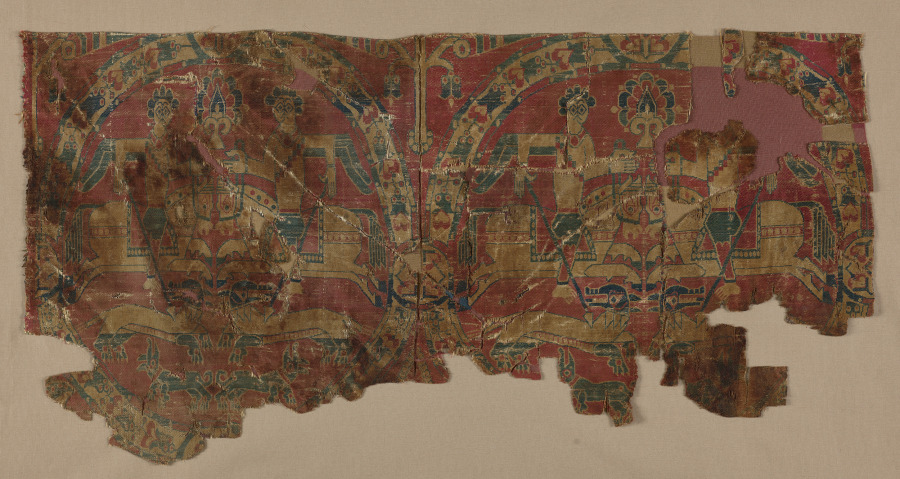
The Enduring Prestige of Silk: A Heritage Artifact Analysis of Roundels with Hunters
In the rarefied atmosphere of London’s Savile Row, where the whisper of a needle against worsted wool is a language of its own, the appreciation for textile heritage transcends mere fashion. It is an acknowledgment of lineage, of craftsmanship that has been honed over centuries, and of materials that carry the weight of empire. Among the most compelling artifacts in this lexicon is the Roundel with Hunters, a silk-woven medallion that serves as a profound testament to the legacy of imperial silk weaving. This artifact, rooted in the opulent courts of the Safavid and Ottoman empires, is not merely a decorative motif; it is a narrative of power, patronage, and the relentless pursuit of perfection in textile artistry. As a Senior Heritage Specialist at the Lauren Fashion Heritage Lab, I present this analysis to illuminate the materiality, cultural significance, and enduring influence of this remarkable silk roundel on contemporary luxury and bespoke tailoring.
Materiality: The Unrivaled Virtue of Silk
The foundation of any heritage artifact lies in its material, and here, silk is sovereign. The Roundel with Hunters is woven from the finest mulberry silk, a fiber that has been synonymous with luxury for millennia. Silk’s inherent properties—its tensile strength, its natural luster, its ability to absorb dye with unparalleled vibrancy—make it the ideal medium for intricate, narrative-driven designs. In the context of imperial weaving, the silk used was often sourced from the Caspian Sea region or from the workshops of Kashan and Isfahan, where silkworms were cultivated with the same care as royal livestock. The thread count in these roundels is astonishingly high, often exceeding 200 threads per inch, allowing for a density of pattern that is both tactile and visual. This is not a fabric that yields to the casual observer; it demands to be studied, its warp and weft revealing the hand of the master weaver.
The roundel itself is a circular composition, typically measuring between 15 to 25 centimeters in diameter, designed to be repeated across a larger textile such as a robe, a ceremonial banner, or a cushion cover. The technique employed is lampas weaving, a complex method where a pattern is woven on a ground weave, often using multiple weft threads to create a raised, almost sculptural effect. In the Roundel with Hunters, the ground is a deep, saturated crimson or sapphire blue, colors derived from cochineal or lapis lazuli, while the hunters and their prey are rendered in gold and silver thread, often wrapped around a silk core. This use of metal thread is not merely decorative; it is a statement of imperial wealth, a reflection of the court’s ability to command resources from across the known world. The gold, often from the mines of Central Asia, was beaten into fine strips and wound around silk, creating a thread that shimmered with a light that seemed to emanate from within the fabric itself.
Iconography: The Hunt as Imperial Metaphor
The imagery within the roundel is as deliberate as the material from which it is made. The hunter, typically depicted on horseback, is a figure of authority and virility, often identified with the Shah or Sultan himself. He is shown in pursuit of lions, deer, or mythical creatures like the simurgh, a giant bird of Persian legend. This is not a simple pastoral scene; it is a visual allegory for the ruler’s role as the protector of the realm, the subduer of chaos, and the arbiter of order. The hunt, in imperial iconography, is a rehearsal for war, a display of martial skill that reinforces the ruler’s legitimacy. The roundel, therefore, is a microcosm of the state: the hunter represents the sovereign, the prey represents the enemies of the empire, and the silk itself represents the wealth and sophistication of the court.
The composition is meticulously balanced. The hunter is central, his horse in mid-gallop, its muscles taut and its mane flowing. The prey is often shown in a moment of vulnerability, its neck arched back in a final, desperate attempt to escape. The background is filled with stylized flora—lotus blossoms, palmettes, and arabesques—that frame the action and tie it to the natural world. This integration of figural and geometric elements is a hallmark of Persian and Ottoman silk design, reflecting a worldview where the divine and the earthly are interwoven. The roundel’s circular form itself is significant: it represents eternity, the cyclical nature of time, and the unbroken lineage of the ruling dynasty. To wear or display such a textile was to align oneself with this eternal order, to claim a place within the imperial narrative.
Legacy: From Imperial Court to Savile Row
The influence of the Roundel with Hunters extends far beyond the courts of the 16th and 17th centuries. As these silks traveled along the Silk Road and into the hands of European merchants, they became objects of fascination and desire. In the 19th century, the revival of interest in historical textiles, driven by the Arts and Crafts movement and the Aesthetic movement, saw these roundels studied and reproduced by firms like Liberty of London and William Morris. The intricate patterns and rich colors were adapted for wallpaper, upholstery, and, crucially, for men’s neckwear and waistcoats. The hunter motif, in particular, resonated with the British aristocracy, who saw in it a reflection of their own sporting traditions—the fox hunt, the deer stalk, the grouse shoot. The silk roundel became a symbol of refined taste, a quiet assertion of cultural capital.
On Savile Row today, the legacy of the Roundel with Hunters is most evident in the bespoke lining of a tailored jacket or the pattern of a silk pocket square. A discerning client, commissioning a three-piece suit from a house like Anderson & Sheppard or Huntsman, might choose a lining woven with a roundel pattern, a subtle nod to the imperial origins of the design. The materiality of silk remains paramount; the hand of the fabric, its weight, and its drape are scrutinized with the same rigor as the cut of the cloth. The roundel’s iconography, too, finds resonance in the equestrian and sporting motifs that adorn many Savile Row creations. The hunter on horseback, rendered in gold thread against a dark silk ground, is as much a statement of personal identity today as it was in the court of Shah Abbas I. It speaks to a lineage of taste, a connection to a heritage that is both global and deeply personal.
Preservation and Interpretation
At the Lauren Fashion Heritage Lab, our mission is to preserve and interpret such artifacts for future generations. The Roundel with Hunters is not a static object; it is a living document of human creativity and ambition. We employ advanced imaging techniques, such as multispectral photography and digital microscopy, to analyze the weave structure and dye composition without damaging the silk. These studies inform our understanding of the trade networks that supplied the raw materials and the technical innovations that made such intricate weaving possible. We also collaborate with contemporary weavers, many of whom work in the historic silk-weaving centers of Como, Italy, and Lyon, France, to revive these patterns for modern use. The roundel’s design, scaled and adapted, can be found in the collections of luxury houses like Hermès and Brunello Cucinelli, a testament to its enduring appeal.
In conclusion, the Roundel with Hunters is far more than a decorative artifact. It is a convergence of material excellence, imperial ambition, and artistic mastery. Its silk threads carry the stories of ancient trade routes, of courtly rituals, and of the human desire to create beauty that transcends time. For those who appreciate the craftsmanship of Savile Row, this roundel is a reminder that true luxury is not about novelty; it is about heritage, about the quiet confidence that comes from wearing a fabric that has been perfected over centuries. It is a legacy that we, as custodians of fashion heritage, are privileged to preserve and to share.