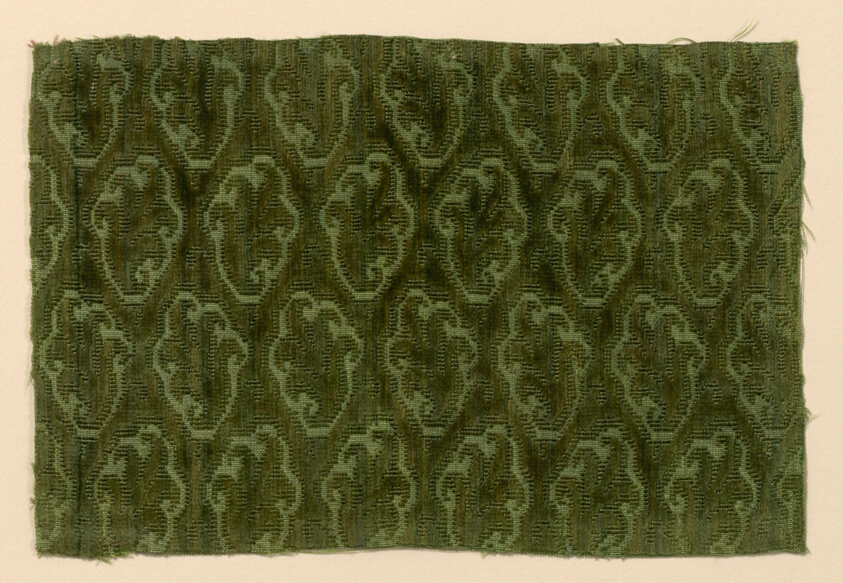
Fragment: A Study in Materiality and the Poetics of Velvet
In the rarefied atmosphere of London’s Savile Row, where cloth is not merely fabric but a testament to lineage and precision, the fragment under examination—a piece of silk, plain weave with supplementary pile warps forming cut, uncut, and voided velvet—demands a scholarly gaze that transcends the merely decorative. This is not a remnant of a forgotten garment; it is a material artifact that encodes centuries of craftsmanship, a dialogue between hand and loom, and a philosophy of elegance that defines the very essence of bespoke luxury. As Senior Heritage Specialist for the Lauren Fashion Heritage Lab, I present this analysis as a meditation on the interplay of structure, texture, and heritage, framed within the lexicon of Savile Row’s exacting standards.
The Architecture of the Fragment: Weave and Pile
At its core, this fragment is a study in structural complexity. The base—a plain weave of silk—provides a foundation of understated strength. Silk, with its natural luster and tensile resilience, has been the chosen medium of luxury for millennia, from the Han dynasty to the ateliers of Mayfair. Yet, it is the supplementary pile warps that elevate this fragment from simple textile to a work of art. The technique of velvet weaving, where additional warp threads are raised to form loops (uncut velvet) or sliced to create a plush surface (cut velvet), introduces a tactile dichotomy: the smooth, reflective ground versus the dense, absorbent pile. The voided areas—where the pile is absent, revealing the plain weave—offer a rhythmic pause, a negative space that accentuates the interplay of light and shadow. This is not mere decoration; it is a choreography of surface, a testament to the weaver’s mastery over tension, density, and timing.
In the context of Savile Row, such a fabric would be reserved for the most discerning clientele—a waistcoat lining, a cravat, or a panel in a bespoke evening jacket. The velvet’s pile, whether cut or uncut, creates a depth that catches the eye without shouting. It whispers of restrained opulence, a hallmark of the Row’s philosophy: elegance is not about abundance but about the judicious use of the extraordinary.
Classic Silk Craftsmanship: The Loom as a Legacy
The production of this fragment is rooted in a tradition that predates the Industrial Revolution. The supplementary pile warps require a drawloom or, in later iterations, a Jacquard mechanism, where each warp thread is individually controlled. This is a labor-intensive process, demanding a weaver’s intuition for tension and a deep understanding of silk’s behavior. The silk itself must be degummed, dyed, and wound with precision; any irregularity in the yarn would disrupt the pile’s uniformity. Historically, such velvets were produced in centers like Lyon, Genoa, and Venice, where guilds guarded their techniques as state secrets. The fragment, likely dating from the 18th or 19th century, embodies this legacy. Its colors—perhaps a deep burgundy, a midnight blue, or an ivory—would have been achieved through natural dyes, each hue a product of meticulous extraction and mordanting.
For the modern bespoke tailor, this fragment is a pedagogical tool. It teaches the value of patience: the weaver’s time, the dyer’s art, and the cutter’s skill in aligning the pile to catch light uniformly. On Savile Row, where a single suit may require 80 hours of handwork, this fragment reminds us that true luxury is not mass-produced but cultivated.
Fluid Elegance: The Aesthetic of Movement
The term “fluid elegance” is often overused in fashion discourse, yet here it finds its truest expression. The velvet’s pile, whether cut or uncut, responds to movement with a liquid quality. As the wearer turns, the light shifts across the surface, revealing the voided areas as dark, recessed channels. This is not a static fabric; it is a dynamic participant in the garment’s life. The plain weave ground provides a subtle drape, while the pile adds weight and a tactile softness that invites touch. In a Savile Row context, this fluidity is essential for garments that must move with the body—a dinner jacket’s lapel, a smoking jacket’s collar, or a scarf that cascades with deliberate nonchalance.
The fragment’s elegance lies in its balance. The cut velvet offers a plush, almost velvety sheen, while the uncut loops create a matte, textured surface. The voided areas introduce a graphic element, a pattern that emerges from the absence of pile. This interplay is reminiscent of the chiaroscuro in painting—a play of light and dark that gives depth to the flat plane. For the connoisseur, this is not a fabric to be worn lightly; it is a statement of refined taste, a nod to the historical opulence of Renaissance courts and the understated luxury of Edwardian gentlemen.
Heritage and Preservation: The Fragment as a Living Document
As a heritage artifact, this fragment is a primary source for understanding the evolution of textile technology and aesthetic preferences. Its condition—the wear on the pile, the fading of dyes, the slight distortion of the weave—tells a story of use and care. Perhaps it was part of a ceremonial garment, a gift, or a sample book. The voided areas may have formed a floral or geometric pattern, now obscured by time. In the Lauren Fashion Heritage Lab, we treat such fragments as archaeological evidence, analyzing fiber composition, dye chemistry, and weave structure to reconstruct their provenance. This work is not merely academic; it informs contemporary design, offering a vocabulary of texture and technique that can be reinterpreted for modern audiences.
For Savile Row, the fragment is a touchstone. It reminds us that the Row’s reputation is built on a foundation of historical knowledge. The bespoke tailor who understands velvet’s pile direction, the cutter who respects the fabric’s memory, the client who appreciates the weight of heritage—all are part of a continuum that this fragment embodies. To wear such a fabric is to participate in history, to carry forward a tradition of excellence that is both personal and universal.
Conclusion: The Fragment as a Whole
In conclusion, this fragment of silk velvet is far more than a remnant. It is a microcosm of craftsmanship, a testament to the human hand’s ability to transform raw material into an object of profound beauty. Its materiality—the interplay of plain weave and supplementary pile, the cut and uncut loops, the voided spaces—speaks to a philosophy of elegance that is both fluid and structured, opulent and restrained. On Savile Row, where every stitch is a decision, this fragment serves as a reminder that true luxury is not about excess but about intention. It is a legacy we are privileged to study, preserve, and, when the occasion demands, to wear.