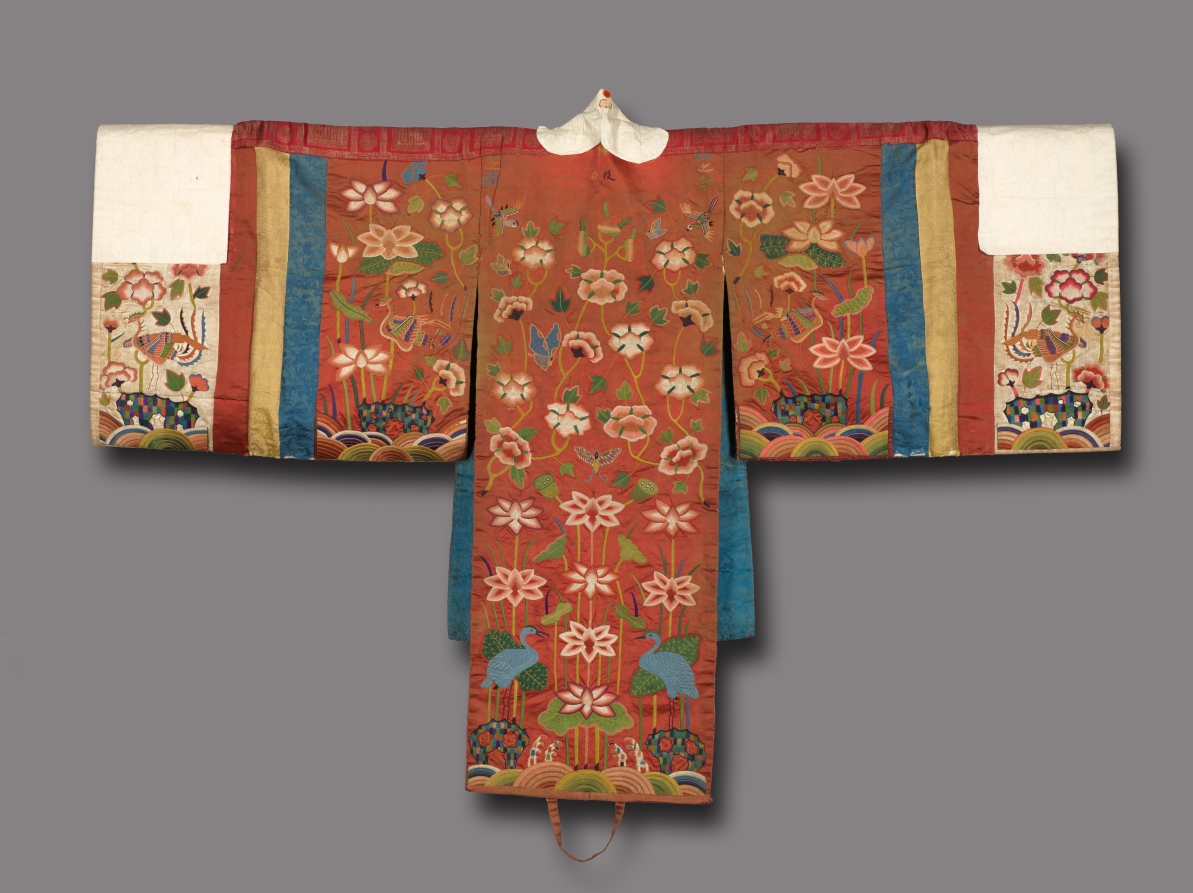
The Hwarot: A Confluence of Imperial Craft and Bridal Sovereignty
In the hushed ateliers of London’s Savile Row, where the cut of a suit is a declaration of character and the drape of a fabric a testament to lineage, we rarely pause to consider the parallel traditions of the East. Yet, the Hwarot—the ceremonial bridal robe of the Joseon Dynasty—demands our attention. It is not merely a garment; it is a heritage artifact of profound materiality, a woven archive of imperial silk weaving that speaks to a legacy of power, protection, and the artistry of a civilization. As a Senior Heritage Specialist at the Lauren Fashion Heritage Lab, I present this artifact as a case study in how materiality—specifically, the legacy of imperial silk—transcends fashion to become a narrative of cultural identity.
Materiality: The Silk of Empires
The Hwarot is constructed from silk, but not the silk of common trade. This is imperial silk, a fabric whose production was a state secret, a monopoly of the royal court. The silkworms were fed on mulberry leaves from designated groves, and the threads were reeled with a precision that bordered on the sacred. The resulting fabric—a damask or satin weave—possesses a weight, a luster, and a resilience that modern textiles cannot replicate. The materiality of this silk is not just tactile; it is political. It announces the wearer’s proximity to the throne, her role as a vessel of dynastic continuity. In the context of the Lauren Fashion Heritage Lab, we consider how such a fabric, when handled, retains the memory of the weaver’s hand, the court’s decree, and the bride’s trembling anticipation.
Context: The Legacy of Imperial Silk Weaving
The legacy of imperial silk weaving in Korea is a lineage of artisanal mastery that stretches back to the Three Kingdoms period (57 BCE – 668 CE). By the Joseon era (1392–1910), the Royal Silk Bureau (Sangbang) oversaw every stage of production, from silkworm cultivation to the final embroidery. The Hwarot, as a bridal robe, was the pinnacle of this craft. It was not a garment for everyday wear; it was a ritual object, worn only once, during the pye-baek ceremony, where the bride greets her new family. The robe’s construction involved months of labor by master weavers and embroiderers, often working in the Gyeongbokgung Palace workshops. The silk itself was dyed with natural pigments—cinnabar for red, indigo for blue, safflower for yellow—each hue carrying symbolic weight. Red, the dominant color, signified yang energy, prosperity, and the warding off of evil spirits. The legacy of this weaving is not merely technical; it is a philosophy of material as message.
Design and Symbolism: The Language of the Robe
From a Savile Row perspective, we appreciate the Hwarot’s construction as a study in balance and proportion. The robe is typically a full-length, front-opening garment with wide sleeves that taper at the wrist. The silhouette is voluminous, designed to envelop the bride in a cocoon of auspicious imagery. The embroidery is not decorative; it is a lexicon. Key motifs include:
- Pomegranates and Peonies: Symbolizing fertility, wealth, and marital bliss.
- Bats and Clouds: Representing good fortune and the celestial realm.
- Phoenixes and Dragons: The phoenix, a symbol of the empress, and the dragon, of the emperor, together signify the union of yin and yang, the bride and groom as a cosmic pair.
- Ten Symbols of Longevity: Including the sun, mountains, water, clouds, pine trees, and turtles, these motifs invoke a life of enduring health and happiness.
The embroidery technique—often gold-wrapped thread on silk—is a hallmark of imperial craftsmanship. Each stitch is a prayer, a wish, a seal of approval from the court. The materiality of the gold thread, interwoven with the silk, creates a surface that catches light in a way that suggests the divine. In the context of the Lauren Fashion Heritage Lab, we analyze how these motifs are not static; they are a visual language that the bride and her family would have read as fluently as a royal decree.
Cultural and Historical Significance
The Hwarot is a cultural artifact that bridges the personal and the political. For the bride, it was a garment of transformation—from daughter to wife, from subject to potential mother of future leaders. For the court, it was a diplomatic tool, a display of the kingdom’s wealth and artistic prowess. The legacy of imperial silk weaving is evident in the robe’s durability. Many Hwarots survive in museums today, their colors still vibrant, their gold thread still gleaming. This is not accidental; the silk was woven to last centuries, a metaphor for the dynasty itself. In the context of the Lauren Fashion Heritage Lab, we consider how this artifact challenges the modern notion of fashion as disposable. The Hwarot is slow fashion in its most extreme form—a garment that takes a year to make, worn for a day, and preserved for eternity.
Preservation and Interpretation
As a heritage specialist, I approach the Hwarot with the same rigor as a Savile Row cutter approaches a bolt of tweed. Preservation requires understanding the silk’s material vulnerabilities—its sensitivity to light, humidity, and handling. The gold thread is particularly fragile; the metal can tarnish and the silk core can disintegrate. At the Lauren Fashion Heritage Lab, we employ conservation techniques that honor the original craftsmanship while ensuring the artifact’s survival for future study. This includes climate-controlled storage, minimal handling, and digital documentation using high-resolution imaging to capture the embroidery’s detail.
Interpretation is equally critical. The Hwarot is not a costume; it is a primary source for understanding Joseon society. When we exhibit it, we must contextualize its materiality—explain the silk’s origin, the weaver’s skill, the dye’s symbolism. We must also address the colonial legacy of Korean artifacts, many of which were taken during the Japanese occupation (1910–1945). The Hwarot’s journey from a Korean palace to a Western museum or lab is a story of power, loss, and restitution. In the context of the Lauren Fashion Heritage Lab, we are committed to ethical stewardship, working with Korean scholars and institutions to ensure that the artifact’s narrative is told with accuracy and respect.
Conclusion: The Hwarot as a Universal Lesson
The Hwarot is a masterclass in the power of materiality. Its silk is not just a fiber; it is a document of imperial ambition, artisanal devotion, and cultural identity. For the Lauren Fashion Heritage Lab, it serves as a reminder that fashion is never trivial. Every stitch, every thread, every dye carries the weight of history. In the tradition of Savile Row, where we honor the bespoke as the highest form of craft, the Hwarot stands as a peer—a garment that was made for one person, one moment, and yet speaks to all of humanity. Its legacy is not merely in the silk, but in the story it tells: of a bride, a dynasty, and a civilization that wove its soul into cloth.
— Senior Heritage Specialist, Lauren Fashion Heritage Lab