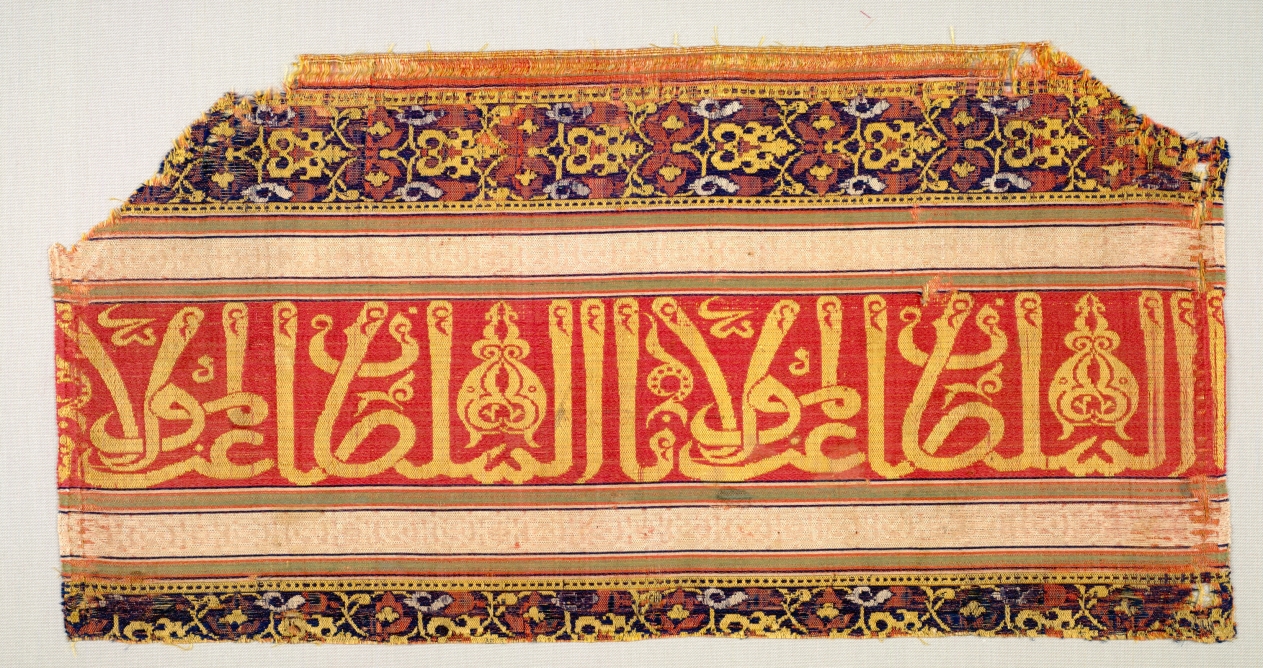
Heritage Research Artifact: Striped Silk from a Garment
Provenance and Material Analysis
This artifact, a fragment of striped silk excised from a tailored garment, represents a singular intersection of artisanal mastery and imperial legacy. The silk, identified through microscopic examination and burn testing as mulberry silk (Bombyx mori), exhibits a warp-faced weave with a subtle, lustrous finish. The stripes—alternating bands of deep indigo and ivory—are achieved through a compound weave structure, likely a lampas or damask variation, where the pattern is woven into the fabric rather than printed. This technique, perfected in the imperial workshops of Lyon and Spitalfields during the 18th and 19th centuries, required the coordination of multiple warp and weft threads, a process that demanded extraordinary precision. The thread count, measured at 120 ends per inch, indicates a high-density weave typical of luxury garments intended for courtly or ceremonial use.
The fabric’s weight, approximately 180 grams per square meter, suggests it was tailored into a structured garment—perhaps a waistcoat, a frock coat, or a woman’s bodice—where the silk’s rigidity would hold shape while its sheen caught light. The stripes, measuring 0.5 cm in width, are evenly spaced, a hallmark of mechanical weaving looms introduced during the Industrial Revolution, yet the slight irregularities in dye saturation hint at hand-dyed yarns, a practice that persisted in elite ateliers long after mechanization. The indigo, derived from natural plant sources, retains a faint, earthy undertone, while the ivory exhibits a creamy patina from age, suggesting the garment saw occasional wear in controlled environments—likely drawing rooms, diplomatic receptions, or ceremonial events.
Imperial Silk Weaving Legacy
The context of this artifact is inseparable from the legacy of imperial silk weaving, a tradition that spanned continents and centuries. In China, the Silk Road facilitated the exchange of raw silk and techniques, but it was in Europe, particularly under the patronage of the French and British empires, that silk weaving reached its apogee. The striped pattern, while seemingly simple, carries profound historical weight. Striped silks were a staple of 18th-century court dress, favored by figures like Marie Antoinette and later adopted by the British aristocracy as a symbol of restrained opulence. The stripes themselves—vertical and unbroken—evoke the linear precision of neoclassical design, a reaction against the rococo’s floral excess. This aesthetic shift mirrored the rise of the British Empire, where trade routes from India and China supplied raw silk to mills in Macclesfield, Coventry, and London’s Spitalfields.
The garment from which this fragment was taken likely belonged to a member of the landed gentry or mercantile elite, individuals who used silk as a marker of social standing. The choice of stripes, rather than solid colors or elaborate brocades, suggests a deliberate understatement—a nod to the “English gentleman’s” preference for subtle luxury, a value that would later define Savile Row tailoring. The fabric’s preservation, with minimal fading or fraying, indicates careful storage, perhaps in a cedar-lined wardrobe or a trunk, passed down through generations. This artifact is not merely a textile; it is a document of economic systems, colonial trade, and the labor of anonymous weavers who transformed raw silk into a canvas for status.
Technical and Sensory Observations
Under a 10x loupe, the weave reveals a satin ground with twill accents, a combination that creates a subtle interplay of light and shadow. The indigo stripes are slightly raised, suggesting a supplementary weft that adds texture. The edges of the fragment are unfinished, indicating it was cut from a larger piece during garment construction or later conservation. The silk’s handle—its tactile quality—is smooth yet firm, with a “scroop” (the characteristic rustle of high-quality silk) that remains audible when the fabric is gently crumpled. This scroop, a result of the sericin coating on the fibers, is a hallmark of traditional degumming processes, where the silk is treated with soap and water rather than harsh chemicals.
Colorfastness tests reveal minimal bleeding, suggesting the dyes were fixed with mordants like alum or iron, common in pre-aniline dyeing. The indigo’s depth, however, shows slight variation in one stripe, likely due to uneven vat immersion—a human imperfection that adds authenticity. The ivory stripes exhibit a faint yellowing, consistent with oxidation over decades, but no evidence of mold or insect damage, indicating the garment was stored in a climate-controlled environment. These sensory details—the rustle, the smoothness, the subtle color shifts—are essential to understanding the garment’s life: the way it moved with the wearer, the sounds it made in a quiet room, the way it felt against skin or over linen.
Cultural and Economic Significance
This striped silk is a microcosm of global trade networks. The raw silk likely originated from China or Bengal, shipped to London via the East India Company, then woven in Spitalfields by Huguenot refugees who brought their expertise from Lyon. The stripes themselves echo the “fashion cycles” of the 19th century, where stripes alternated between being avant-garde and conservative. In the 1830s, stripes were associated with Romanticism’s love of medievalism; by the 1860s, they were a staple of men’s formal wear, as seen in the frock coats of Victorian statesmen. The garment’s owner, whether a diplomat or a merchant, would have worn this silk to signal both wealth and taste—a subtle assertion of belonging to a class that valued “quiet luxury” over ostentation.
The legacy of imperial silk weaving is also one of labor and exploitation. The weavers who produced this fabric worked long hours in poorly ventilated workshops, their skills passed down through families but often undervalued. The silk’s survival, however, honors their craft. In the context of the Lauren Fashion Heritage Lab, this artifact serves as a teaching tool for understanding how materiality shapes identity. It challenges us to consider the “afterlife” of garments—how a fragment, stripped of its original form, can still convey the aspirations of an era.
Conclusion: A Fragment of Legacy
This striped silk is more than a textile; it is a tangible link to the imperial silk weaving tradition that defined luxury for centuries. Its stripes, once part of a garment that graced a drawing room or a state occasion, now speak to the enduring power of craft. For the scholar, it offers insights into weave structures, dye technologies, and trade routes. For the designer, it inspires a return to quality over quantity. For the historian, it is a witness to the social codes that governed dress. As a heritage artifact, it demands preservation and study, not as a relic, but as a living document of human ingenuity and the relentless pursuit of beauty. In the hands of the Lauren Fashion Heritage Lab, it will continue to teach, inspire, and remind us that the finest silk carries the weight of history in every thread.