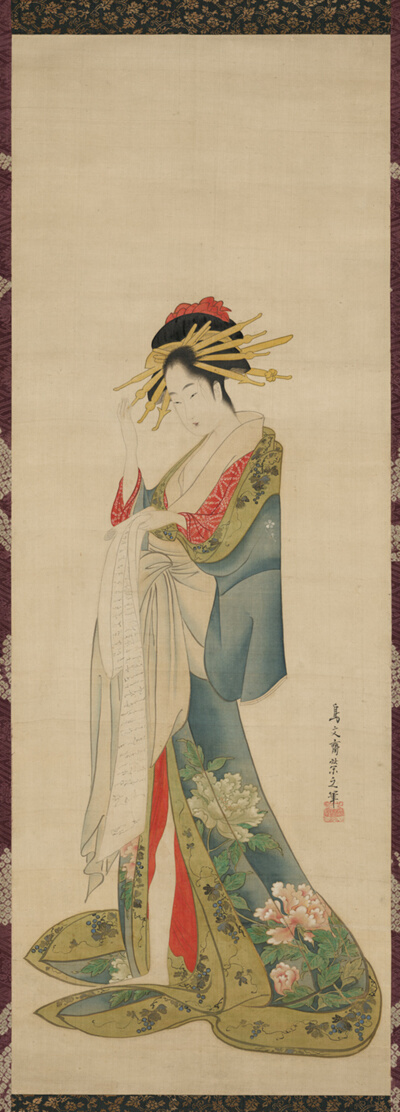
A Courtesan Reading a Letter: A Study in Materiality and Narrative
In the hushed, discerning corridors of Lauren Fashion Heritage Lab, we examine artifacts not merely as objects of aesthetic delight, but as repositories of cultural intelligence. The hanging scroll, A Courtesan Reading a Letter, executed in ink and color on silk, presents a singular opportunity to decode the interplay between materiality, narrative, and the craft of luxury. This piece, rooted in the classic silk craftsmanship of East Asia, speaks a language of fluid elegance that resonates profoundly with the principles of Savile Row: precision, heritage, and an unspoken dialogue between the maker and the wearer.
The Silk Substrate: A Foundation of Prestige
Silk is not merely a medium; it is a protagonist in this composition. The choice of silk as the ground for ink and color is a deliberate assertion of status and sensitivity. In the context of the scroll’s creation—likely during the Ming or Qing dynasties—silk was a material of immense value, reserved for the highest echelons of society. Its lustrous, yet subtly matte surface, achieved through meticulous degumming and weaving, offers a unique receptivity to pigment. Unlike paper, which absorbs ink with a porous immediacy, silk demands a lighter, more controlled hand. The brush must dance across the warp and weft, allowing the ink to settle in a delicate, almost translucent veil. This technical constraint elevates the artist’s skill, mirroring the restraint required of a Savile Row tailor who works with a bolt of super 150s wool: every stitch is a commitment, every line a legacy.
The materiality of the silk itself—its weight, its drape, its ability to hold color without bleeding—creates a visual texture that is both intimate and expansive. In A Courtesan Reading a Letter, the silk’s natural sheen catches the light, imbuing the courtesan’s robes with a subtle luminosity. The reds and golds of her attire are not flat; they shimmer with a depth that suggests the fabric of her life—layered, opulent, and fleeting. This is not a passive background. The silk is an active participant, a silent collaborator in the storytelling.
Fluid Elegance: The Craft of the Brush
The term fluid elegance is often invoked in discussions of East Asian painting, but in this scroll, it takes on a precise, almost architectural quality. The courtesan is depicted in a moment of quiet absorption: her head tilted, her fingers lightly holding the letter, her gaze downward. The lines of her silhouette are rendered with a single, continuous stroke of the brush—a technique known as gongbi, or meticulous painting. Yet, there is no rigidity. The ink flows from the tip, varying in thickness and pressure, creating a rhythm that mimics the breath of the viewer. This is the same principle that governs the cut of a bespoke jacket: the line must follow the body’s natural movement, not constrain it.
The letter itself is a focal point of tension. It is a rectangle of white silk within the scroll, a void of negative space that draws the eye. The courtesan’s expression is ambiguous—is she reading a lover’s confession, a business directive, or a summons? The artist leaves this unresolved, allowing the materiality of the ink and silk to carry the emotional weight. The folds of her robe, painted with washes of color that bleed into the silk, suggest a life of leisure, yet the slight furrow of her brow hints at a deeper narrative. This is the essence of Savile Row storytelling: the garment—or in this case, the painting—must whisper, not shout.
Classic Silk Craftsmanship: A Lexicon of Luxury
The production of a hanging scroll of this caliber required a mastery of silk craftsmanship that is now nearly lost. The silk was hand-reeled from the cocoons of Bombyx mori, then woven on a drawloom by artisans who could control the density of the threads. The result is a fabric that is both strong and supple, capable of withstanding the tension of being rolled and unrolled over centuries. The mounting—the silk borders that frame the painting—is equally significant. In this scroll, the mounting is a deep, muted indigo, a color chosen to complement the courtesan’s robes without competing. The choice of mounting silk is a silent negotiation between the artwork and its environment, much like the lining of a bespoke suit—a private luxury known only to the wearer.
The ink, ground from soot and animal glue, and the pigments, derived from minerals and plants, were applied in layers. The courtesan’s skin, for instance, is built from a base of white lead and a whisper of peach, overlaid with a wash of transparent red at the cheeks. This technique, called mogu or “boneless” painting, creates a sense of volume without hard outlines. It is a lesson in restraint: the artist knows that the silk will do half the work, reflecting light in a way that mimics the translucency of human flesh. This is the same philosophy that guides a tailor’s choice of a lightweight worsted wool for a summer jacket—the fabric breathes, moves, and reveals its quality over time.
Narrative and the Art of the Unspoken
What makes A Courtesan Reading a Letter a heritage artifact of enduring relevance is its narrative economy. The scene is static, yet charged with potential. The courtesan is a figure of luxury, but her role in society is ambiguous—she is both an object of desire and a subject of agency. The letter, a private communication, disrupts the public performance of her life. This tension between interiority and exteriority is a hallmark of fine craftsmanship. In Savile Row, a garment is never just a garment; it is a statement of identity, a negotiation between the wearer’s inner world and the outer gaze. The courtesan’s silk robes, her posture, the letter in her hand—all are elements of a carefully constructed persona.
The scroll’s format—a hanging scroll meant for display in a scholar’s studio or a merchant’s home—further underscores this interplay. It is an object of private contemplation, yet it is also a public declaration of taste. The viewer is invited to step into the scene, to imagine the contents of the letter, to feel the weight of the silk in their hands. This is the same invitation extended by a bespoke suit: to inhabit a garment that has been crafted with your specific proportions and desires in mind.
Conclusion: A Legacy of Material Intelligence
A Courtesan Reading a Letter is not merely a painting; it is a testament to the power of materiality in storytelling. The silk, the ink, the color, the brushwork—each element is a thread in a larger narrative of luxury, craft, and human emotion. For the Lauren Fashion Heritage Lab, this artifact serves as a reminder that the most profound expressions of elegance are often the most restrained. In the hands of a master, silk becomes a language, and a courtesan’s letter becomes a mirror of the soul. This is the heritage we preserve: not just objects, but the wisdom of how to make the material world speak.