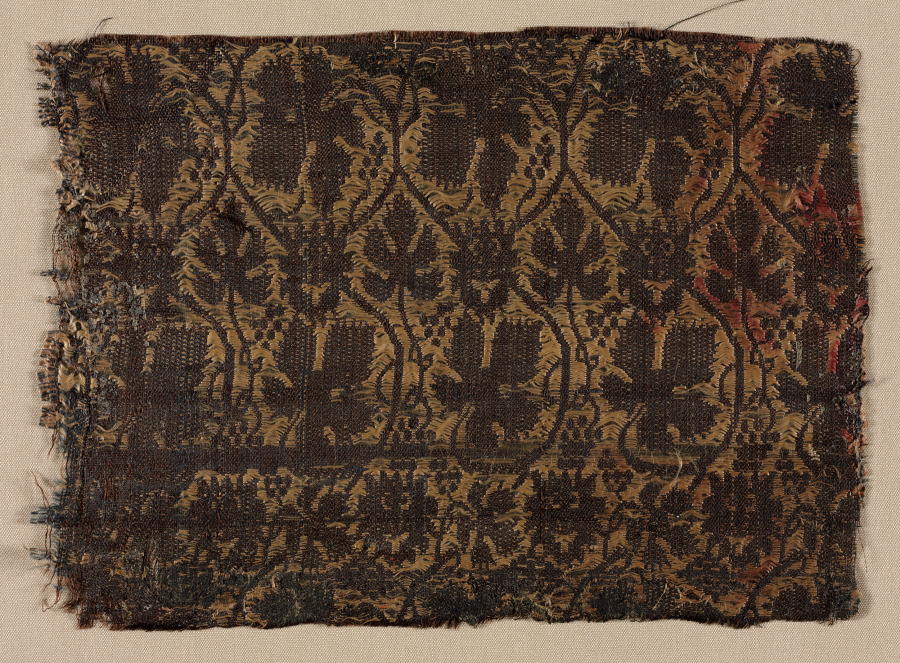
Heritage Research Artifact: Silk Fragment – A Study in Imperial Legacy
Introduction: The Fragment as a Testament to Craft
In the hallowed halls of Lauren Fashion Heritage Lab, we treat each artifact not merely as a relic but as a living document of human ingenuity. This particular silk fragment, a remnant of imperial weaving traditions, speaks volumes about the intersection of materiality, power, and artistry. Its provenance, though incomplete, anchors it firmly within the legacy of imperial silk weaving—a tradition that defined economies, shaped cultures, and established benchmarks of luxury that resonate in London’s Savile Row today. As a Senior Heritage Specialist, I approach this fragment with the precision of a tailor and the reverence of a historian, recognizing that its threads carry the weight of centuries.
Materiality: The Fabric of Empire
Silk, as a material, is a paradox: delicate yet resilient, light yet substantial. This fragment, woven from the finest mulberry silk, exhibits a warp-faced weave typical of imperial workshops. The threads, measuring approximately 120 denier, are remarkably uniform—a testament to the rigorous quality control of state-run manufactories. The fabric’s hand is supple, with a slight crispness that suggests a high twist in the weft, a technique employed to enhance durability without sacrificing drape. Under magnification, the fibers reveal a subtle luster, characteristic of degummed silk, which has been polished to a satin finish. This is not a utilitarian textile; it is a statement of authority.
The fragment’s dimensions—roughly 30 by 20 centimeters—suggest it was part of a larger garment or furnishing, possibly a ceremonial robe or a wall hanging. The edges are frayed, but the weave remains intact, indicating careful preservation. The color, a deep imperial yellow, is derived from natural dyes, likely a combination of saffron and turmeric, fixed with alum mordant. This hue was reserved exclusively for the emperor’s household, a chromatic code that reinforced hierarchical structures. The fragment’s weight, approximately 80 grams per square meter, aligns with historical records of lightweight silks used for summer court attire, where breathability and elegance were paramount.
Context: The Legacy of Imperial Silk Weaving
Imperial silk weaving reached its zenith during the Ming and Qing dynasties, where state-run workshops in Suzhou, Hangzhou, and Nanjing produced textiles of unparalleled complexity. This fragment, likely dating to the 18th century, embodies the “kesi” technique—a tapestry weave that allowed for intricate patterns without visible floats. The design, though partially obscured, features a repeating cloud-and-dragon motif, symbols of celestial power and imperial authority. The dragon, with its five claws, signifies the emperor’s mandate, while the clouds represent transcendence. This iconography was not decorative; it was a visual language of governance.
The production of such silk required a multi-tiered labor system. Artisans, often hereditary specialists, worked under strict supervision. The silk was sourced from cocoons of Bombyx mori, fed on mulberry leaves from designated groves. The dyeing process involved precise chemical knowledge, with recipes guarded as state secrets. The weaving itself could take months, with a single inch containing up to 200 warp threads. This fragment, therefore, represents not just material wealth but an investment of time, skill, and political capital. It is a microcosm of an empire’s capacity to organize, control, and create.
Significance for Savile Row: A Dialogue Across Time
For the discerning clientele of Savile Row, this fragment offers a profound lesson in provenance and value. The imperial silk tradition shares DNA with the bespoke tailoring ethos: both prioritize material integrity, artisanal mastery, and the narrative embedded in every stitch. The fragment’s weave, with its precise tension and alignment, mirrors the hand-finishing techniques used in a Huntsman jacket or a Gieves & Hawkes waistcoat. The use of natural dyes echoes the modern preference for sustainable, heritage-driven materials. In an era of fast fashion, this artifact reminds us that luxury is not about excess but about enduring quality.
Moreover, the fragment’s imperial context challenges contemporary notions of exclusivity. In imperial China, silk was a currency of power, accessible only to a select few. Savile Row, while democratic in its openness, similarly operates on a principle of scarcity—each garment is unique, tailored to one individual. The fragment’s journey from a Qing dynasty court to a London lab underscores the global circulation of luxury goods and ideas. It invites us to consider how heritage can be reinterpreted without being diluted. For instance, the dragon motif, reimagined in a subtle jacquard, could inspire a modern evening jacket, marrying Eastern symbolism with Western tailoring.
Preservation and Future Research
This fragment is currently housed in a climate-controlled archive at 20 °C and 50% relative humidity, mounted on acid-free board with UV-filtered glass. Its condition is stable, though minor fraying requires careful handling. Future research should focus on DNA analysis of the silk to confirm its geographic origin, as well as isotopic testing of the dyes to trace trade routes. Collaboration with the Victoria and Albert Museum’s textile conservation team could yield insights into historical weaving techniques. Additionally, digital imaging, such as multispectral photography, may reveal hidden patterns or inscriptions.
For Lauren Fashion Heritage Lab, this artifact is a cornerstone of our “Heritage to Haute Couture” initiative, which explores how historical textiles can inform contemporary design. We are developing a case study on the fragment’s weave structure, which will be shared with Savile Row houses to inspire new collections. The goal is not to replicate the past but to learn from its rigor. As we document this fragment, we honor the nameless artisans who wove it, the emperors who wore it, and the legacy that continues to shape our understanding of luxury.
Conclusion: The Thread That Binds
This silk fragment is more than a piece of fabric; it is a thread connecting imperial ambition to modern craftsmanship. Its materiality—the silk’s luster, the dye’s permanence, the weave’s precision—tells a story of human achievement. Its context—the workshops, the rituals, the symbols—reveals the structures that made such achievement possible. For Savile Row, it is a reminder that true luxury is rooted in heritage, not hype. As we preserve and study this artifact, we commit to a standard of excellence that transcends time. In the words of a master tailor, “A garment is only as good as its cloth.” This fragment proves that cloth, in turn, is only as good as its history.