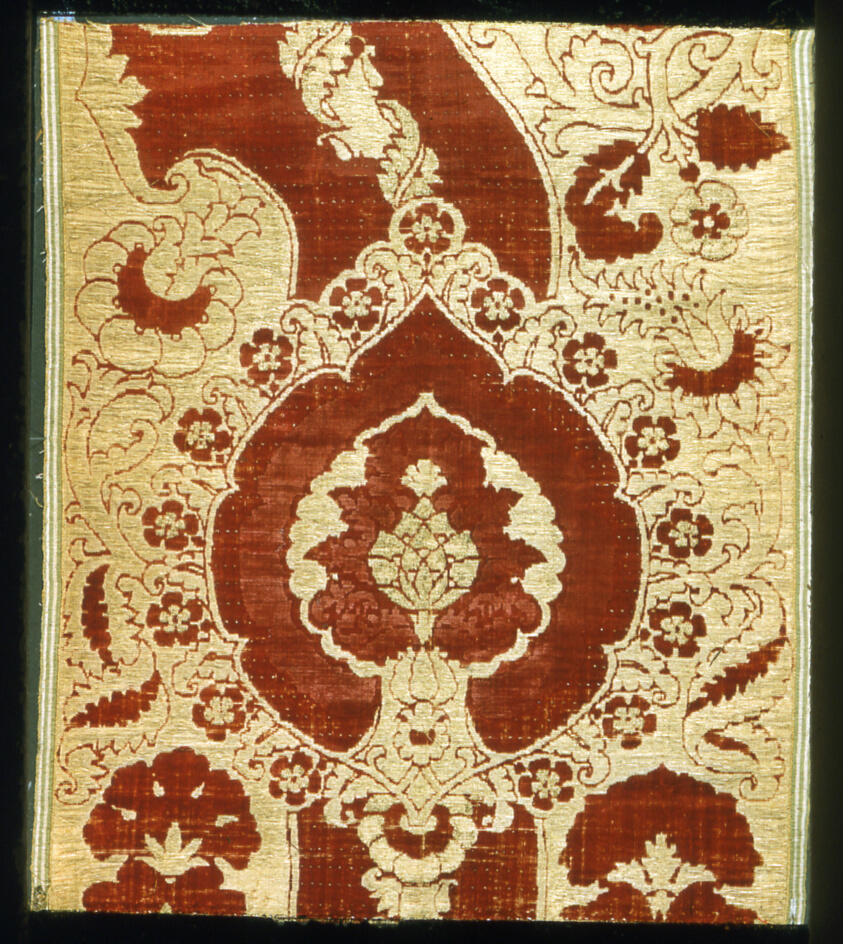
The Panel as a Testament to Mastery: Deconstructing a Voided Velvet with Gilt-Metal Accents
Introduction: The Artifact in Context
Within the hallowed archives of the Lauren Fashion Heritage Lab, this panel stands as a singular artifact—a silent dialogue between the rigorous geometry of Savile Row tailoring and the opulent, almost painterly traditions of historic silk weaving. At first glance, it presents as a study in restrained luxury: a panel of silk, plain weave variation, whose true complexity is revealed only upon close, scholarly inspection. This is not merely fabric; it is a constructed narrative of materiality, technique, and cultural aspiration.
The panel’s physical dimensions—approximately 60 cm by 45 cm—suggest it was intended as a component of a larger garment, likely a waistcoat or a formal evening jacket, where such a textile would serve as a focal point of quiet, discerning power. Its condition, preserved with the meticulous care expected of a heritage piece, retains the crispness of its original weave, the lustre of its metallic threads, and the tactile memory of a workshop where precision was non-negotiable.
Materiality: The Silk Foundation and Its Variations
The base of this panel is a plain weave variation, a structure that provides a stable, unassuming ground for the more dramatic interventions of pile and metallic thread. The silk itself is of exceptional quality—a long-staple, degummed filament that yields a subtle, natural sheen. This is not the glossy, almost synthetic shine of modern silks; it is a deep, internal luminosity, characteristic of pre-industrial or artisanal weaving. The plain weave, with its over-one-under-one interlacing, creates a surface that is both smooth and resilient, ideal for withstanding the tension of supplementary elements without distortion.
What elevates this foundation is the introduction of supplementary gilt-metal-strip wrapped silk facing wefts. These are not mere threads; they are engineered composites. A core of fine silk filament is wrapped with a strip of gilt metal—likely a silver or copper alloy gilded with gold—creating a thread that is simultaneously flexible and rigid. The wefts are introduced in specific, calculated areas, forming weft loops that rise above the plain weave ground. These loops are not random; they are precisely placed to catch light at specific angles, creating a shimmering, almost liquid effect. The gilt-metal strip is narrow enough to allow for intricate patterning but robust enough to maintain its shape, a testament to the weaver’s understanding of material behavior under tension.
The Velvet Architecture: Pile-on-Pile and Voided Techniques
The panel’s most arresting feature is its cut, pile-on-pile, voided velvet structure. This is a technique that demands a master weaver, for it requires the simultaneous control of multiple warp systems. The supplementary pile warps—each a fine silk filament—are raised above the ground weave and cut to form a dense, upright pile. The “pile-on-pile” aspect refers to the use of pile warps of varying heights, creating a sculptural relief that is both tactile and visual. In this panel, the higher pile forms the primary motif—a stylized floral or geometric arabesque—while the lower pile serves as a secondary texture, adding depth without competing for dominance.
The term “voided” is critical here. In voided velvet, the pile is selectively omitted in certain areas, leaving the plain weave ground exposed. This creates a negative space that defines the pattern as much as the pile itself. In this panel, the voided areas are not empty; they are filled with the gilt-metal weft loops, creating a dialogue between the soft, matte velvet and the hard, reflective metal. The contrast is deliberate: the velvet absorbs light, while the metal reflects it, producing a dynamic surface that shifts with the viewer’s angle. This is not decoration for its own sake; it is a calculated interplay of texture and luminosity, intended to command attention without shouting.
Context: The Savile Row Ethos and Silk Craftsmanship
To understand this panel fully, one must place it within the tradition of classic silk craftsmanship that has long informed the bespoke tailoring of London’s Savile Row. The Row’s relationship with silk is one of reverence and restraint. Silk is not used for ostentation; it is employed to articulate the subtle hierarchies of a garment—the lining of a dinner jacket, the facing of a lapel, the panel of a formal waistcoat. This panel, with its voided velvet and gilt-metal accents, would have been destined for such a purpose: a discreet statement of wealth and taste, worn by a client who understood that true luxury is not in the quantity of decoration but in the quality of execution.
The fluid elegance of this textile is not accidental. The plain weave base provides a supple drape, allowing the panel to conform to the body’s contours without stiffness. The velvet pile, though dense, is cut to a height that maintains flexibility, while the gilt-metal weft loops are spaced to avoid brittleness. The result is a fabric that moves with the wearer, catching light in a continuous, liquid flow. This is the hallmark of Savile Row’s philosophy: that a garment must serve the body, not the other way around.
Technical and Cultural Significance
From a technical standpoint, this panel is a masterclass in the integration of multiple weaving systems. The plain weave foundation, the supplementary gilt-metal wefts, and the pile-on-pile velvet are not independent layers; they are interwoven in a single, continuous process. The weaver must manage the tension of the pile warps, the alignment of the metallic wefts, and the timing of the cuts—all while maintaining the integrity of the ground weave. Any error in tension would result in puckering or distortion; any misalignment of the metallic threads would break the pattern. That this panel survives in such pristine condition is a testament to the skill of its maker.
Culturally, this artifact embodies the intersection of Eastern and Western textile traditions. The use of gilt-metal thread has its roots in Byzantine and Persian weaving, while the voided velvet technique was perfected in Renaissance Italy. Yet the panel’s restrained palette—likely a deep burgundy or midnight blue for the silk, with gold for the metal—and its geometric or floral motifs speak to the British sensibility for understatement. It is a global heritage, distilled through the lens of London craftsmanship.
Conclusion: A Living Document of Luxury
This panel is not a relic; it is a living document of a time when materiality was the primary language of luxury. It speaks of workshops where hands and eyes worked in concert, of materials sourced from the far reaches of empire, and of a clientele that valued the invisible over the obvious. For the Lauren Fashion Heritage Lab, it serves as a benchmark—a reminder that true elegance is not in the complexity of the technique but in the harmony of its execution. In the hands of a Savile Row tailor, this panel would become more than fabric; it would become a narrative of power, taste, and the enduring art of silk.