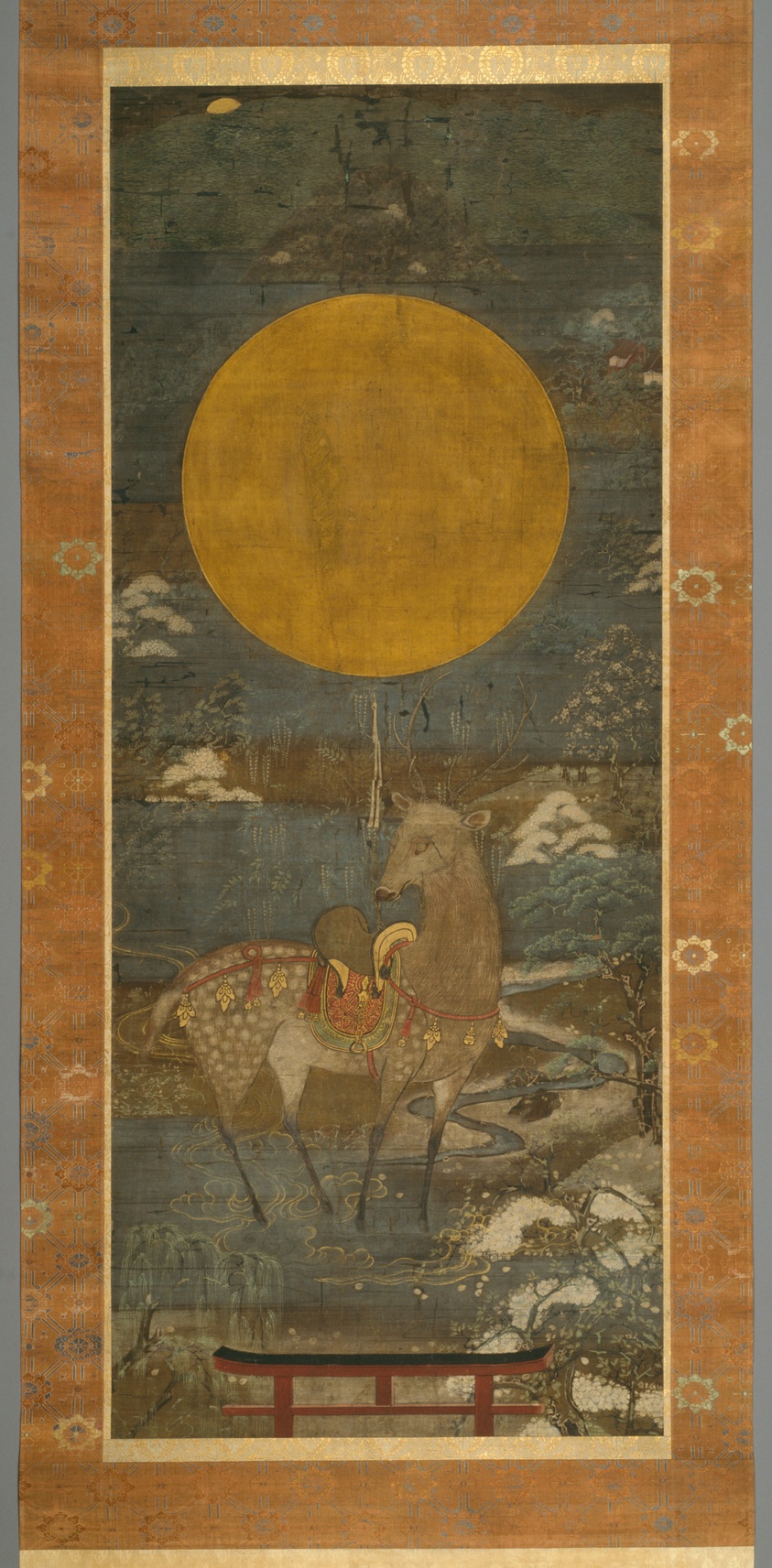
An Examination of the Kasuga Deer Mandala: Propriety in Pigment and Thread
To engage with the Kasuga Deer Mandala is not merely to observe an artefact of religious iconography; it is to be granted an audience with a consummate exercise in disciplined artistry, where every element—from the foundational support to the most ethereal application of gold—adheres to a silent, exacting protocol. The subject, drawn from the sacred precincts of the Kasuga Grand Shrine in Nara, presents the divine messenger, the deer, within a cosmogram of Shinto-Buddhist syncretism. Yet, it is the material execution on silk that elevates this piece from a theological diagram to a masterpiece of heritage craftsmanship, demanding an analysis as one would accord a bespoke garment from a Savile Row establishment: with attention to cloth, cut, and canvas.
The Foundation: Silk as Bespoke Canvas
One does not commence a work of this calibre with a standardised material. The silk ground is the equivalent of the finest, most meticulously woven bespoke cloth—a heavyweight, yet impeccably refined habotai or perhaps a damask, chosen for its latent potential. Its virtue lies not in overt declaration but in its sublime capacity to receive and retain. The silk’s tooth and tension are calculated to accept the mineral pigments and gold without bleed, while its inherent luminosity provides a subcutaneous glow, a vitality that mere paper or panel could never replicate. This is a foundation that understands its role: to provide structural integrity and a subtle, living depth, much as the canvas of a Chesterfield overcoat provides the form upon which the velvet nap plays. The craftsman’s first act of reverence is the selection of this ground, a silent pact between artisan and medium.
The Articulation: Ink and Colour as Tailored Line
Upon this rarefied surface, the application of ink and colour demonstrates a fluid elegance born of absolute technical mastery. The line work, executed in sumi ink, is the sartorial equivalent of a perfectly drawn chalk line—confident, purposeful, and defining the sacred anatomy of the deer and the enclosing geometry of the mandala with unerring precision. There is no room for hesitation or correction; the silk is a demanding taskmaster, forgiving no indecision.
The mineral pigments—malachite greens, azurite blues, cinnabar reds—are applied with a tailored opacity. They are not flat washes but built-up layers, each ground and bound with animal glue, creating a rich, velvety matte finish that sits upon the silk with dignified weight. This is colour applied with propriety, enhancing the form without obscuring the foundational draftsmanship. The palette is restrained, symbolic, and deployed with the strategic intent of a pocket square or a lining cloth—a calculated accent that elevates the whole composition without resorting to ostentation.
The Embellishment: Gold as Discreet Bespoke Detail
Here we encounter the piece’s most distinguished feature, its definitive bespoke element: the application of gold. This is not gilding as mere decoration, but gold as conceptual and spiritual illumination. Employed as kirikane—delicate sheets cut into fine strips or geometric shapes—or as suspended particles in kindei paint, the gold is applied with a jeweller’s precision. It traces the haloes, delineates the celestial patterns, and perhaps catches the light along the deer’s sublime form. Its purpose is twofold. Visually, it creates a dynamic interplay with the static silk and matte pigments, capturing and redirecting ambient light, causing the mandala to breathe and shift with the viewer’s perspective. Spiritually, it materialises the ineffable radiance of the sacred realm. This application is akin to the hand-stitched buttonhole on a bespoke jacket: a detail of immense complexity and cost, often understated, that unequivocally declares the object’s provenance and the artisan’s commitment to transcendence through craft.
Context and Connoisseurship: The Whole Garment
To appreciate the Kasuga Deer Mandala in its totality is to understand the synthesis of these elements into a coherent and commanding whole. The classic silk craftsmanship provides the dignified, enduring base. The fluid elegance of the painted line articulates its sacred narrative. The gold offers a transcendent detail. Together, they create an artefact that functions on multiple levels: as a focus for devotional practice, a manifestation of doctrinal principles, and an unimpeachable statement of artistic heritage.
Its preservation, like the maintenance of a heritage tweed, speaks to its perceived value. The silk, though fragile, has been protected; the colours, though fugitive to harsh light, retain their ceremonial depth; the gold, though susceptible to abrasion, continues to illuminate. This longevity is a testament to the inherent correctness of its initial construction. In the lexicon of Savile Row, it is a "once-in-a-lifetime" commission—not for its cost, but for the confluence of perfect material, peerless technique, and profound purpose it represents. It stands as a silent arbiter of taste and tradition, reminding us that true luxury, whether in spiritual icon or tailored cloth, resides in the integrity of the craft and the eloquent restraint of its execution.