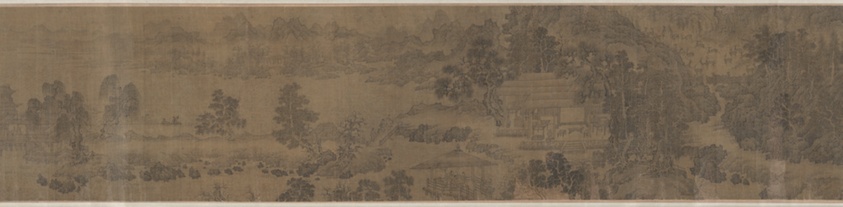
The Wangchuan Villa: A Study in Silk, Lineage, and the Poetics of Place
I. Materiality as Narrative: The Handscroll in Silk
The Wangchuan Villa (Wangchuan Tu), a handscroll executed in ink on silk, represents a pinnacle of Tang dynasty artistic and philosophical achievement. Its materiality is not merely a support for image but an integral component of its narrative power. Silk, in the context of classical Chinese craftsmanship, is a medium of profound significance. It is a fabric of fluid elegance, demanding a disciplined yet spontaneous hand. The handscroll format itself—a horizontal, unfolding sequence—mirrors the experience of traversing a landscape, a journey both physical and metaphysical. The silk’s natural lustre and absorbency create a unique dialogue between the ink and the ground, allowing for subtle gradations of tone that evoke mist, water, and the passage of time. This is not a static image; it is a temporal artifact, meant to be unrolled, savoured, and re-rolled, each viewing a fresh encounter with the artist’s vision.
The choice of silk over paper is deliberate. Silk, with its inherent strength and smoothness, lends itself to the precise yet lyrical brushwork required for the Wangchuan Villa. The ink, applied with controlled pressure, sinks into the fibres, creating a sense of depth and permanence. The handscroll’s dimensions—typically modest in height, allowing for intimate viewing—further emphasize the personal, contemplative nature of the work. It is an object of quiet luxury, a testament to the patron’s refined taste and the artist’s mastery. The silk’s weave, often a fine, even tabby, provides a neutral, luminous backdrop that enhances the ink’s vibrancy. This is not a medium for the impatient; it requires a deep understanding of material behaviour, a skill honed over generations.
II. The Artist and the Villa: Wang Wei’s Vision
The Wangchuan Villa is inextricably linked to its creator, the poet-painter Wang Wei (701–761). A figure of immense cultural stature, Wang Wei was a master of both poetry and painting, a rare synthesis that defined the literati ideal. His villa at Wangchuan, located in the Lantian region near Chang’an, was not merely a residence but a cultivated landscape, a retreat from the political turmoil of the court. The handscroll, originally a series of twenty scenes, each accompanied by a poem, documents this idyllic domain. The original work, now lost, survives through later copies, most notably a Song dynasty version attributed to Guo Zhongshu. Yet, the essence of Wang Wei’s vision—the integration of poetry, painting, and landscape—remains palpable.
Wang Wei’s approach to painting was revolutionary. He eschewed the vibrant colours of the courtly tradition, favouring monochrome ink to capture the subtle atmospheres of nature. His technique, known as “broken ink” (pomo), involved layering washes to create a sense of volume and distance, a departure from the linear, outline-based style of earlier masters. This method, perfectly suited to the silk surface, allowed him to evoke the misty, ethereal quality of the Wangchuan landscape. The villa itself became a symbol of the harmonious coexistence of man and nature, a theme that resonated deeply with the literati class. Each scene—from the “Luanjia Rapids” to the “Pepper Garden”—is a microcosm of this ideal, a place where the boundaries between the human and the natural dissolve.
III. The Handscroll as a Journey: Structure and Sequence
The handscroll’s structure is a masterclass in narrative pacing. The viewer, unrolling the silk from right to left, is invited on a journey through the villa’s grounds. The sequence is not merely descriptive but experiential. The opening scenes, such as the “Mengcheng Hollow,” establish a sense of seclusion, with winding paths and dense foliage. As the scroll progresses, the landscape opens up, revealing water features, pavilions, and distant mountains. The composition is carefully orchestrated, with moments of intense detail—a bamboo grove, a rustic bridge—contrasted with expansive, empty spaces that suggest the vastness of the natural world.
This rhythmic alternation between density and openness is a hallmark of Wang Wei’s genius. It mirrors the cadence of a poem, with its pauses and emphases. The handscroll’s format, with its horizontal orientation, encourages a slow, deliberate viewing. The eye moves not in a single glance but in a series of connected glances, each building upon the last. The silk’s surface, with its subtle texture, adds a tactile dimension to this experience. The ink, applied in varying densities, creates a sense of depth that is both optical and haptic. The viewer is not a passive observer but an active participant, tracing the path of the artist’s brush and the poet’s mind.
IV. The Legacy: Influence and Interpretation
The Wangchuan Villa has exerted a profound influence on Chinese painting and culture. It established the paradigm of the literati landscape, where the artist’s personal vision and moral character are as important as the subject itself. Wang Wei’s fusion of poetry and painting inspired generations of scholar-artists, from the Song dynasty’s Mi Fu to the Yuan dynasty’s Ni Zan. The handscroll became a template for the “garden painting” genre, a celebration of the cultivated landscape as a space for retreat and reflection.
In the context of the London Savile Row sensibility, the Wangchuan Villa embodies a certain understated elegance. It is not a work of ostentation but of quiet mastery. The silk’s lustre, the ink’s precision, the composition’s balance—these are qualities that resonate with the ethos of bespoke tailoring. Both the handscroll and a Savile Row suit are artifacts of patience and skill, designed to be appreciated over time. The Wangchuan Villa, like a well-cut garment, is an investment in heritage, a statement of identity that transcends the ephemeral. It is a reminder that true luxury lies not in excess but in the thoughtful curation of material and form.
In conclusion, the Wangchuan Villa handscroll is a testament to the enduring power of silk as a medium for artistic expression. Its materiality, its narrative structure, and its cultural significance converge to create an artifact of extraordinary depth. It is a journey through a landscape, a meditation on nature, and a reflection on the artist’s soul. For the connoisseur, it is a treasure to be unrolled, studied, and cherished—a piece of heritage that continues to inspire.