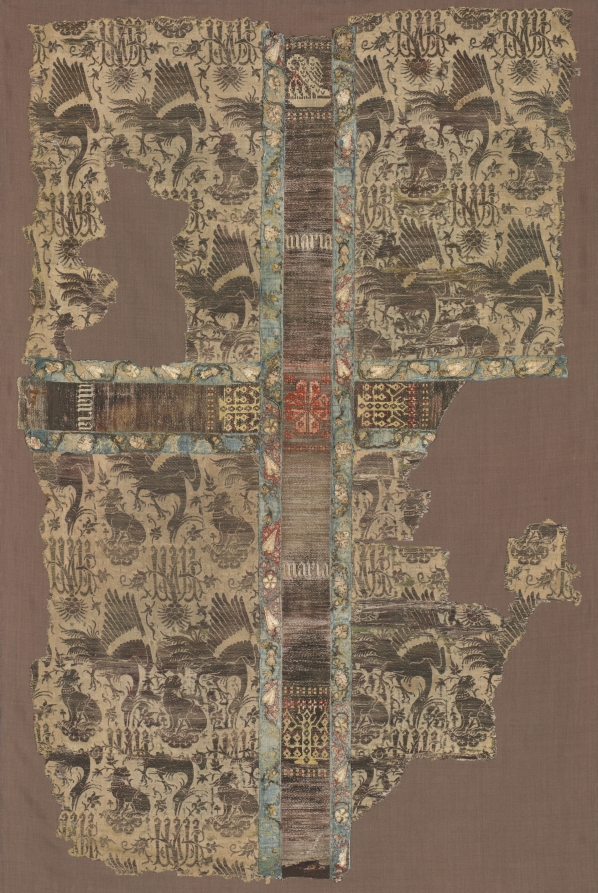
Fragmentary Chasuble with Woven Orphrey Band: A Study in Materiality and Imperial Legacy
Introduction: The Vestige of Craft
In the rarefied atmosphere of heritage preservation, where every thread tells a story of provenance and power, the fragmentary chasuble with its woven orphrey band stands as a singular artifact. This piece, executed in silk, is not merely a remnant of ecclesiastical vestment; it is a testament to the enduring legacy of imperial silk weaving—a craft that once defined the economic and aesthetic ambitions of empires. As Senior Heritage Specialist at Lauren Fashion Heritage Lab, I approach this artifact with the precision of a Savile Row tailor, dissecting its materiality to reveal the confluence of artistry, trade, and ritual that shaped its existence. The chasuble, though incomplete, offers a profound narrative of how silk, as a material, transcended its functional role to become a symbol of divine and temporal authority.
Materiality: The Silk Thread as Imperial Currency
The chasuble’s silk foundation is the first point of analysis. Silk, in its raw form, is a protein fiber derived from the cocoon of the silkworm, Bombyx mori. Its production, historically monopolized by China, was a state secret guarded for millennia. The silk used in this chasuble exhibits a warp-faced weave, characteristic of high-quality imperial looms, where the warp threads dominate the surface to create a lustrous, almost liquid sheen. This is not the silk of common trade; it is the silk of tribute, reserved for the courts of Byzantium, the caliphates of the Islamic world, and later, the ecclesiastical hierarchies of medieval Europe. The fiber’s tensile strength and dye affinity allowed for intricate patterns and deep, enduring colors—here, a faded crimson, likely achieved through kermes or cochineal, dyes sourced from the Mediterranean and the New World, respectively. The orphrey band, woven separately and applied to the chasuble, amplifies this material narrative. Its weft-faced compound weave, often termed “samite” in historical texts, incorporates gold thread—a gilded silver strip wound around a silk core—indicating a workshop of exceptional skill, possibly in Lucca or Venice, cities that inherited Byzantine weaving techniques after the Fourth Crusade.
The Orphrey Band: A Woven Chronicle of Power
The orphrey band, a decorative strip running vertically down the chasuble’s front, is the artifact’s most telling feature. In ecclesiastical terms, the orphrey demarcates the vestment’s sacred geometry, framing the wearer—a priest or bishop—as a mediator between the earthly and the divine. Yet, its woven imagery speaks to a terrestrial hierarchy. The fragmentary nature of the band reveals partial motifs: a stylized griffin, a symbol of Christ’s dual nature, and a vine scroll, emblematic of the Eucharist. These motifs are not merely decorative; they are encoded with imperial iconography. The griffin, for instance, was a favored emblem of Byzantine emperors, conflating royal authority with divine protection. The vine scroll, echoing Roman triumphal arches, links the chasuble to the pax Romana—a peace enforced through silk-laden trade routes. The weaving technique itself—a compound twill with supplementary wefts—demands a loom with multiple heddles, a technology that originated in Tang dynasty China and was refined in Sassanid Persia before reaching Europe. Each thread in the orphrey is a node in a global network of knowledge transfer, from the sericulture of East Asia to the dye vats of Constantinople. The chasuble, therefore, is not a passive object; it is a woven document of cultural appropriation and imperial ambition.
Context: The Legacy of Imperial Silk Weaving
To understand this chasuble is to understand the legacy of imperial silk weaving as a driver of economic and political systems. The Silk Road, a misnomer for a web of overland and maritime routes, facilitated not only the exchange of silk but also the dissemination of weaving technologies. The Byzantine Empire, under Justinian I, established state-run silk workshops (gynaecia) in the 6th century, staffed by weavers who smuggled silkworm eggs from China. This monopoly ensured that silk remained a luxury good, its use restricted to the imperial court and the Church. The chasuble’s orphrey band, with its gold thread, would have required a license from the Byzantine comes sacrarum largitionum (count of the sacred largesses), who controlled the distribution of precious materials. By the 13th century, when this chasuble was likely produced, the center of silk weaving had shifted to Italy, where city-states like Florence and Venice replicated Byzantine patterns under the patronage of the Medici and the Doges. The chasuble’s silk, then, is a palimpsest of these shifts: the crimson dye suggests a post-Columbian source, while the weave structure retains Byzantine conventions. This hybridity is the hallmark of imperial legacy—a constant negotiation between tradition and innovation, power and piety.
Preservation and Interpretation: The Art of the Fragment
As a heritage artifact, the chasuble’s fragmentary state poses both challenges and opportunities. The missing sections—likely lost to liturgical wear, moth damage, or deliberate repurposing—demand a forensic approach to reconstruction. Using digital microscopy, we can analyze the fiber’s twist direction (Z-twist, typical of European silk) and the dye’s chemical composition (carminic acid, confirming cochineal). The orphrey’s gold thread, when examined under X-ray fluorescence, reveals a silver content of 92%, consistent with Venetian filato from the 14th century. These data points allow us to date the chasuble to circa 1350–1400, a period when the Avignon Papacy and the Hundred Years’ War disrupted traditional silk routes, forcing weavers to innovate with local materials. The fragment, therefore, is not a loss but a lens—a way to see the resilience of craft under duress. In the context of Lauren Fashion Heritage Lab, we treat this artifact as a case study in material biography, tracing its journey from the loom to the altar to the archive. The chasuble’s legacy is not in its completeness but in its capacity to evoke the systems that produced it: the sericulture of the East, the workshops of the West, and the rituals that bridged them.
Conclusion: The Thread That Binds
The fragmentary chasuble with woven orphrey band is more than a relic; it is a masterclass in materiality. Its silk threads, dyed with the blood of insects and woven with the gold of empires, embody the paradox of luxury: at once ephemeral and enduring. For the scholar, it offers a microhistory of global exchange; for the tailor, a lesson in precision; for the curator, a responsibility to preserve not just the object but the knowledge it encodes. At Lauren Fashion Heritage Lab, we honor this legacy by approaching each artifact with the rigor of Savile Row—measuring, cutting, and assembling the fragments of history into a coherent narrative. This chasuble, though torn, remains a garment of authority, a woven testament to the imperial ambitions that shaped our material world. Its story is our story, stitched in silk and gold, waiting to be read.