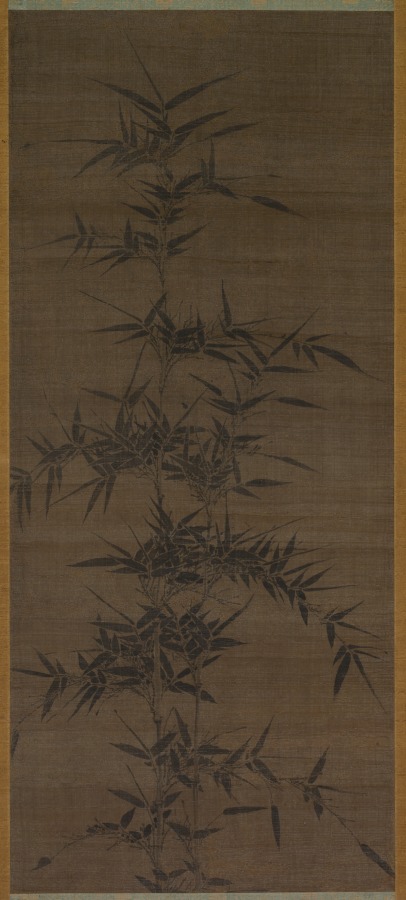
On the Material Confluence of Ink Bamboo and Imperial Silk
To consider the subject of Ink Bamboo rendered upon silk is to engage with a confluence of legacies, each of the most profound order. It is not merely a decorative motif applied to a luxurious ground; it is a statement of philosophical alignment, executed through the most technologically advanced and culturally sacrosanct medium of the East: imperial silk. The artifact demands an examination not unlike the appraisal of a bespoke garment from Savile Row—where every thread, every stitch, carries the weight of history, technique, and an unspoken understanding of form and function elevated to art.
The Ground: Imperial Silk Weaving
One must first understand the canvas. Imperial silk weaving, particularly as perfected in the Jiangnan regions of China, represents the apogee of textile engineering prior to the industrial age. This was not a trade; it was a state-sanctioned discipline, a monopoly of aesthetic and technical excellence administered through formidable workshops like those of Nanjing, Suzhou, and Hangzhou. The looms were complex, the sericulture meticulously controlled, and the weavers—often generations bound to the craft—operated with a precision that would satisfy the most exacting master cutter.
The resulting silks—kesi (silk tapestry), duan (satin), ling (gauze)—were more than fabrics. They were substrates of power and communication. They conveyed rank through regulated colour and motif, wealth through density of thread and complexity of weave, and cosmological harmony through symbolic patterning. To drape oneself in such silk was to wear a manifesto of one’s place within a celestial and terrestrial order. The legacy is one of uncompromising standards, where deviation from perfection was not an option, for the recipient was the Son of Heaven himself, and the context, the ritualized theatre of the court.
The Subject: The Philosophy of Ink Bamboo
Against this ground of regal splendour and technical rigour, one encounters the subject: Ink Bamboo. This is no mere botanical representation. In the scholar’s tradition, bamboo painted in monochrome ink is a test of character, a visual distillation of principle. The brushstroke must be at once confident and yielding, capturing the plant’s essential nature: its hollow stem signifying humility, its resilient flexibility in the wind denoting strength, its evergreen constancy representing integrity. The great masters—Wen Tong, Su Shi—approached the subject as a martial art of the spirit, a discipline where the mind directs the brush in a single, unhesitating gesture. There is no room for correction, no space for indecision. The integrity of the line is the integrity of the man.
Thus, Ink Bamboo exists in a realm of austere, intellectual elegance. It is the antithesis of ostentation, finding profundity in restraint and moral fortitude in simplicity. It is, in its original context, an art of the literati—of the individual scholar in his studio, communing with nature and philosophy through ink, paper, and brush.
The Confluence: A Dialogue of Contrasts
Herein lies the profound dialogue of our artifact. The application of the Ink Bamboo motif onto imperial silk creates a tension of extraordinary creative potency. One brings the legacy of the collective, the monumental, the courtly, and the technically sublime. The other brings the legacy of the individual, the introspective, the scholarly, and the spontaneously expressive. It is, if you will, the meeting of the court robe and the scholar’s rock.
The materiality of silk transforms the presentation of Ink Bamboo. The luminous, subtly textured ground of a fine duan satin or the intricate, painterly surface of kesi tapestry captures light differently than paper. The ink tones, whether applied by dye or woven in fine gradations of black and grey silk, gain a depth and a sheen—a quiet opulence that paper cannot confer. The motif is elevated, literally framed by the wealth and status inherent in the cloth itself. Yet, the philosophical austerity of the bamboo remains, tempering the splendour of its ground. It declares that the wearer or owner appreciates not merely luxury, but the luxury of meaning; not just surface, but substance.
Legacy and Continuity
To commission or create such an artifact was a act of profound cultural literacy. It signaled an individual who moved seamlessly between worlds: one who commanded the respect of the court and the language of the literati. It demonstrated an understanding that true sophistication lies in the synthesis of apparent opposites—the collective and the individual, the opulent and the austere, the regulated and the spontaneous.
The legacy for the contemporary connoisseur, much like the client of a bespoke tailor, is in recognizing the narrative held within the weave. Each piece of silk bearing the Ink Bamboo motif is not a simple textile. It is a document of technical mastery over one of the world’s most demanding fibres. It is a bearer of philosophical weight, a symbol of resilience and uprightness. And it is a testament to a cultural moment where material and motif could engage in a dialogue that elevated both.
To hold such an artifact is to appreciate a standard. The standard of the imperial workshops, where the weave was flawless. The standard of the scholar-painter, where the line was true. In an age of mass production and fleeting trends, this confluence of Ink Bamboo and imperial silk stands as a permanent reminder that heritage is built upon such dual pillars: the relentless pursuit of material excellence, and the courageous expression of foundational ideals. It is, in the final analysis, a perfectly tailored statement.