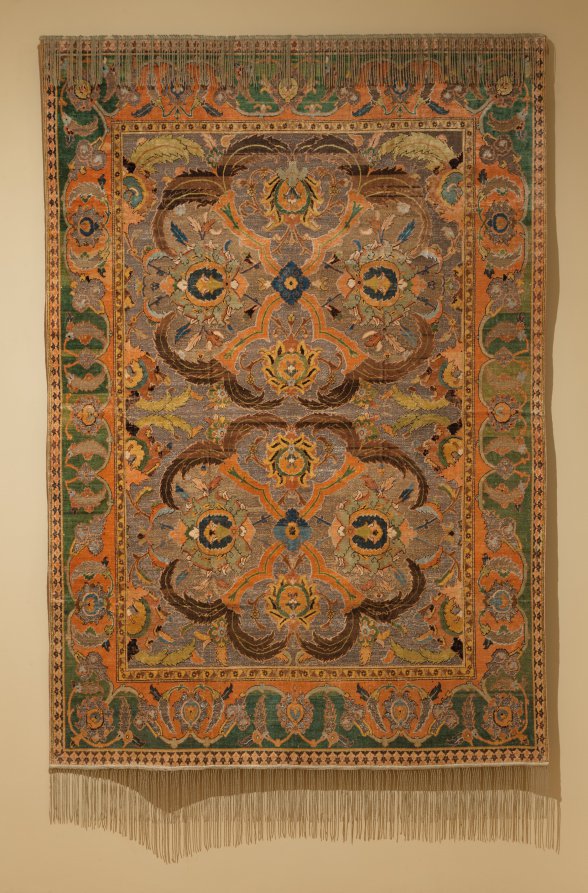
The Royal Carpet with Silk and Metal Thread: A Legacy of Imperial Weaving
In the hushed corridors of heritage conservation, where the air is thick with the scent of aged cedar and the faint whisper of history, the Royal Carpet with Silk and Metal Thread stands as a testament to an era when craftsmanship was not merely a trade but a declaration of power. At Lauren Fashion Heritage Lab, we approach such artifacts with the precision of a Savile Row tailor—measuring every thread, scrutinizing every weave, and understanding the narrative stitched into its fabric. This carpet, a relic of imperial silk weaving, embodies the zenith of material opulence and technical mastery, offering a window into the socio-political and artistic currents of its time.
Materiality: The Silk Foundation
The foundation of this carpet is silk, a fiber that has long been synonymous with luxury, diplomacy, and imperial ambition. Silk’s journey from the silkworm’s cocoon to the loom is a narrative of transformation—one that required not only biological precision but also an intricate network of trade routes, from the ancient Silk Road to the courts of Europe and Asia. In the context of imperial weaving, silk was not chosen arbitrarily; it was a deliberate statement of sovereignty. The fiber’s natural luster, tensile strength, and ability to absorb dyes with unparalleled depth made it the preferred medium for royal commissions. The carpet’s silk warp and weft, likely sourced from mulberry-fed silkworms in regions such as China’s Jiangnan or Persia’s Khorasan, were spun and dyed using techniques that were closely guarded secrets, passed down through generations of master weavers. The resulting fabric is not just a textile but a canvas for power—its softness underfoot belies the rigid discipline required to produce it.
The Gilded Thread: Metal as Symbol and Substance
Interwoven with the silk are metal threads, typically composed of silver or gold-gilt strips wrapped around a silk core. This technique, known as filé or passementerie, elevated the carpet from a functional object to a ceremonial artifact. The metal thread was not merely decorative; it served as a visual and tactile marker of wealth, divine right, and imperial reach. In the courts of the Safavid, Mughal, or Ottoman empires, such carpets were often displayed during coronations, diplomatic receptions, or religious processions, where the glint of metal under candlelight would have mesmerized onlookers. The process of creating these threads was labor-intensive: gold or silver was hammered into thin foils, cut into strips, and then wound around silk filaments. The result was a material that resisted tarnish through careful alloying—often with copper to maintain flexibility—yet still demanded meticulous conservation. The metal thread’s presence in the carpet is a reminder that imperial weaving was as much about alchemy as it was about artistry.
Context: The Legacy of Imperial Silk Weaving
The Royal Carpet with Silk and Metal Thread must be understood within the broader legacy of imperial silk weaving, a tradition that spanned continents and centuries. From the Byzantine Empire’s silk workshops in Constantinople to the royal manufactories of Louis XIV’s Gobelins, silk weaving was a state-sponsored enterprise. In the East, the Mughal emperor Akbar established imperial karkhanas (workshops) that blended Persian, Indian, and Central Asian techniques, producing carpets that were both trade goods and diplomatic gifts. The carpet in question likely originated from such a workshop, where master weavers—often working from cartoons designed by court artists—executed patterns that incorporated floral motifs, geometric borders, and calligraphic inscriptions. These designs were not arbitrary; they carried symbolic weight. For instance, the use of the chintamani motif (three circles representing jewels) or the palmette (a stylized lotus) signified prosperity, eternity, and divine favor. The metal thread, when used in these patterns, created a play of light that mimicked the celestial—a reminder that the ruler was a mediator between the earthly and the divine.
Technical Mastery: The Weave and Its Preservation
From a technical standpoint, the carpet’s construction is a marvel of engineering. The silk warp threads, often numbering in the hundreds per inch, provided the structural integrity, while the weft, including the metal threads, was woven using a symmetrical knot (Turkish or Ghiordes knot) or asymmetrical knot (Persian or Senneh knot), depending on regional tradition. The density of knots—sometimes exceeding 500 per square inch—ensured that the carpet could withstand the weight of courtiers and the passage of time. However, this density also presents challenges for conservation. The metal threads, while durable, are prone to oxidation and brittleness, especially when exposed to humidity or light. At Lauren Fashion Heritage Lab, we employ a methodology akin to a Savile Row tailor’s approach to a bespoke suit: we assess the carpet’s condition through non-invasive imaging, such as X-ray fluorescence to identify metal alloys, and then devise a conservation plan that stabilizes the silk without compromising the metal’s integrity. This might involve controlled humidity environments, UV-filtered lighting, and, in rare cases, the careful application of consolidants to prevent thread detachment.
Cultural Resonance: The Carpet as a Living Artifact
Beyond its material and technical dimensions, the Royal Carpet with Silk and Metal Thread is a living artifact that continues to resonate in contemporary fashion and design. The interplay of silk’s fluidity and metal’s rigidity has inspired modern textile artists and luxury houses, from the embroidered gowns of Alexander McQueen to the metallic jacquards of Dior. The carpet’s legacy is also a cautionary tale: the imperial workshops that produced such masterpieces often relied on exploitative labor systems, a reality that modern heritage practitioners must acknowledge. At Lauren Fashion Heritage Lab, we approach this artifact with a dual lens—celebrating its artistry while interrogating the socio-economic structures that made it possible. This is not to diminish its beauty but to honor the full scope of its history.
Conclusion: A Thread Through Time
The Royal Carpet with Silk and Metal Thread is more than a decorative object; it is a chronicle of human ambition, ingenuity, and the relentless pursuit of perfection. Its silk foundation whispers of ancient trade routes, its metal threads glint with the ambition of empires, and its patterns encode the spiritual and political aspirations of its creators. As we preserve this artifact for future generations, we do so with the understanding that heritage is not static—it is a dialogue between past and present. In the spirit of Savile Row, we do not merely conserve; we curate, ensuring that every thread, every knot, and every glint of gold tells its story with the dignity it deserves. The carpet remains, as it always has, a royal statement—one that continues to inspire, challenge, and captivate.