The Roundels with Hunters: A Study in Imperial Silk Weaving and Savile Row’s Enduring Legacy
Introduction: The Artifact as a Testament to Power and Precision
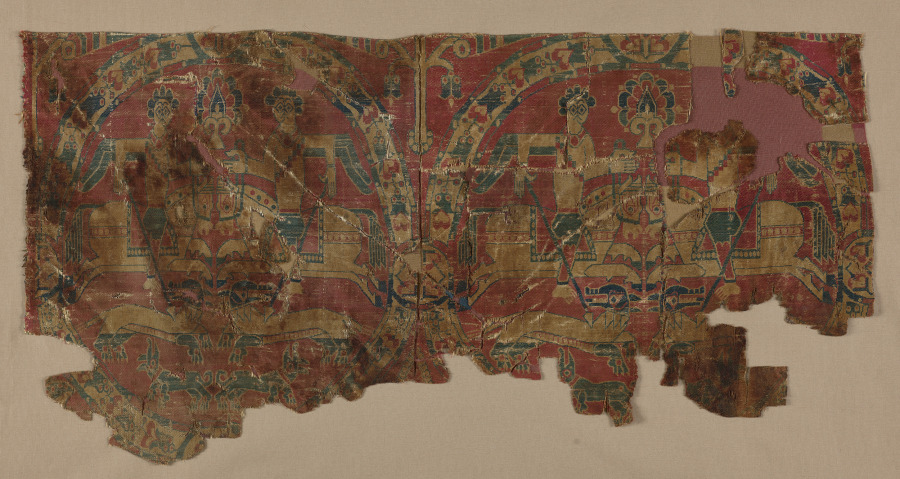
The Roundels with Hunters, executed in silk, represent a pinnacle of imperial weaving that transcends mere textile production. These circular medallions, often measuring between 20 and 30 centimeters in diameter, depict mounted hunters in pursuit of game—a motif that resonates with the martial and aristocratic ethos of empires from the Sassanid to the Ottoman. As a heritage artifact, the roundel is not merely decorative; it is a document of technological mastery, cultural symbolism, and the relentless pursuit of perfection that defines both imperial courts and the bespoke tailoring houses of London’s Savile Row. The materiality of silk—its luster, drape, and tensile strength—elevates the roundel from a functional object to a statement of authority, much like a well-cut suit asserts its wearer’s status without a word.
Materiality: Silk as the Medium of Imperial Ambition
Silk, in the context of imperial weaving, is a material that demands both reverence and technical rigor. The Roundels with Hunters were likely woven on drawlooms, a technology that allowed for intricate, repeating patterns—a precursor to the jacquard looms that later revolutionized textile production. The silk itself, sourced from the sericulture of East Asia or the Mediterranean, was prized for its ability to hold vibrant dyes, such as madder red, indigo blue, and saffron yellow, which were often reserved for the elite. The roundel’s construction involved a compound weave, where the warp and weft threads interlace to create a double-faced fabric—a technique that required immense skill to ensure the design was crisp on both sides. This is analogous to the bespoke tailoring process on Savile Row, where a jacket’s internal structure is as meticulously finished as its exterior, reflecting a philosophy that true luxury is invisible to the untrained eye.
The hunters depicted in these roundels are not generic figures; they are often shown with specific attributes—a falcon on the wrist, a bow drawn, or a horse in mid-gallop—that suggest a narrative of dominance over nature. The silk’s sheen catches light in a way that animates these figures, making the roundel a dynamic object even in stillness. This interplay of light and texture is a hallmark of imperial silk weaving, where the material itself becomes a stage for storytelling. For the contemporary connoisseur, this is not unlike the way a Savile Row tailor uses a fine worsted wool or a silk-wool blend to create a garment that moves with the wearer, enhancing rather than constraining.
Context: The Legacy of Imperial Silk Weaving
The Roundels with Hunters belong to a tradition that spans centuries and continents. In the Byzantine Empire, silk roundels were used as insignia for court officials, their patterns denoting rank and allegiance. The Sassanid Persians, masters of the silk trade, wove roundels with royal hunting scenes to assert the shah’s dominion over both the animal kingdom and his human subjects. By the time of the Ottoman Empire, these motifs had evolved into a sophisticated visual language, where the hunter symbolized the sultan’s role as protector and provider. The silk itself was often a gift of state, a diplomatic tool that conveyed power without the need for words.
This legacy of silk as a carrier of authority finds a parallel in Savile Row’s history. The Row emerged in the late 18th century as a hub for military tailors, who translated the precision of uniform-making into civilian attire. The same attention to detail—the perfect shoulder, the unbroken line of a lapel—mirrors the weaver’s obsession with the roundel’s symmetry. Both traditions understand that a garment or textile is not just cloth; it is a statement of identity. The imperial weaver and the Savile Row tailor share a common goal: to create something that endures, both physically and symbolically.
Design and Symbolism: The Hunter as Archetype
The hunter motif in the roundels is rich with symbolism. The horse, often depicted with a raised foreleg, suggests motion and readiness. The hunter’s gaze is fixed on the prey, a metaphor for focus and determination. In many roundels, the prey is a lion or a stag—creatures that themselves symbolize strength and nobility. This is not a simple hunt; it is a ritualized display of virtue. The roundel’s circular form reinforces this idea of eternity, of a cycle that repeats without end. For the imperial court, this was a reminder of the ruler’s perpetual vigilance. For the modern observer, it evokes the timelessness of true craftsmanship.
The color palette of these roundels is equally deliberate. Gold thread, often made from silk wrapped in gilded parchment, highlights the hunter’s weapons or the horse’s tack, drawing the eye to the action. The background is typically a deep, saturated hue—crimson, sapphire, or emerald—that signifies wealth and power. This use of color is not arbitrary; it is a calculated choice to command attention, much like the subtle pinstripe or the bold check of a Savile Row suit. Both the roundel and the suit use color and pattern to communicate without words, a language understood by those who know how to read it.
Preservation and Relevance: The Roundel in the Modern Wardrobe
Today, the Roundels with Hunters are preserved in museum collections, their silk carefully maintained under controlled conditions. But their relevance extends beyond the archive. The roundel’s design principles—balance, narrative, and material integrity—are directly applicable to contemporary luxury. On Savile Row, a tailor might reference the roundel’s motif in a bespoke lining or a pocket square, creating a connection between past and present. The hunter’s silhouette, rendered in silk, becomes a subtle nod to heritage, a conversation piece that elevates the garment from mere clothing to artifact.
This is the essence of the Lauren Fashion Heritage Lab’s mission: to bridge the gap between historical craftsmanship and modern application. The roundel teaches us that luxury is not about excess but about meaning. Every thread, every color, every figure in the design serves a purpose. The same can be said for a Savile Row suit, where every stitch is a decision, every seam a testament to the tailor’s art. The roundel is not a relic; it is a lesson in how to create something that lasts.
Conclusion: The Thread That Binds
The Roundels with Hunters in silk are more than a heritage artifact; they are a blueprint for excellence. From the imperial looms of antiquity to the ateliers of Savile Row, the pursuit of perfection remains unchanged. The roundel’s hunters, frozen in silk, remind us that true craftsmanship is a hunt—a relentless pursuit of the ideal, where every detail matters. As we continue to study and reinterpret these objects, we honor not just the weavers of the past but the tailors of the present, who carry forward a legacy of precision, beauty, and enduring relevance.