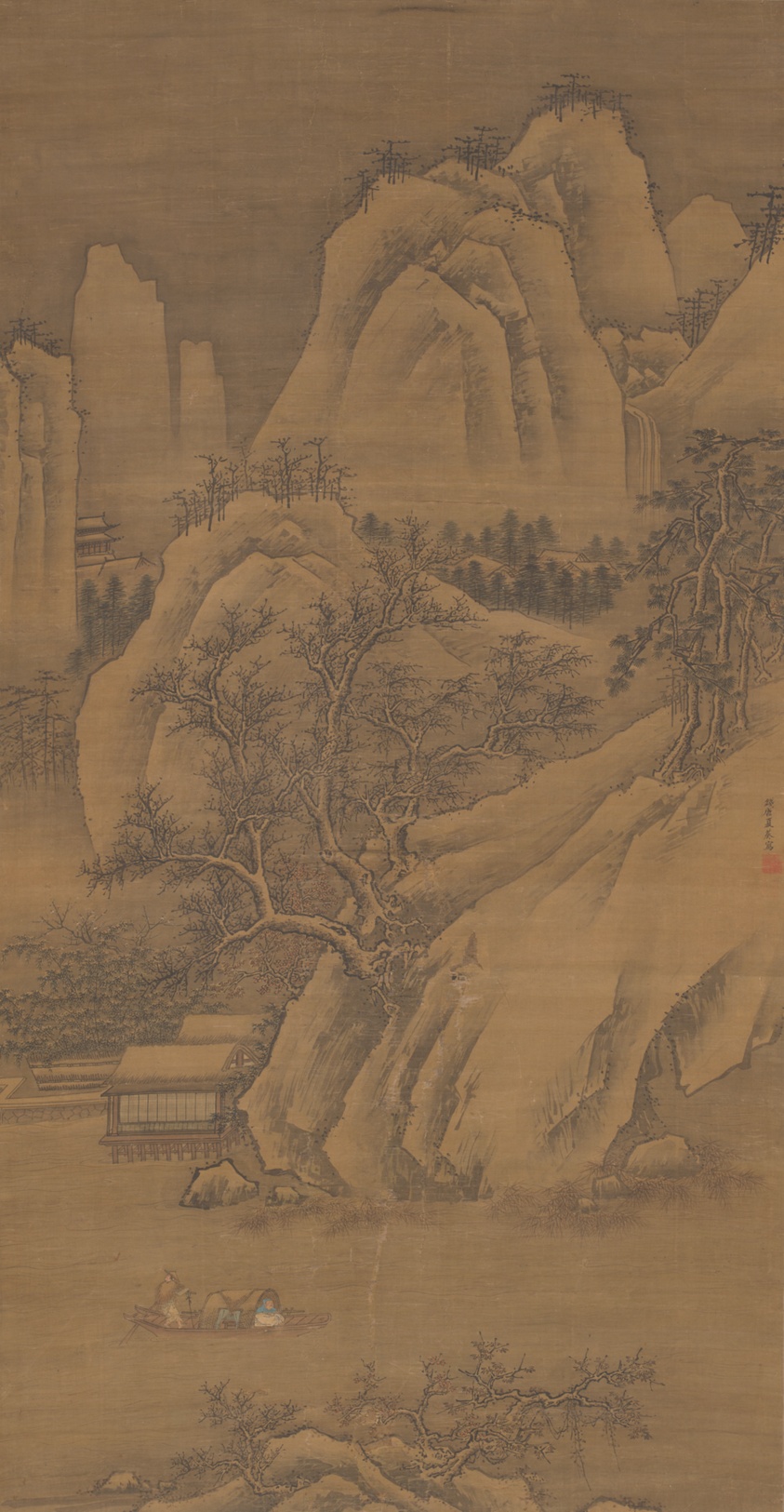
The Materiality of a Moment: Deconstructing “Visiting Dai Kui on a Snowy Night” as a Heritage Artifact
Preliminary Observations: The Silk as a Stage
In the rarefied atmosphere of heritage preservation, where every thread tells a story, the artifact known as “Visiting Dai Kui on a Snowy Night” (雪夜訪戴圖) stands as a masterclass in the marriage of materiality and narrative. As a Senior Heritage Specialist for the Lauren Fashion Heritage Lab, I approach this hanging scroll not merely as a painting, but as a textile artifact—a physical document of craftsmanship, cultural philosophy, and the fluid elegance that defines classical Chinese silk artistry. Executed in ink and colors on silk, this scroll embodies the very essence of a tradition that values restraint, spontaneity, and the quiet power of suggestion. It is, in the language of London’s Savile Row, a bespoke garment of the mind: tailored to perfection, yet breathing with the ease of a well-worn coat.
The materiality of this piece is its first and most commanding statement. Silk, as a substrate, is not a passive canvas; it is an active participant in the artistic dialogue. The weft and warp of the fabric, the subtle sheen that catches light at different angles, and the inherent tensile strength that allows for vertical suspension—all these properties inform the artist’s choices. In “Visiting Dai Kui on a Snowy Night,” the silk is not merely a support but a medium of expression. The ink and colors are absorbed into the fibers, creating a diffusion that mimics the soft, muffled quality of a snow-covered landscape. This is not the sharp, crisp line of paper; it is the blurred, atmospheric edge of memory—a fitting choice for a scene that celebrates the ephemeral nature of inspiration.
The Craftsmanship of the Hanging Scroll: A Study in Structural Elegance
The hanging scroll format itself is a testament to the ritualistic and functional heritage of Chinese art. Unlike the static, framed oil painting of the Western tradition, a hanging scroll is a dynamic object. It is unrolled, viewed, and rolled again—a performance of appreciation that mirrors the narrative it depicts. The silk must be of a quality that withstands repeated handling without losing its integrity. The mounting, often a complex layering of silk borders, serves both protective and aesthetic functions. The top and bottom rollers, typically made of wood or ivory, are not mere hardware; they are the anchors of a system that balances tension and flexibility. In “Visiting Dai Kui on a Snowy Night,” the mounting is executed with a precision that speaks to the atelier-level skill of the artisan. The seams are invisible, the alignment flawless—a quiet nod to the discipline that underlies the apparent spontaneity of the brushwork.
From a material science perspective, the silk used in this scroll is likely a plain-weave tabby, chosen for its even surface and ability to hold both ink and pigment without bleeding. The colors—subtle washes of indigo, ochre, and vermilion—are applied in thin, translucent layers, allowing the silk’s natural luminosity to shine through. This technique, known as “boneless” painting (没骨画), eschews outlines in favor of direct color application, creating a sense of weightlessness. The snow is not painted white; it is the negative space of the silk itself, left untouched, while the ink defines the river, the boat, and the solitary figure. This is the ultimate luxury: the material becomes the subject.
Narrative and Technique: The Art of the Unfinished Gesture
The story behind “Visiting Dai Kui on a Snowy Night” is as integral to its heritage as the silk it is painted on. The tale, drawn from the Shishuo Xinyu (A New Account of the Tales of the World), recounts the philosopher Wang Huizhi’s impulsive journey to visit his friend Dai Kui. Upon arriving at Dai’s door, Wang turns back, explaining that the pleasure of the journey itself—the snow, the night, the anticipation—was the true destination. This is a parable of aesthetic spontaneity, a core tenet of Chinese literati culture. The artist, in rendering this scene, must capture not the arrival but the moment of decision. The composition is spare: a lone figure in a skiff, a winding river, and the vast, empty expanse of snow. The brushwork is fluid, almost careless, yet every stroke is deliberate. The ink is applied in varying dilutions, from the deep black of the boat’s hull to the pale grey of the distant mountains. This is not a painting of things; it is a painting of atmosphere.
In the context of silk craftsmanship, the artist’s technique is a form of controlled risk. Silk is unforgiving; a mistake cannot be erased. The ink must be applied with a confidence that borders on arrogance, yet the result is humility—a scene that invites the viewer to complete the narrative. This is the same philosophy that underpins the best of Savile Row tailoring: the garment is not finished until the wearer inhabits it. The scroll, too, is incomplete without the viewer’s imagination. The snow, the night, the journey—these are not depicted; they are evoked.
Heritage and Preservation: The Silk as a Living Document
As a heritage artifact, “Visiting Dai Kui on a Snowy Night” presents unique challenges and opportunities. The silk, though durable, is vulnerable to light, humidity, and handling. The pigments, particularly the organic reds and blues, are fugitive and may fade over time. Preservation requires a holistic approach that respects both the material and the cultural context. The scroll should be stored in a climate-controlled environment, unrolled only for exhibition or study, and handled with the reverence due a rare manuscript. Yet, paradoxically, its value lies in its ephemeral nature. The silk will age, the colors will shift, and the ink will crack. This is not decay; it is patina—a record of the object’s journey through time. In the same way that a bespoke suit gains character with wear, this scroll accrues meaning with each passing century.
The Lauren Fashion Heritage Lab’s interest in this artifact extends beyond its aesthetic merit. It is a case study in material intelligence—the ability of a substrate to shape and be shaped by artistic intent. The silk of “Visiting Dai Kui on a Snowy Night” is not a neutral ground; it is a protagonist. Its weave, its weight, its response to ink—all these factors are part of the artist’s vocabulary. To understand this scroll is to understand the symbiosis between medium and message, a lesson that resonates across disciplines, from fashion to architecture to design.
Conclusion: The Enduring Elegance of the Unspoken
In the final analysis, “Visiting Dai Kui on a Snowy Night” is a testament to the power of restraint. The silk does not shout; it whispers. The ink does not argue; it suggests. The narrative does not conclude; it lingers. This is the hallmark of true craftsmanship—whether in a Tang dynasty scroll or a Savile Row suit. The material is honored, the technique is invisible, and the result is a quiet, enduring elegance that transcends time. As a heritage specialist, I am reminded that the most profound artifacts are those that leave room for the viewer, the wearer, the reader. They are not finished; they are invitations. And in that invitation lies the soul of heritage.