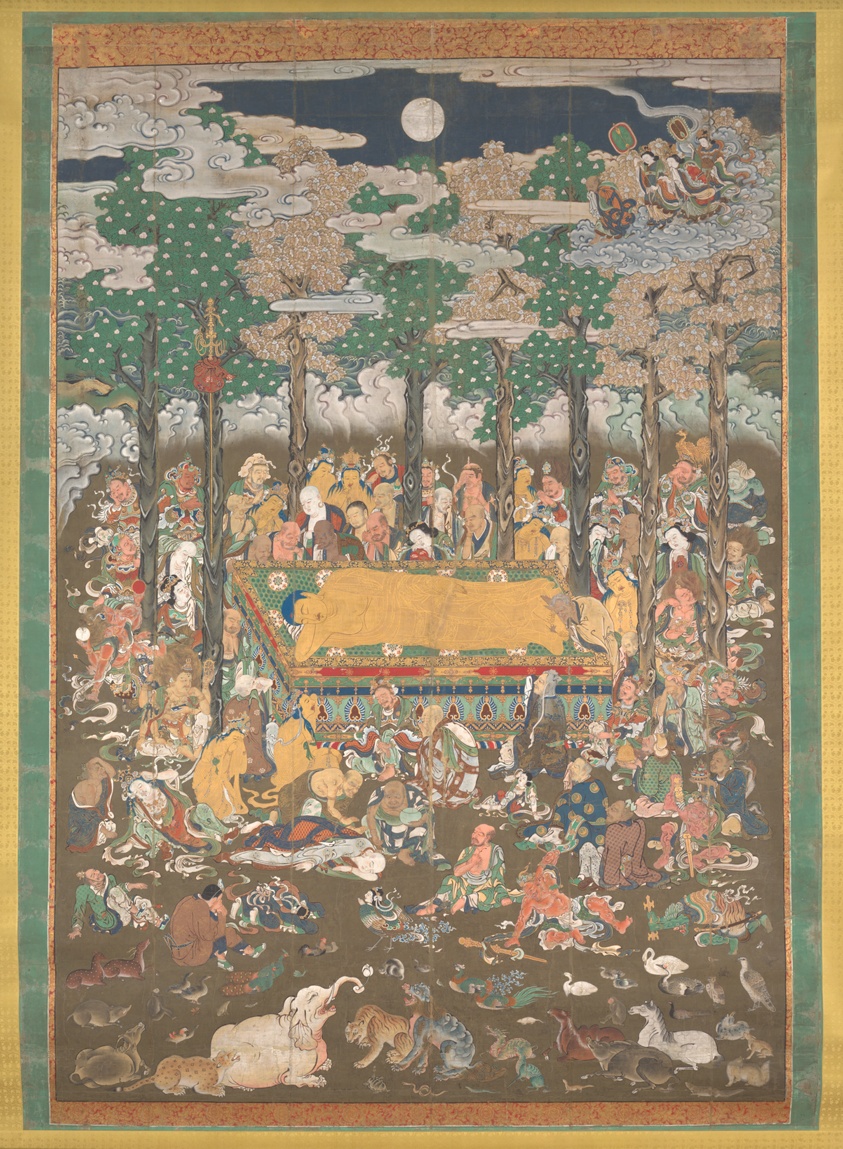
An Exegesis on the Fabric of Transcendence
To engage with this artifact—a hanging scroll depicting the Nehan, or the Death of the Buddha—is to enter into a most solemn and exacting contract with the sublime. One does not merely view such a piece; one is received by it. The medium, as ever with matters of consequence, is not incidental. It is the very foundation of the statement. Here, the statement is rendered in silk: a ground both profound and perilous. Consider, if you will, the inherent audacity of the selection. Silk is not a forgiving textile. It does not permit the hesitant stroke or the corrective gesture. Each application of ink, each wash of colour, each meticulous filament of gold leaf must be deployed with a certainty that borders on the prophetic. The craftsman’s hand must be steady, his vision clear, for the silk accepts the pigment with a chilling permanence. There are no second drafts. This unyielding materiality mirrors the philosophical finality of the scene it portrays—the Parinirvana, the ultimate release from the cycle of suffering. The fabric, in its costly, delicate strength, becomes a metaphor for the Buddha’s own perfected nature: seemingly fragile, yet possessing an immutable, enduring core.
The Drapery of Eternity: Composition and Line
The composition, we must assert, achieves its serenity through a masterful application of controlled tension. The central figure of the Buddha, reclining in his final repose, establishes a profound horizontal axis—a baseline of eternal calm. This is not a collapse, but a deliberate, graceful descent. Observe the treatment of the monastic robe cascading over the dais. The lines describing the folds are not mere representations of cloth; they are cartographies of spiritual energy, flowing with a rhythmic, liquid elegance that belies their technical precision. The fluidity of the ink wash on the silk creates a sense of both weight and weightlessness, the fabric appearing to dissolve into light even as it drapes with tangible substance. This is the sartorial equivalent of a perfectly rolled lapel: a complex curvature achieved through an understanding of underlying form and an economy of means that appears effortless only through immense discipline. The surrounding figures—bodhisattvas, arhats, and weeping disciples—are arranged not as a chaotic throng, but as a tailored ensemble. Each form, from the divinely composed to the humanly grief-stricken, finds its place within the hierarchy of the scroll, their poses and expressions creating a silent polyphony of emotion against the unwavering bass note of the Buddha’s stillness.
The Grammar of Adornment: Pigment and Gold
Colour and gold are employed here not for mere ornament, but as a precise lexical system. The palette is necessarily restrained, speaking in the muted, dignified tones of mineral pigments and lacquer. This is not the gaudy spectacle of the court; it is the sober, rich language of the sanctuary. The subtle greens, ochres, and azurites define form and space with a solemnity appropriate to the subject. But it is in the application of gold where the artifact makes its most sophisticated argument. Gold is not lavished indiscriminately. It is applied with the discretion of a bespoke tailor selecting silk facings for a midnight blue dinner jacket—a highlight, not an overlay. It traces the sacred aura (kōhai) of the Buddha, a luminous contour separating the transcendent from the mortal. It might delicately pick out the patterns on a celestial robe or the intricate details of a lotus pedestal. On silk, gold does not shout; it whispers with an authority that commands the light in the room. It possesses a depth and warmth that flat pigment cannot, catching the ambient glow and suggesting a source of illumination from within the scene itself, from within the Buddha’s perfected state. This strategic gilding elevates the narrative from the historical to the cosmological, reminding the viewer that this death is, in truth, the ultimate victory.
Context and Continuity: The Scroll as Legacy
The hanging scroll format itself is integral to its function and presence. It is an object designed for ritual engagement and contemplative focus, to be unfurled for specific observance before being carefully conserved. Like a master garment, its beauty is revealed in its intended deployment. The silk ground, the layered pigments, the suspended gold—all are calculated to interact with the soft, diffuse light of a temple alcove or a scholar’s chamber. The craftsmanship speaks of a lineage, a passing down of techniques as guarded and refined as those of a premier atelier. Each generation of artisans honed the methods of sizing the silk, grinding the minerals, and applying the binding agents, ensuring the work’s endurance for centuries. This technical heritage is the unseen armature upon which the spiritual narrative is draped. The artifact thus becomes a nexus of traditions: the philosophical depth of Buddhist thought, the poetic allusion of classical literature, and the uncompromising standards of the artisan’s studio. It stands as a testament to the principle that profound expression is never separate from exemplary technique.
In final analysis, this rendering of the Nehan is a masterclass in composed profundity. It understands that true power resides in restraint, that elegance is born from discipline, and that legacy is woven from threads both material and ethereal. The silk is its foundation, the fluid line its voice, the gold its transcendent punctuation. It does not seek to overwhelm with sentiment, but to persuade with sublime clarity. It presents the Great Demise not as an occasion for unbridled sorrow, but as the serene culmination of a path perfectly walked—a final, flawless garment laid aside, its purpose gloriously fulfilled. To commission, or indeed to comprehend, such a piece requires a connoisseurship of the spirit, an appreciation for the silent eloquence of the masterfully made, and a deep respect for the quiet authority of the sublime.