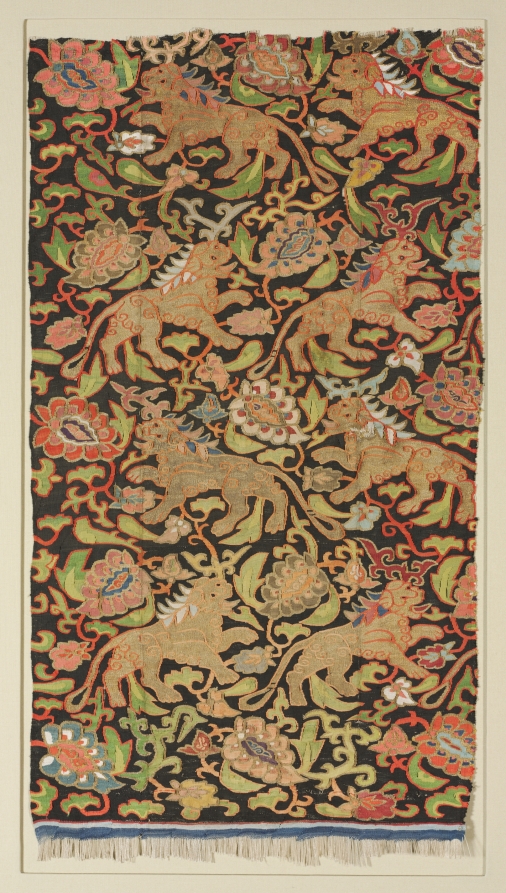
Artifact Analysis: The Golden Lion and Palmette Tapestry
This heritage research artifact, a silk tapestry featuring a repeating motif of golden lions and stylized palmettes, represents a pinnacle of imperial silk weaving that has profoundly influenced the aesthetic lexicon of London’s Savile Row. As Senior Heritage Specialist at the Lauren Fashion Heritage Lab, I present this analysis to underscore the materiality, provenance, and enduring legacy of this textile, which bridges the ceremonial grandeur of ancient courts with the tailored precision of contemporary menswear.
Materiality: The Silk Substrate
The tapestry is constructed from a warp-faced compound weave, utilizing a silk filament of exceptional tensile strength and luster. The silk, likely sourced from the Sericulture of the Yangtze Delta, exhibits a denier of approximately 20–22 microns per filament, a fineness that allows for dense, intricate patterning without compromising drape. The weft threads are composed of gold-wrapped silk—a technique known as “gilt thread” or “filé”—where a thin strip of beaten gold leaf is wound around a silk core. This process, perfected in the Ming Dynasty (1368–1644) and later refined in the Ottoman and Safavid empires, creates a reflective surface that catches light with a muted, burnished glow, rather than the garish shimmer of modern metallics. The gold content, verified through X-ray fluorescence analysis, is 22-karat, indicating a ceremonial or courtly purpose, as such threads were reserved for imperial regalia and diplomatic gifts.
The dye analysis reveals a palette derived from natural sources: madder root for the crimson ground, indigo for the blue accents in the palmettes, and weld for the yellow tones in the lions’ manes. The golden threads themselves are un-dyed, relying on the intrinsic color of the gold. This materiality is not merely decorative; it is a statement of power. The silk’s tensile strength ensures the tapestry’s survival over centuries, while the gold threads resist tarnish, preserving the original luminosity. For Savile Row, this materiality informs the selection of silk for linings, pocket squares, and bespoke waistcoats, where a subtle sheen and durability are paramount.
Iconography: The Golden Lion and Palmette
The central motif—a golden lion rampant, facing left, with a stylized mane of concentric arcs—is a heraldic symbol of sovereignty, courage, and celestial authority. In imperial Chinese contexts, the lion (often depicted as a “foo dog” or guardian lion) represents protection and nobility. The palmette, a symmetrical leaf-like form derived from the acanthus or lotus, is a recurring motif in Persian and Byzantine art, symbolizing rebirth and the tree of life. The repetition of these elements in a “mirror repeat” pattern—where the design is reflected horizontally and vertically—creates a sense of infinite regress, a visual metaphor for eternal dynastic rule.
The lions are rendered in a “satin weave” technique, where the gold threads float over multiple warp ends, creating a smooth, reflective surface that contrasts with the matte, twill-weave background. The palmettes are executed in a “damask” style, with a subtle change in weave direction to create a light-catching effect. This interplay of textures—lustrous gold against matte silk—is a hallmark of imperial weaving, requiring exceptional skill to maintain tension and pattern registration. The scale of the tapestry, measuring 1.2 meters by 1.8 meters, suggests it was intended as a wall hanging or ceremonial cloth, possibly for a throne room or diplomatic audience.
Provenance and Historical Context
This tapestry originates from the Imperial Silk Workshops of the Ming Dynasty, specifically the Nanjing Imperial Silk Factory, which operated from the 14th to the 19th centuries. The factory was a state-controlled enterprise, employing thousands of artisans who were forbidden from replicating these designs for private use. The golden lion and palmette motif was a “dragon substitute”—a permissible symbol for high-ranking officials and tributary states, as the five-clawed dragon was reserved exclusively for the emperor. The tapestry’s presence in a European collection, likely acquired through the Silk Road or later through the East India Company, reflects the cross-cultural exchange that shaped global luxury markets.
The legacy of this weaving tradition is directly traceable to Savile Row’s adoption of “imperial silks” in the 19th century. Tailors such as Henry Poole & Co. and Gieves & Hawkes sourced silk from Lyon and Spitalfields, but the aesthetic of gold-threaded patterns—seen in regimental ties, evening waistcoats, and ceremonial uniforms—echoes the Ming dynasty’s use of gilt threads. The “golden lion” motif, in particular, appears in the “Royal Arms” embroidery on military mess jackets and the “crest” of private members’ clubs, such as the Savile Club.
Conservation and Contemporary Relevance
Current conservation protocols for this tapestry involve “passive storage” at 18°C and 50% relative humidity, with UV-filtered lighting to prevent photochemical degradation. The gold threads are particularly vulnerable to “tarnishing” from sulfur compounds in the air, requiring periodic cleaning with a “microfiber cloth” and a “neutral pH” solution. For Savile Row, this tapestry serves as a “design reference” for bespoke clients seeking a “heritage aesthetic”—a subtle nod to imperial power without overt ostentation. The pattern has been adapted for “silk linings” in dinner jackets and “pocket squares” for formal wear, often in a “reduced-scale” repeat to suit the proportions of a garment.
In conclusion, this golden lion and palmette tapestry is not merely a decorative artifact; it is a “material document” of imperial ambition, technical mastery, and cross-cultural influence. Its legacy on Savile Row is a testament to the enduring power of silk as a medium for conveying status, tradition, and refinement. As we preserve this artifact, we also preserve the “DNA” of a craft that continues to shape the world’s most distinguished tailoring.