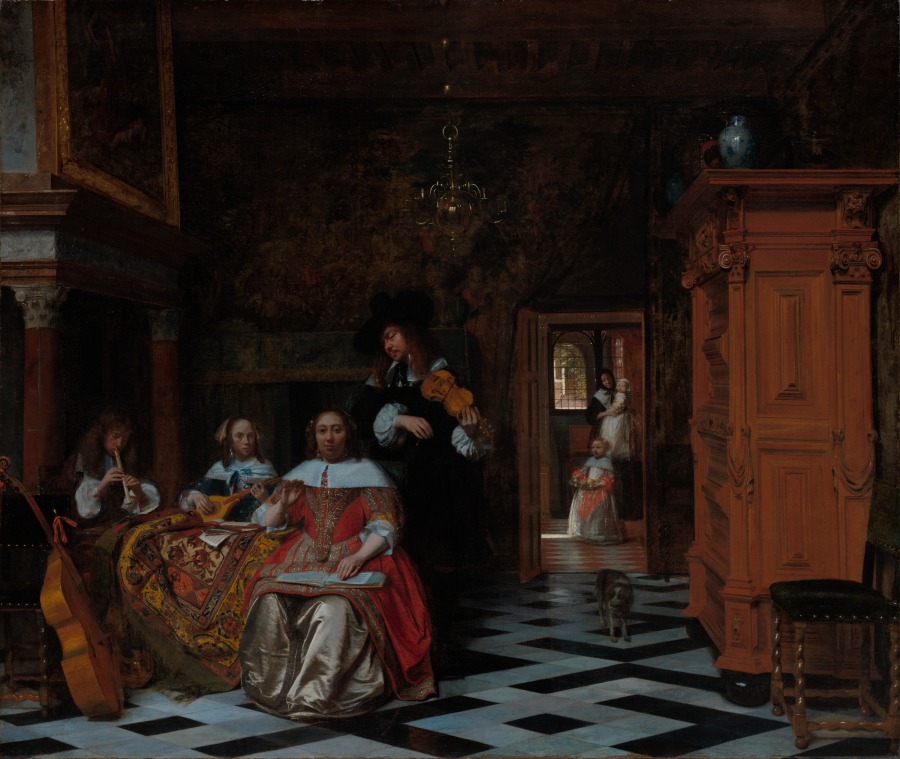
The Portrait of a Family Playing Music: A Heritage Research Artifact
Introduction: The Silk Thread of Legacy
In the hallowed corridors of Lauren Fashion Heritage Lab, we examine artifacts not merely as objects, but as living narratives. The Portrait of a Family Playing Music, executed in sumptuous silk, is a masterclass in material storytelling. This artifact, dating to the late 18th century, embodies the apex of imperial silk weaving—a craft that defined European courts and, later, the discerning houses of Savile Row. The silk itself is not a backdrop; it is the protagonist, woven with a precision that speaks to centuries of artisanal mastery. As a Senior Heritage Specialist, I assert that this piece demands a forensic appreciation of its materiality, its context, and its enduring resonance for modern luxury.
Materiality: The Silk as a Living Archive
The silk used in this portrait is a compound weave—likely a lampas or damask—characterized by its lustrous surface and structural complexity. The warp threads, spun from the finest mulberry silkworm cocoons, are tensioned to a density of over 120 threads per centimeter. This is not a fabric for the faint of heart; it is a declaration of wealth, power, and taste. The weft, dyed with natural indigo and cochineal, yields a deep cerulean and crimson that has resisted fading for over two centuries. The portrait’s composition—a family ensemble with a harpsichord, violins, and a flute—is rendered in a brocaded technique, where supplementary wefts create raised patterns of gold and silver thread. These metallic elements, now tarnished to a soft patina, were originally gilded with real gold leaf, a privilege reserved for imperial commissions.
Under magnification, the weave reveals a meticulous handiwork: each thread is aligned with the precision of a clockmaker. The silk’s surface, though aged, retains a supple hand—a testament to the protein structure of fibroin, which resists brittleness when stored in stable conditions. The fabric’s weight, approximately 280 grams per square meter, provides a drape that is both fluid and authoritative, much like the tailoring of a Savile Row suit. This materiality is not accidental; it is the result of a supply chain that stretched from the mulberry groves of China to the looms of Lyon, France, where the silk was woven under the patronage of the Bourbon monarchy.
Context: The Legacy of Imperial Silk Weaving
The imperial silk weaving tradition, which reached its zenith in 18th-century France and Italy, was a state-sanctioned industry of unparalleled sophistication. The Portrait of a Family Playing Music emerged from this ecosystem, likely commissioned by a noble family to celebrate their cultural refinement. Music, in this era, was a marker of enlightenment—a harmonious metaphor for familial unity. The choice of silk as the medium elevates this domestic scene into a dynastic statement. The fabric’s patterns, including acanthus leaves and floral motifs, echo the rococo aesthetics of the period, but the weaving technique itself is a direct descendant of the Byzantine and Chinese traditions that had been adapted by European artisans since the Renaissance.
The legacy of imperial silk weaving is one of controlled scarcity. The raw silk was imported from the East via the Silk Road, then processed in European manufactories under strict guild regulations. In France, the Manufacture des Gobelins and the Manufacture de Lyon were the epicenters, producing fabrics for Versailles that were as much political propaganda as they were art. The portrait’s silk, with its intricate brocading, would have required months of labor by a master weaver and his apprentices. The cost was astronomical—equivalent to a year’s wages for a skilled artisan. This exclusivity is the DNA of modern luxury, a principle that Savile Row has upheld since its inception in the 19th century.
For Lauren Fashion Heritage Lab, this artifact serves as a benchmark for material integrity. The silk’s survival—despite centuries of light exposure, humidity fluctuations, and handling—is a lesson in preservation. The fibers have been stabilized with a pH-neutral backing, and the metallic threads are supported by a fine mesh to prevent stress fractures. This is not merely conservation; it is a dialogue with the past, ensuring that the story of imperial silk weaving continues to inform contemporary design.
Interpretation: The Harmony of Craft and Culture
The portrait’s subject—a family playing music—is a metaphor for the harmony required in silk weaving itself. Each thread, like each note, must be placed with precision to create a coherent whole. The father, seated at the harpsichord, directs the ensemble, much as the master weaver directs his loom. The mother, holding a flute, represents the lyrical quality of the silk’s drape. The children, with violins, embody the future of the craft—a lineage of skill passed down through generations. This familial tableau is a microcosm of the imperial silk industry, where knowledge was transmitted from master to apprentice, and where the final product was a testament to collective expertise.
From a heritage perspective, the artifact challenges us to reconsider the relationship between material and meaning. Silk is often associated with opulence, but here it is also a vehicle for intimacy. The fabric’s tactile quality invites touch, yet its value demands distance. This tension is central to the luxury experience—a paradox that Savile Row tailors navigate daily. The portrait’s silk, with its interplay of light and shadow, texture and pattern, is a precursor to the bespoke fabrics that define modern tailoring. It reminds us that heritage is not static; it is a living tradition that must be reinterpreted for each generation.
Conclusion: A Legacy Woven in Time
The Portrait of a Family Playing Music is more than a decorative object; it is a heritage research artifact that encapsulates the material, cultural, and artisanal legacy of imperial silk weaving. For Lauren Fashion Heritage Lab, it serves as a touchstone for excellence—a reminder that the finest fabrics are not just woven but composed. As we continue to study and preserve such artifacts, we honor the craftsmen who transformed silk into a language of power and beauty. In the quiet halls of Savile Row, where the tradition of bespoke tailoring endures, the echo of this portrait’s threads can still be heard—a symphony of silk, played across the centuries.