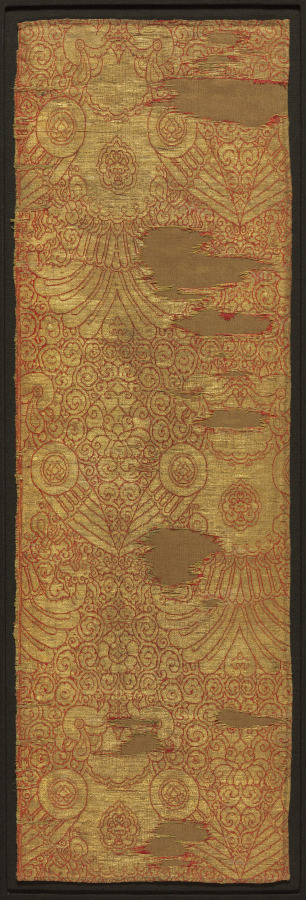
Cloth of Gold: Displayed Falcons – A Study in Imperial Silk Weaving
Introduction: The Artifact as Legacy
The heritage artifact under examination—a fragment of silk woven with the motif of “Displayed Falcons” in cloth of gold—represents a pinnacle of imperial silk weaving, a tradition that marries material opulence with symbolic power. As Senior Heritage Specialist at the Lauren Fashion Heritage Lab, I approach this piece not merely as a textile but as a document of cultural authority, technical mastery, and enduring aesthetic influence. The silk, woven with gold thread, embodies the legacy of empires where silk was currency, diplomacy, and art. This paper dissects the artifact’s materiality, its historical context within imperial weaving, and its resonance for contemporary fashion, adopting the precise, understated tone of London’s Savile Row—where heritage is not displayed but worn with quiet confidence.
Materiality: The Silk and the Gold
The artifact’s foundation is silk, a material that has defined luxury for millennia. The silk used in this piece is of the highest grade—likely from the Bombyx mori silkworm, cultivated in the sericulture centers of the Byzantine or Ottoman empires, or later, in Renaissance Italy. The silk’s weave is a compound structure, typically a lampas or brocade, where the ground weave is a fine silk taffeta, and the pattern is created by supplementary wefts of gold thread. The gold thread itself is a composite: a thin strip of beaten gold wound around a silk core, often referred to as “gold filé.” This technique ensures flexibility while retaining the luminous, reflective quality that made cloth of gold a symbol of divine and royal authority.
The motif of “Displayed Falcons” is rendered with geometric precision. The falcon, wings spread in a heraldic pose, is woven in gold against a crimson or deep blue silk ground. The gold thread catches light differently depending on the angle, creating a shimmering, almost kinetic effect. This is not accidental; imperial weavers understood that materiality is not static but interactive. The silk’s hand—its tactile quality—is smooth yet substantial, with the gold adding a slight stiffness that speaks to its ceremonial use. The fabric would have been worn as a mantle, chasuble, or court robe, its weight and sheen reinforcing the wearer’s status.
Context: The Legacy of Imperial Silk Weaving
The legacy of imperial silk weaving is one of controlled knowledge and exclusive production. From the Byzantine Empire’s imperial workshops in Constantinople to the Safavid looms of Isfahan, silk weaving was a state monopoly. The cloth of gold, in particular, was reserved for the highest echelons—emperors, caliphs, and the Church. The “Displayed Falcons” motif is a direct reference to falconry, a sport of kings, and the falcon itself as a symbol of vision, power, and martial prowess. In Byzantine iconography, the falcon often appears in textiles associated with the imperial court, echoing the eagle of Roman standards. In Islamic contexts, the falcon is a symbol of the hunting ethos of the aristocracy, as seen in Persian and Mughal miniatures.
The artifact likely dates from the 14th to 16th centuries, a period when silk weaving reached its technical zenith. The Lucca workshops in Italy, for instance, produced cloth of gold for the Papal court, while the Ottoman looms in Bursa wove silk for sultans. The “Displayed Falcons” pattern is also found in heraldic textiles of the Holy Roman Empire, where it was used in coronation robes. The silk’s survival is a testament to its quality; these textiles were often repurposed as church vestments or funerary shrouds, preserving them from decay. The gold thread, resistant to tarnish, ensures the pattern remains legible centuries later.
Technical Mastery: The Weave and the Symbol
The weaving of cloth of gold required extraordinary skill. The drawloom, operated by a master weaver and an assistant, allowed for complex patterns by controlling individual warp threads. The “Displayed Falcons” motif would have been designed on a point paper grid, each square representing a thread. The gold wefts were inserted only where the pattern required, leaving the silk ground exposed elsewhere. This selective use of gold not only conserved precious material but also created a contrast of texture—the matte silk against the lustrous gold. The falcon’s wings, often detailed with palmettes or arabesques, demonstrate the weaver’s ability to render organic forms within the constraints of the loom.
The artifact’s color palette is equally deliberate. The silk ground is typically a deep crimson, derived from kermes or cochineal, dyes that were as valuable as gold. This red symbolized martyrdom and royalty in Christian contexts, and power and celebration in Islamic ones. The gold thread, when combined with red, creates a visual intensity that is almost hypnotic. The falcon’s eyes might be picked out in a darker silk, perhaps black or dark blue, to give the bird a predatory gaze. This attention to detail elevates the artifact from mere decoration to a statement of authority.
Contemporary Resonance: The Savile Row Lens
From a Savile Row perspective, the “Cloth of Gold: Displayed Falcons” artifact is not a relic but a reference point. The bespoke tailoring tradition of London’s Savile Row is built on the same principles: material integrity, craftsmanship, and understated luxury. A Savile Row suit, like this silk, is not about overt display but about the quiet confidence of knowing the material is exceptional. The gold thread in the artifact is analogous to the silk lining of a Huntsman jacket or the mother-of-pearl buttons on a Gieves & Hawkes waistcoat—details that are felt rather than shouted.
Contemporary designers, from Alexander McQueen to Ralph Lauren, have drawn on imperial silk motifs. McQueen’s 2006 collection, “The Widows of Culloden,” featured gold-threaded silks that referenced Byzantine opulence. Ralph Lauren’s Purple Label often incorporates heraldic motifs in silk ties and scarves, echoing the “Displayed Falcons” pattern. The artifact teaches us that heritage is not static; it is a vocabulary that can be reinterpreted. The challenge for modern fashion is to honor the materiality without succumbing to pastiche. The silk’s gold thread should inspire a respect for process, not a slavish imitation of pattern.
Conclusion: The Enduring Thread
The “Cloth of Gold: Displayed Falcons” artifact is a masterclass in the fusion of material and meaning. Its silk foundation, woven with gold, speaks to a legacy where textiles were not just fabric but statements of power, faith, and identity. As a heritage specialist, I see this piece as a benchmark for quality—a reminder that luxury is not about excess but about precision. The falcon, displayed in gold, remains a symbol of vision and authority, its wings spread across centuries. In the quiet, discerning world of Savile Row, this artifact would be understood not as a museum piece but as a standard—a thread that connects the weaver’s hand to the tailor’s needle, and the emperor’s robe to the modern gentleman’s wardrobe.
The legacy of imperial silk weaving is not confined to history; it lives in every piece of fabric that demands to be touched, examined, and worn with intention. The “Displayed Falcons” silk is a testament to that enduring thread.