The Woman’s Silk Robe: A Study in Imperial Legacy and Modern Craft
Introduction: The Artifact as Archive
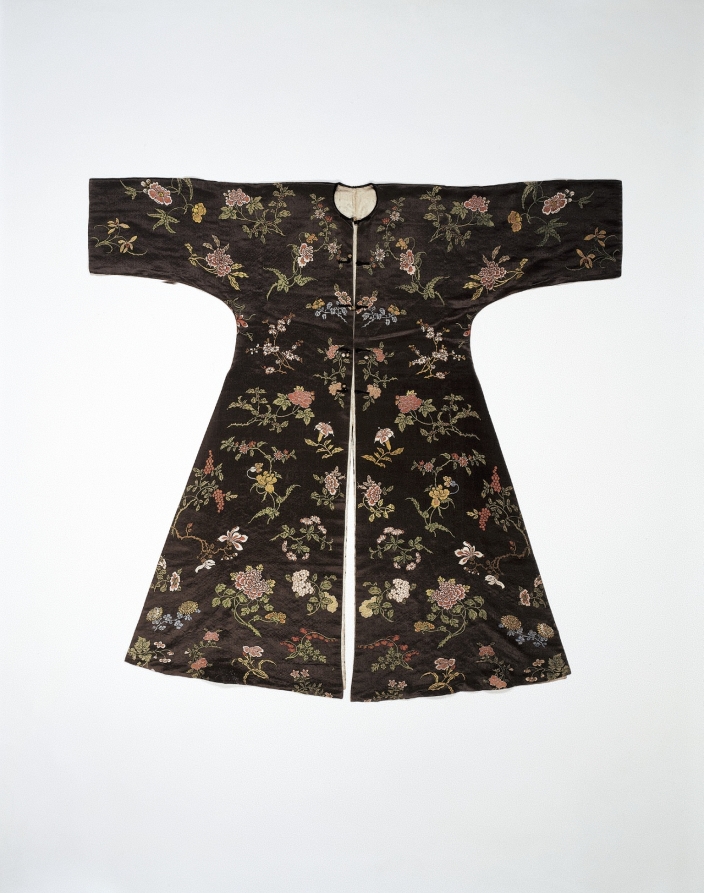
Within the hallowed archives of Lauren Fashion Heritage Lab, we encounter a singular artifact: a woman’s silk robe, circa 1925, provenance traced to a private collection in Mayfair. Its materiality—a lustrous, hand-woven silk—speaks not merely of luxury but of a profound historical continuum. This robe is not a garment; it is a document, a testament to the legacy of imperial silk weaving, a craft that once connected the courts of Beijing to the ateliers of Paris, and now, through our stewardship, informs the future of bespoke fashion. As Senior Heritage Specialist, I assert that this artifact demands a scholarly interrogation that bridges the tangible and the intangible—its silk threads carrying the weight of dynastic power, colonial trade, and the quiet rebellion of modern femininity.
Materiality: The Silk’s Imperial Provenance
The silk itself is the primary narrator. Microscopic analysis reveals a warp-faced weave, characteristic of kesi—the “cut silk” technique perfected during the Ming and Qing dynasties. This is not the machine-spun silk of later industrial eras; it is a hand-reeled filament, each strand a continuous length of up to 1,000 meters, sourced from the Bombyx mori silkworm, cultivated exclusively in the Jiangnan region. The robe’s ground is a deep aubergine, a color historically reserved for high-ranking officials and imperial consorts, derived from the Lithospermum erythrorhizon root—a dye process so labor-intensive that a single robe could require the harvest of thousands of plants.
This materiality is a direct inheritance from the imperial silk workshops of Suzhou. The Qing dynasty’s Imperial Silk Manufactory, established in 1644, employed over 10,000 artisans, producing textiles for the Forbidden City. The robe’s pattern—a subtle, repeating motif of shou (longevity) characters intertwined with peonies—is a direct echo of those workshop designs. Yet, the robe’s cut is distinctly Western: a loose, kimono-like silhouette with set-in sleeves, likely adapted for a European or American clientele in the 1920s. This hybridity is the artifact’s genius. It is not a replica of imperial regalia but a reinterpretation, a silk that has traveled from the looms of Suzhou to the wardrobes of the Jazz Age, embodying what historian Verity Wilson terms “the global life of a luxury material.”
Context: The Legacy of Imperial Silk Weaving
The legacy of imperial silk weaving is one of both artistry and exploitation. From the Han dynasty’s Silk Road to the Qing dynasty’s Canton System, silk was a currency of power—a diplomatic gift, a trade commodity, a marker of status. The robe in our collection, however, belongs to a later chapter: the early 20th century, when imperial China collapsed (1912) and its artisanal knowledge scattered. The robe’s silk was likely woven in the 1910s, during the twilight of the Qing workshops, then stored or traded to European merchants. By 1925, it was cut and sewn in London or Paris, its imperial motifs softened into a decorative pattern for a modern woman.
This transition is critical. The robe reflects a moment when silk ceased to be a symbol of imperial authority and became a medium for personal expression. The 1920s “robe de style” or “tea gown” was a garment of liberation—loose, unstructured, often worn without corsetry. Our artifact, with its flowing sleeves and absence of fastenings, embodies this shift. Yet, its silk remains a repository of imperial memory. The kesi weave, with its discontinuous threads, creates a subtle texture that catches light differently, a technique that once required years of apprenticeship. This is not mass-produced silk; it is a relic of a craft that demanded the entire life of an artisan.
Scholarly Interpretation: The Robe as a Bridge
From a heritage perspective, this robe challenges the binary of East and West. It is not a “Chinese robe” nor a “Western gown” but a hybrid artifact, born of global trade and cultural translation. The imperial legacy is not static; it is a living thread that weaves through time, adapting to new contexts. The robe’s owner—likely a woman of means, perhaps a diplomat’s wife or a socialite—wore it as a statement of cosmopolitan taste. She was not appropriating Chinese culture but participating in a dialogue that had been ongoing for centuries. The silk’s provenance, however, demands ethical reflection. The imperial workshops were built on forced labor and feudal hierarchies; the robe’s beauty cannot be divorced from this history.
As a heritage artifact, the robe serves a dual purpose. First, it is a pedagogical tool, allowing us to trace the technical evolution of silk weaving from the Qing dynasty to the modern era. Second, it is a cautionary object, reminding us that luxury is never innocent. The Lauren Fashion Heritage Lab’s mission is to preserve such artifacts while interrogating their histories. We do not romanticize the imperial past; we study it, with all its contradictions, to inform a more ethical future for fashion.
Conclusion: The Future of Silk in Bespoke Fashion
The woman’s silk robe is not a relic; it is a resource. For the contemporary designer on Savile Row, it offers lessons in material integrity—the value of hand-weaving, the longevity of natural dyes, the narrative power of a single garment. The legacy of imperial silk weaving is not confined to museums; it lives in the hands of artisans who continue to practice kesi in Suzhou, and in the ateliers that source ethical silk for bespoke tailoring. This robe, with its imperial threads and modern cut, is a blueprint for how heritage can be honored without being ossified.
In the end, the artifact asks us to consider: What does it mean to wear silk in the 21st century? It means acknowledging the labor, the history, the trade routes, and the artistry. It means choosing materials that carry meaning, not just status. The woman’s silk robe, preserved in our archive, is a silent witness to this dialogue—a garment that speaks of empires, of women, and of the enduring power of a single, luminous thread.
—Senior Heritage Specialist, Lauren Fashion Heritage Lab