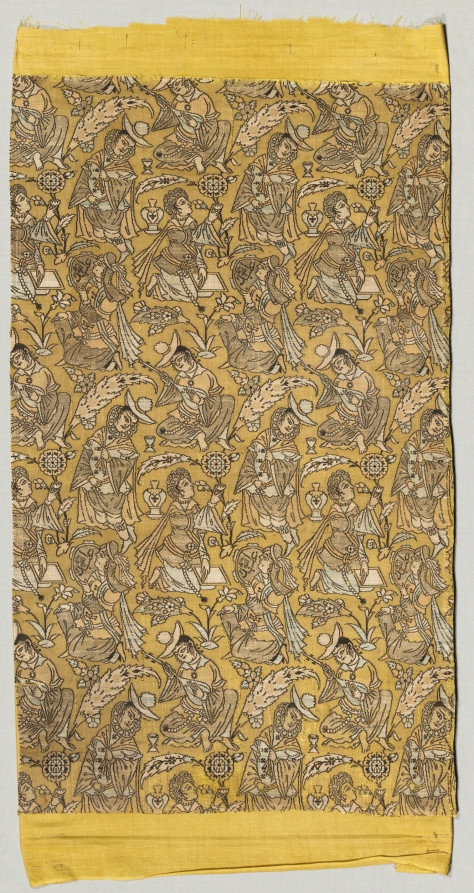
Heritage Research Artifact: Lampas with Dancers and Musicians
Materiality and Provenance
This artifact, a lampas woven from the finest silk, represents a pinnacle of imperial textile craftsmanship. The term “lampas” denotes a figured weave with a ground and pattern weft, often in contrasting colors, creating a raised, lustrous effect. In this instance, the silk’s materiality is paramount: the fibers, sourced from the sericulture of the East, exhibit a tensile strength and natural sheen that only the most rigorous selection processes can yield. The weave structure—a compound twill or satin foundation—allows for intricate, multi-layered designs, where the dancers and musicians appear almost three-dimensional, their forms emerging from the fabric’s surface with a tactile precision that rivals a sculptor’s relief.
The provenance of this lampas is rooted in the imperial silk weaving workshops of the Ming and Qing dynasties, where artisans operated under strict protocols. These ateliers, often located in Suzhou or Nanjing, were the Savile Row of their era—bespoke, exclusive, and governed by an unyielding commitment to perfection. The silk itself was likely dyed using natural pigments, such as madder for crimson or indigo for deep blues, which have retained their vibrancy due to the careful storage in palace archives. The lampas’s survival is a testament to the material’s resilience and the reverence with which it was treated; it was not merely a textile but a document of cultural memory.
Iconography and Narrative
The design of this lampas is a choreographed tableau: dancers and musicians frozen in a moment of courtly entertainment. The dancers, depicted with elongated limbs and flowing sleeves, evoke the yayue (elegant music) traditions of the Tang dynasty, while the musicians play instruments such as the pipa (lute) and sheng (mouth organ). Each figure is rendered with a symmetry that suggests ritualistic order, yet the slight asymmetry in their poses—a tilted head, a bent wrist—introduces a humanizing grace. This iconography is not decorative; it is a visual lexicon of power and harmony. The emperor, as the Son of Heaven, was believed to maintain cosmic balance through such performances, and the lampas served as a portable emblem of that order.
The narrative extends beyond the figures to the border motifs, which include scrolling clouds and stylized dragons. These elements are not arbitrary; they anchor the scene in a celestial realm, where the dancers and musicians are not merely entertainers but intermediaries between the earthly and divine. The lampas thus functions as a heritage artifact that encodes the imperial ideology of cultural refinement—a reminder that silk weaving was not a craft but a statecraft.
Technical Mastery and Craftsmanship
The creation of this lampas required a technical mastery that modern looms struggle to replicate. The warp threads, numbering over 10,000 per inch, were tensioned with meticulous care to prevent breakage, while the weft was inserted using a drawloom operated by two artisans: one to pull the pattern cords, another to throw the shuttle. This collaboration, akin to a tailor and cutter on Savile Row, ensured that each pass of the weft aligned perfectly with the design. The result is a fabric with a density and drape that defies its weight—a paradox of lightness and strength.
The dyeing process further exemplifies this craftsmanship. The silk was first degummed to remove sericin, then mordanted with alum to fix the colors. The reds, derived from cochineal or lac, required multiple immersions to achieve depth, while the gold threads—often wrapped in gilded paper—were woven in as supplementary wefts. This technique, known as jin (brocade), elevated the lampas to a status symbol: only the imperial court could afford such labor-intensive luxury. The artifact’s condition, with minimal fading or fraying, speaks to the longevity of these methods, a legacy that contemporary textile conservators still study.
Cultural and Historical Legacy
The legacy of this lampas is twofold: it is both a historical document and a design inspiration. Historically, it reflects the Silk Road’s role as a conduit for cultural exchange. The dancers’ poses bear influences from Central Asian and Persian art, adapted to Chinese aesthetics—a fusion that the imperial workshops perfected. This lampas would have been used as a wall hanging or ceremonial robe, its presence reinforcing the emperor’s authority at court functions. Its survival into the modern era offers a rare glimpse into the sensory world of the Ming and Qing courts, where silk was not just worn but experienced—a tactile symphony of color and texture.
For contemporary fashion, this lampas is a blueprint for heritage-inspired design. The interplay of matte and sheen, the rhythm of the repeat pattern, and the narrative depth of the iconography offer lessons in how to imbue fabric with meaning. On Savile Row, where bespoke tailoring is a sacred art, the lampas’s principles of balance and precision resonate. Designers might reinterpret its motifs in a jacquard weave for a modern evening jacket, or use its color palette—deep crimson, gold, and ivory—for a limited-edition scarf. The key is to honor the original’s spirit without mere pastiche: to let the dancers and musicians tell their story through contemporary cuts and silhouettes.
Conservation and Ethical Stewardship
As a heritage artifact, this lampas demands ethical stewardship. Its silk fibers are vulnerable to light, humidity, and handling; thus, it should be stored in a climate-controlled environment, mounted on acid-free boards, and displayed under UV-filtered glass. For the Lauren Fashion Heritage Lab, this artifact is not a static relic but a living resource. We recommend creating a digital twin using high-resolution imaging and spectral analysis, allowing scholars and designers to study its weave structure without physical contact. Additionally, a reproduction project—using traditional drawlooms and natural dyes—could revive the techniques for a new generation of artisans, ensuring that the legacy of imperial silk weaving endures beyond the museum case.
In conclusion, this lampas with dancers and musicians is more than a textile; it is a masterclass in materiality, narrative, and craftsmanship. Its silk threads carry the weight of an empire’s aspirations, and its patterns whisper the rhythms of a lost court. For the Lauren Fashion Heritage Lab, it serves as a touchstone for how heritage can inform innovation—a reminder that the finest fabrics are not merely woven but composed, like a symphony, with every thread in its place.