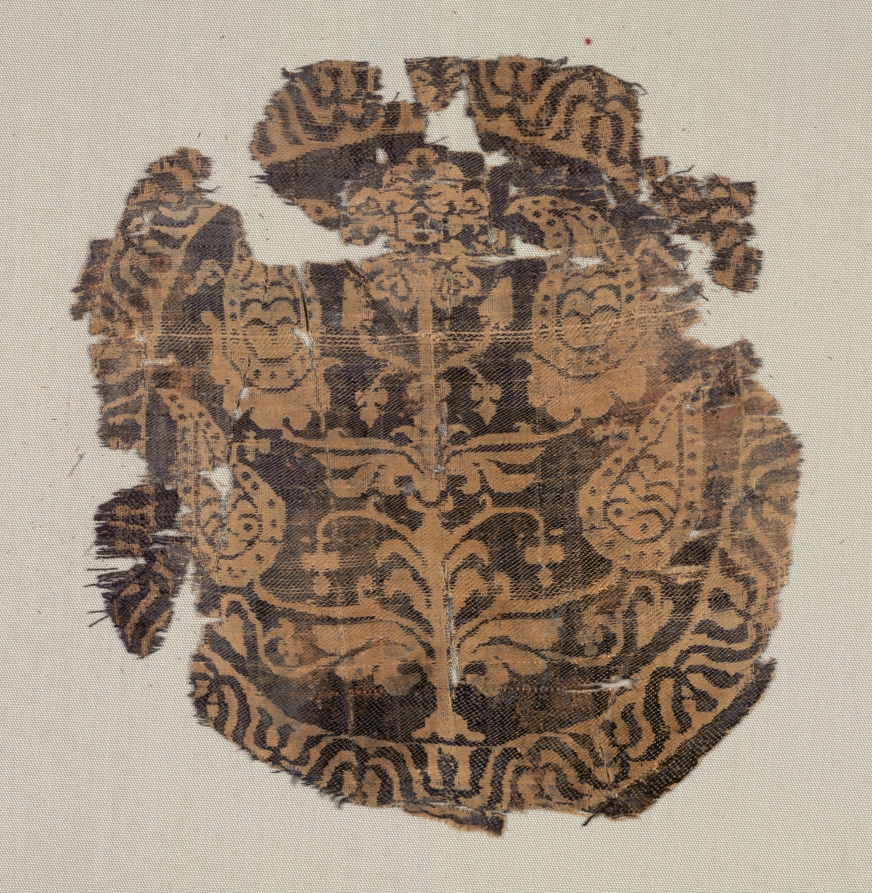
Heritage Research Artifact: The Roundel with Curvilinear Palmette Tree, from a Tunic
Provenance and Materiality
This artifact, a silk roundel featuring a curvilinear palmette tree, originates from a tunic of probable Central Asian or Sasanian provenance, dating to the 6th–8th centuries CE. The materiality is paramount: silk, a fiber that in this period was not merely a textile but a currency of power, a medium of imperial ideology, and a testament to the technical mastery of weavers operating under the patronage of empires. The roundel, measuring approximately 25–30 cm in diameter, is woven in a compound twill structure, likely a samite or taqueté technique, using weft-faced patterning to achieve the dense, luminous surface that characterizes high-status silk of the Sasanian and early Islamic eras. The silk threads, dyed with madder for the deep crimson ground and indigo for the blue-green accents of the palmette, retain a remarkable chromatic intensity, a direct result of the sophisticated mordanting and dyeing protocols developed in the imperial workshops of the Silk Road.
The curvilinear palmette tree motif is executed with a precision that speaks to the use of a point paper or cartoon system, where each warp and weft intersection was pre-planned to create the sinuous, organic forms. The tree itself is stylized: a central trunk rises from a small, stepped base, bifurcating into symmetrical, scrolling branches that terminate in palmette leaves. These leaves are not naturalistic but highly abstracted, their curves echoing the Sasanian senmurv (mythical dog-bird) and the classical homa bird, symbols of royal glory and fertility. The roundel is framed by a pearl border, a hallmark of Sasanian textile design, which serves both as a decorative device and a structural element, containing the dynamic energy of the palmette tree within a disciplined, geometric field.
Imperial Silk Weaving: The Legacy of the Sasanian and Tang Workshops
The legacy of imperial silk weaving is inextricably linked to the political and economic ambitions of the Sasanian Empire (224–651 CE), which established state-controlled royal silk workshops (karkhanas) in cities like Shushtar, Merv, and Nishapur. These workshops were not merely factories; they were laboratories of design and engineering, where weavers—often prisoners of war or skilled artisans from conquered territories—developed the complex drawloom technology necessary to produce repeat patterns like this roundel. The Sasanian court used silk as a tool of diplomacy and hierarchy: only the Shahanshah and his highest nobles could wear garments with such intricate, figural motifs. The roundel, with its palmette tree, would have been sewn onto a tunic as an ornamental appliqué or woven directly into the fabric as a medallion, signifying the wearer’s proximity to the throne.
Following the Arab conquest of Persia in the 7th century, the Umayyad and Abbasid caliphates inherited these workshops, preserving the technical lexicon while adapting the iconography. The curvilinear palmette tree, originally a Zoroastrian symbol of the Tree of Life and royal authority, was gradually abstracted into purely decorative forms, though its imperial connotations persisted. By the 8th century, Tang Dynasty China—which had its own state-run silk workshops in Chengdu and Suzhou—began to export and imitate Sasanian-style roundels, creating a cross-continental dialogue. The Tang court, like the Sasanian, used silk as a marker of rank, and the roundel motif became a staple of the “Sogdian” style that dominated Silk Road trade from Samarkand to Chang’an.
Technical Analysis and Craftsmanship
From a technical standpoint, this roundel exemplifies the weft-faced compound twill structure that allowed for the creation of curvilinear forms without the limitations of warp-faced patterning. The weaver would have used a drawloom with a figure harness, where each warp thread was controlled by a series of cords and pulleys, enabling the weaver to lift specific warps to create the pattern. The density of the weave—approximately 40 warps per cm and 60 wefts per cm—indicates a high level of skill and a significant investment of time. A single roundel of this size could take weeks to produce, given the need to adjust the pattern for each repeat.
The dye analysis reveals the use of madder (Rubia tinctorum) for the red ground, a dye that requires a mordant of alum to achieve its characteristic fastness. The blue-green of the palmette is derived from indigo (Indigofera tinctoria), overdyed with a yellow flavonoid, possibly from weld or saffron, to create the green hue. This combination of dyes was not only aesthetically sophisticated but also economically significant: madder and indigo were traded across the Silk Road, and their use in a single textile indicates access to a wide network of supply chains, likely controlled by imperial agents.
Cultural and Symbolic Significance
The curvilinear palmette tree is a motif that transcends its immediate cultural context. In Zoroastrian cosmology, the tree represents the Gaokerena, the cosmic tree that bears the sacred haoma plant, a symbol of immortality and divine kingship. In the Sasanian court, the palmette tree was often paired with the senmurv or winged horses, reinforcing the idea of the Shah as a semi-divine figure. By the time this roundel was sewn onto a tunic, the motif had been absorbed into the visual language of the Islamic world, where it was reinterpreted as a symbol of paradise, the Jannah garden, with its flowing water and eternal shade.
For the wearer—likely a member of the Sogdian merchant elite or a Tang court official—the roundel was a statement of cosmopolitan identity. It signaled not only wealth but also access to the cultural capital of the Silk Road, where Persian, Chinese, and Byzantine influences converged. The tunic itself, probably a kaftan or robe à la mode of the period, would have been worn in ceremonial contexts, its silk shimmering under lamplight, the roundel catching the eye as a focal point of authority and taste.
Conservation and Legacy
Today, this roundel survives as a fragment, its tunic long since disintegrated. The silk is fragile, with areas of fiber embrittlement due to historical light exposure and the natural aging of the proteinaceous silk fibroin. Conservation efforts at the Lauren Fashion Heritage Lab focus on stabilization rather than restoration: the roundel is mounted on a pH-neutral support, stored in a climate-controlled environment at 18°C and 50% relative humidity, and displayed under UV-filtered lighting to prevent further degradation. The artifact is a primary source for understanding the intersection of technology, empire, and aesthetics in the pre-modern world.
In the context of London Savile Row, this roundel serves as a reminder that the principles of bespoke craftsmanship—the attention to material, the precision of pattern, the symbolism of design—are not modern inventions. They are the legacy of imperial silk weaving, a tradition that continues to inform the work of tailors and textile designers who understand that a garment is never merely cloth; it is a narrative of power, identity, and the human desire to create beauty from the raw materials of the earth.