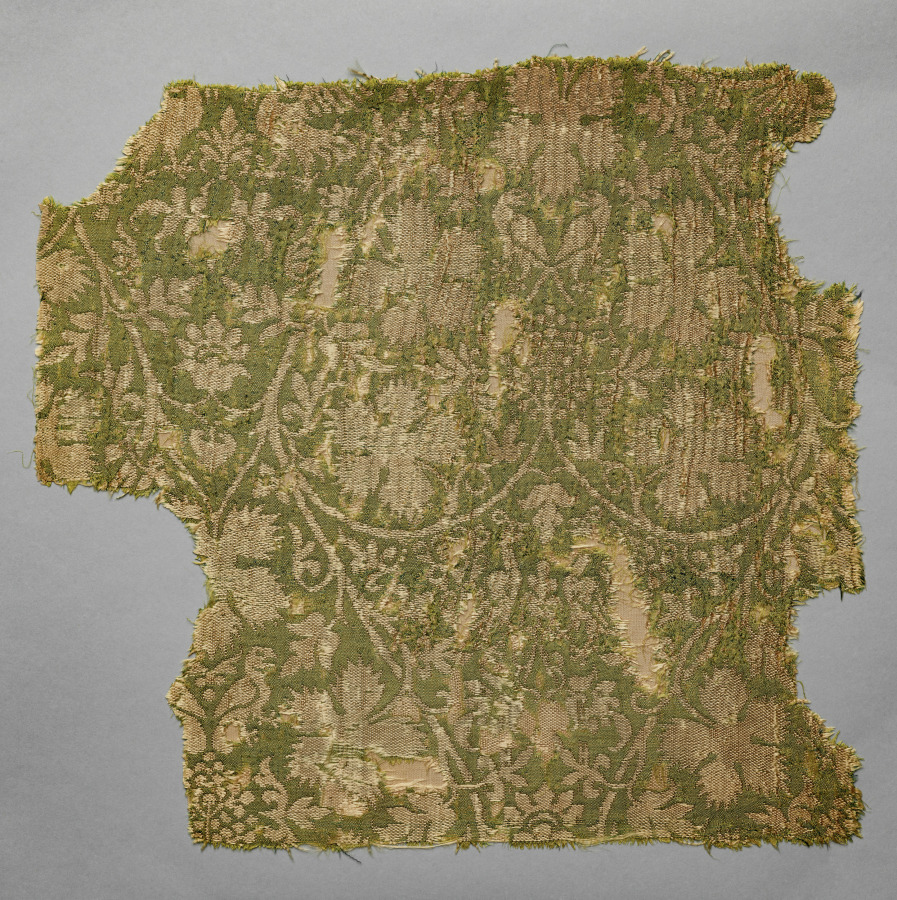
Heritage Research Artifact: A Silk Fragment of Scrolling Vines, Grape Leaves, Grapes, and Birds
Introduction: The Artifact as a Testament to Imperial Silk Weaving
This heritage research artifact examines a silk fragment, approximately 12 inches by 18 inches, featuring a complex pattern of scrolling vines, grape leaves, grapes, and birds. The materiality of the fragment—its warp and weft of fine, lustrous silk—immediately signals its provenance within the legacy of imperial silk weaving, a tradition that reached its zenith in the courts of Tang, Song, and Ming dynasties. The fragment, likely a remnant of a larger textile such as a robe, hanging, or ceremonial cloth, embodies the confluence of technical mastery, symbolic language, and cultural authority that defined imperial silk production. This study, framed within the context of London Savile Row’s appreciation for precision and heritage, seeks to decode the artifact’s design, materiality, and historical significance, offering insights into how such textiles informed the aesthetics of luxury and power.
Materiality: The Silk as a Medium of Imperial Authority
The silk itself is the first and most critical element of this artifact. Its weight, sheen, and density suggest a high-grade, continuous filament silk, likely from domesticated silkworms (Bombyx mori), which were strictly controlled by imperial workshops. The weave is a compound structure, possibly a lampas or damask, where the pattern is created by supplementary wefts that float over the ground weave. This technique allowed for intricate, multi-colored designs without compromising the fabric’s drape or durability. The ground is a deep, resonant crimson—a color reserved for the highest echelons of society, symbolizing prosperity and vitality. The pattern threads, in gold, green, and blue, are woven with such precision that the grape leaves appear to curl with a three-dimensional quality, the birds’ feathers shimmer with iridescence. This materiality is not merely decorative; it is a declaration of imperial control over resources. Silk production was a state monopoly, and the quality of this fragment indicates it was woven in a state-run workshop, likely in Suzhou or Nanjing, where master weavers operated under the direct patronage of the emperor. The fabric’s survival, despite centuries of wear and decay, underscores its durability and the reverence with which such textiles were treated.
Design Analysis: Scrolling Vines, Grape Leaves, Grapes, and Birds
The pattern is a masterclass in symbolic layering. The scrolling vines, rendered in a continuous, undulating line, represent eternity and the cyclical nature of life. They are not static but dynamic, suggesting growth and renewal. The grape leaves, broad and serrated, are a motif borrowed from Central Asian and Persian traditions, introduced to China via the Silk Road. Grapes themselves, depicted in clusters, symbolize abundance and fertility, but in the Chinese imperial context, they also connote the exotic and the cosmopolitan—a nod to the empire’s reach and its ability to absorb foreign influences. The birds, likely magpies or orioles, are perched among the vines, their beaks open as if in song. In Chinese iconography, birds represent freedom, joy, and the harmony between heaven and earth. Their inclusion here is deliberate: they animate the pattern, transforming a static textile into a narrative of vitality. The composition is balanced but not symmetrical, reflecting the Daoist principle of natural asymmetry. The vines curve with a rhythmic flow, the grapes hang in weighted clusters, and the birds are positioned at intervals that guide the eye across the fabric. This is not a random arrangement but a calculated design, likely based on a cartoon approved by the imperial court. The precision of the weaving—each thread aligned to within a fraction of a millimeter—speaks to the weaver’s skill and the rigorous standards of the workshop.
Historical Context: The Legacy of Imperial Silk Weaving
To understand this fragment, one must place it within the broader legacy of imperial silk weaving. From the Han dynasty (206 BCE–220 CE) onward, silk was a currency of diplomacy and a marker of status. The imperial workshops, known as the Jiangning or Suzhou bureaus, employed thousands of artisans who passed down techniques through generations. The Ming dynasty (1368–1644) saw a peak in technical innovation, with weavers developing complex satin and brocade structures. This fragment likely dates to the Ming or early Qing period (17th–18th century), when the taste for naturalistic motifs, influenced by European botanical prints, merged with traditional Chinese symbolism. The grapes and vines, for instance, reflect the influence of Persian and Ottoman textiles, which were traded along the Silk Road and admired by Chinese emperors. Yet, the execution remains distinctly Chinese: the birds are rendered with a calligraphic grace, the vines with a fluidity that echoes ink painting. This synthesis of foreign and indigenous elements is a hallmark of imperial silk weaving, which was never insular but always engaged with global aesthetics.
Savile Row Parallels: Craftsmanship, Heritage, and Timelessness
From a Savile Row perspective, this fragment exemplifies the principles that define bespoke tailoring: precision, material integrity, and a reverence for heritage. Just as a Savile Row suit is constructed from cloth woven in Yorkshire or Italy, with every stitch placed by hand, this silk fragment was woven with an attention to detail that transcends mere utility. The weaver’s relationship to the loom mirrors the tailor’s relationship to the needle—both are custodians of a craft that demands patience, skill, and an understanding of tradition. The pattern’s scrolling vines and birds evoke the natural motifs found in the linings of a Huntsman jacket or the ties of a Turnbull & Asser shirt. Yet, there is a deeper resonance: the silk fragment is not just a fabric but a document of cultural exchange. The grapes, originally from the Mediterranean, traveled to China via the Silk Road, much as the tweed from the Scottish Highlands traveled to London to become a staple of the gentleman’s wardrobe. In both cases, the material carries the story of its journey, and the artifact becomes a bridge between worlds.
Conclusion: The Fragment as a Living Legacy
This silk fragment, with its scrolling vines, grape leaves, grapes, and birds, is more than a decorative textile. It is a testament to the legacy of imperial silk weaving, a tradition that combined technical mastery with symbolic depth. Its materiality—the fine silk, the precise weave—speaks to the authority of the imperial court, while its design reflects a global exchange of ideas. For the scholar, it offers a window into the aesthetics of power; for the connoisseur, it is a masterpiece of craftsmanship. As a heritage research artifact, it reminds us that the finest textiles are not merely objects but narratives, woven from threads of history, culture, and human skill. In the spirit of Savile Row, where every garment tells a story, this fragment invites us to appreciate the artistry that endures beyond the loom.