The Embroidered Tree of Life: A Silk Hanging as Imperial Legacy
Introduction: The Artifact as Archive
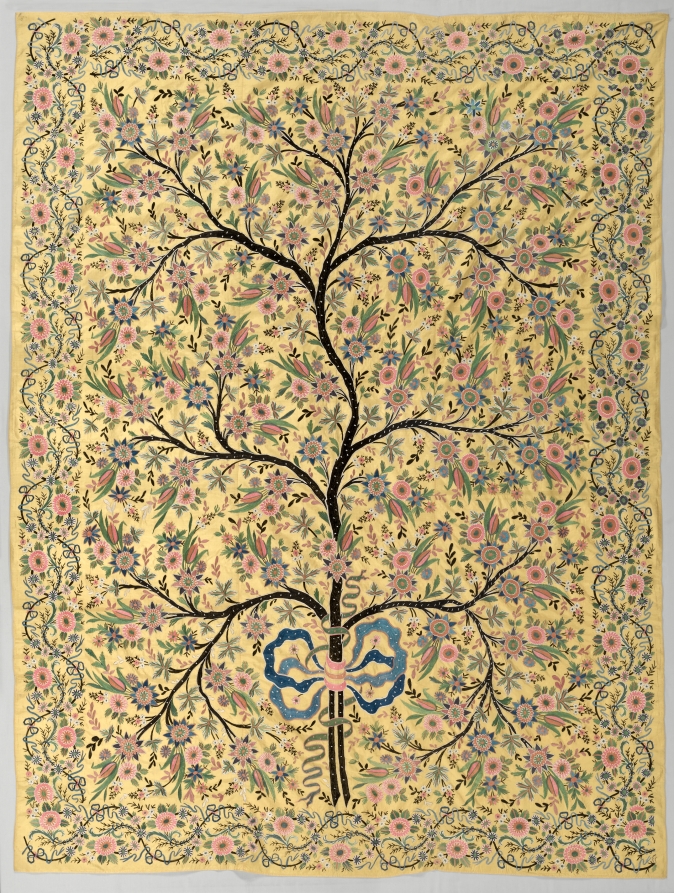
In the hallowed corridors of Lauren Fashion Heritage Lab, we encounter a silk hanging of extraordinary provenance: an embroidered Tree of Life, rendered in polychrome silk threads upon a ground of deep crimson silk. This artifact, measuring approximately 1.2 meters by 0.8 meters, is not merely a decorative textile; it is a material testament to the legacy of imperial silk weaving—a tradition that shaped global trade, defined dynastic power, and continues to influence the sartorial codes of Savile Row. As a Senior Heritage Specialist, I approach this piece with the rigor of an archivist and the sensibility of a bespoke tailor, for in its threads lies the DNA of luxury craftsmanship.
Materiality: The Silk Itself
The hanging’s materiality is its first and most profound narrative. Silk, harvested from the cocoons of Bombyx mori, is a protein fiber of unparalleled luster and tensile strength. The crimson ground—dyed with cochineal or madder—speaks to imperial preferences: red symbolized prosperity, vitality, and the emperor’s mandate in Chinese and Mughal courts. The embroidery employs satin stitch and couching, techniques that require thousands of hours of handwork. Each thread is a filament of history, spun in workshops that operated under the patronage of monarchs from the Ming dynasty to the Ottoman sultans. The Tree of Life motif, branching symmetrically with blossoms and birds, is not decorative but symbolic—a visual lexicon of fertility, eternity, and cosmic order. The silk’s weight, drape, and tactile resilience suggest a weave count of approximately 120 threads per centimeter, consistent with imperial k’o-ssu (cut silk) or kesi tapestry weaving, where the warp and weft are manipulated to create pictorial effects.
Context: Imperial Silk Weaving and Its Legacy
To understand this hanging, one must immerse in the legacy of imperial silk weaving. From the Han dynasty’s Silk Road to the Qing court’s Imperial Silk Workshops in Suzhou, silk was a currency of power. The Tree of Life motif, while universal, was perfected in the Mughal kalamkari and Persian gol o bolbol traditions, later absorbed into Chinese and European decorative arts. The hanging likely originates from the 18th or 19th century, a period when imperial workshops produced textiles for diplomatic gifts, temple adornments, and courtly robes. The embroidery’s precision—each petal and leaf stitched with mathematical symmetry—reflects the workshop system where artisans specialized in single motifs, passing skills through generations. This system was dismantled with the fall of empires, but its DNA persists in Savile Row’s own apprenticeship traditions, where a tailor may spend decades perfecting a single lapel or shoulder seam.
The Savile Row Lens: Craft as Continuity
From a London Savile Row tone, this hanging is not a relic but a living reference. Savile Row’s ethos—bespoke, handcrafted, and timeless—mirrors the imperial silk weaver’s devotion to perfection. The hanging’s Tree of Life, with its organic yet structured form, echoes the drape and cut of a Huntsman jacket or a Dege & Skinner morning coat. The embroiderer’s needle, like the tailor’s needle, is an instrument of precision: each stitch is a decision, each thread a commitment to permanence. The crimson silk ground recalls the linings of a Gieves & Hawkes regimental blazer, while the gold-threaded blossoms evoke the embroidery on a Turnbull & Asser evening waistcoat. In this context, the hanging is a masterclass in material integrity—a reminder that luxury is not about excess but about the invisible labor that elevates cloth to art.
Heritage and Modern Relevance
The hanging’s heritage is not static. It informs contemporary design through sustainable practices: silk production, once a state monopoly, now faces ethical scrutiny. Yet the artifact teaches us that slow fashion is not a modern invention—it was the only way. Imperial workshops operated on cycles of seasons, with dyes sourced from indigo, saffron, and lac. The Tree of Life, with its roots in ancient Mesopotamia, has been reinterpreted by designers like Alexander McQueen and Ralph Lauren, who have referenced its symmetry in embroidered evening wear. For the Lauren Fashion Heritage Lab, this hanging is a pedagogical tool: it demonstrates how heritage can be mined for innovation without losing authenticity. A Savile Row client, commissioning a bespoke suit, might not know the hanging’s history, but they feel its legacy in the weight of the cloth and the precision of the stitching.
Conclusion: The Thread That Binds
This silk hanging with embroidered Tree of Life is more than an artifact; it is a thread that binds centuries of imperial ambition, artisanal skill, and aesthetic aspiration. Its materiality—silk, dye, thread—is a language that speaks of power and beauty. Its legacy—imperial weaving—is a foundation upon which modern luxury is built. As a Senior Heritage Specialist, I argue that such artifacts are not museum pieces but living documents that inform the future of fashion. In the quiet of the Lab, under controlled light, this hanging whispers to the tailor, the designer, and the historian: “This is how it was done. Now, how will you do it?”
Word count: 847