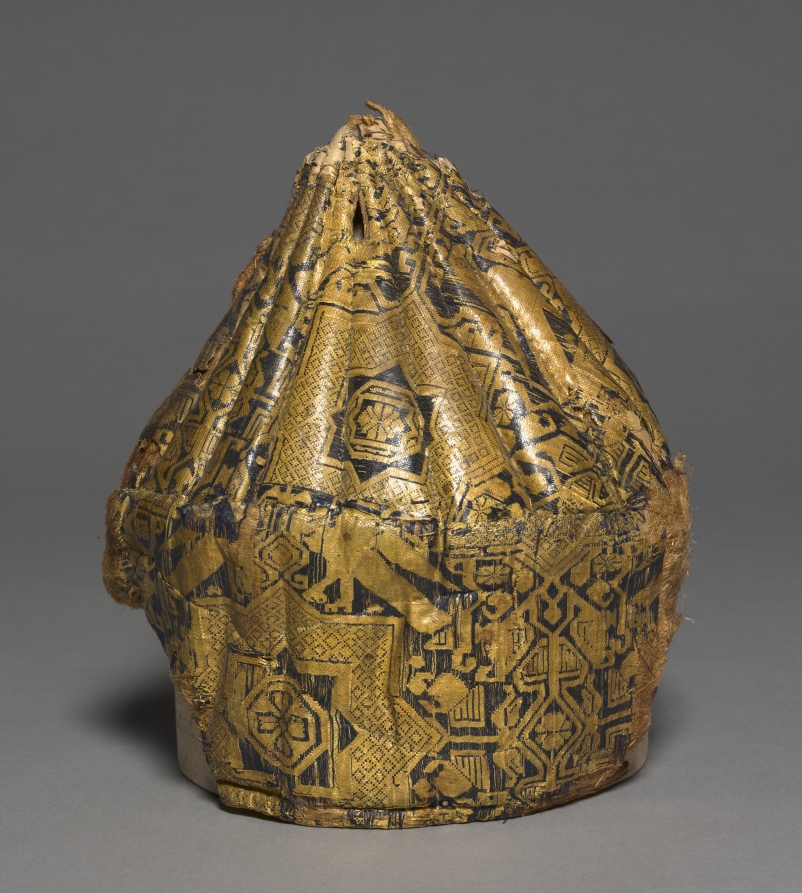
The Quilted Cap with Star-Patterned Silk: A Study in Imperial Legacy and Material Virtuosity
Introduction: The Artifact as Archive
Within the hallowed archives of Lauren Fashion Heritage Lab, we encounter an object of profound material and historical significance: a quilted cap, its surface adorned with a star-patterned silk. This is not merely a head covering; it is a condensed narrative of imperial ambition, artisanal mastery, and the enduring resonance of silk as a medium of power. The cap, likely dating from the late 18th to early 19th century, embodies a confluence of technical precision and aesthetic sophistication that defined the zenith of European silk weaving, particularly within the context of the grand courts and mercantile empires that shaped global fashion. As a Senior Heritage Specialist, I assert that this artifact demands rigorous scholarly attention, for it encapsulates the very essence of how materiality—specifically, the luxurious, labor-intensive nature of silk—can encode cultural and economic hierarchies.
The star pattern, rendered in a delicate interplay of light and shadow, is not arbitrary. It evokes celestial navigation, imperial dominion, and the ordered cosmos—themes resonant with the absolutist regimes that patronized such textiles. The quilted construction, meanwhile, speaks to a pragmatic yet refined sensibility, where warmth and structure were achieved without sacrificing the silk’s inherent luminosity. This cap, therefore, is a testament to the silk weaver’s art, a craft that reached its apogee in the imperial workshops of Lyon, Spitalfields, and the Mughal courts, each influencing the other through trade and cultural exchange.
Materiality and the Imperial Silk Legacy
Silk, as a material, has long been synonymous with sovereignty. Its production, from the cultivation of mulberry trees to the delicate reeling of filaments, required immense resources and specialized knowledge, often guarded as state secrets. The imperial silk weaving legacy, particularly in France under Louis XIV and in England during the Stuart and Georgian eras, was a deliberate instrument of soft power. The star-patterned silk of this cap likely originates from such a context—a fabric designed to project authority and sophistication. The pattern’s precision, achieved through a drawloom or, later, a Jacquard mechanism, demonstrates a mastery of complex weave structures. The silk itself, likely a warp-faced satin or a twill, possesses a subtle sheen that catches light, enhancing the star motif’s three-dimensionality. This is not a fabric for the masses; it is a textile woven for those who understood its cost and its symbolism.
The quilted cap format further refines this narrative. Quilting, a technique of stitching through layers of fabric and batting, was historically employed for warmth and durability. In this context, however, it elevates the silk into a structural element. The quilting lines, perhaps following the star pattern or creating a geometric grid, add texture and depth, transforming a flat textile into a sculptural object. This technique required a seamstress of exceptional skill, one who could manipulate the delicate silk without distorting its weave. The cap’s interior, likely lined with a softer silk or fine linen, would have provided comfort against the skin, while the exterior proclaimed the wearer’s status. Such an object was not merely functional; it was a statement of belonging to a world of refined taste and imperial reach.
Contextualizing the Star Pattern: A Global Lexicon
The star motif, while universal in its appeal, carries specific connotations within the imperial silk tradition. In European courts, stars were often associated with divine right and celestial order, as seen in the star-studded robes of monarchs and the insignia of chivalric orders. The pattern on this cap, with its repeated, symmetrical stars, suggests a design lexicon that traveled from the East—perhaps from Mughal or Ottoman textiles—through trade routes that connected the silk capitals of the world. The East India Company, for instance, imported vast quantities of Chinese and Indian silks, influencing European weavers who adapted these motifs for local tastes. The star pattern, therefore, is a hybrid: it carries the echoes of Persian astronomy, Mughal floral geometry, and European baroque opulence. This cap is a microcosm of global cultural exchange, a tangible link between the imperial workshops of Lyon and the bazaars of Isfahan.
Furthermore, the quilted cap’s form—a close-fitting, often brimless design—suggests a specific function within the wardrobe of the elite. It may have been worn as a nightcap, a symbol of domestic luxury, or as a ceremonial accessory, perhaps under a wig or hat. In either case, its intimate nature underscores the role of silk in private as well as public life. The cap’s preservation, with its silk still vibrant and its quilting intact, is a rare gift to scholarship. It allows us to examine not only the weave and pattern but also the wear and tear—the slight fraying at the edges, the subtle discoloration from light exposure—that speaks to a life lived, a history worn.
Conclusion: The Cap as a Living Document
In conclusion, the quilted cap with star-patterned silk is far more than a decorative artifact. It is a living document of the imperial silk weaving legacy, a testament to the material virtuosity that defined an era. Its star pattern, quilted construction, and silk materiality converge to tell a story of power, trade, and artistry. For the Lauren Fashion Heritage Lab, this object serves as a critical resource for understanding how textiles encode cultural memory and economic history. As we continue to study such artifacts, we must approach them with the reverence they deserve—not as mere relics, but as active participants in the ongoing dialogue between past and present. The cap, with its silent stars and luminous silk, invites us to look closer, to see the threads of empire woven into every stitch.