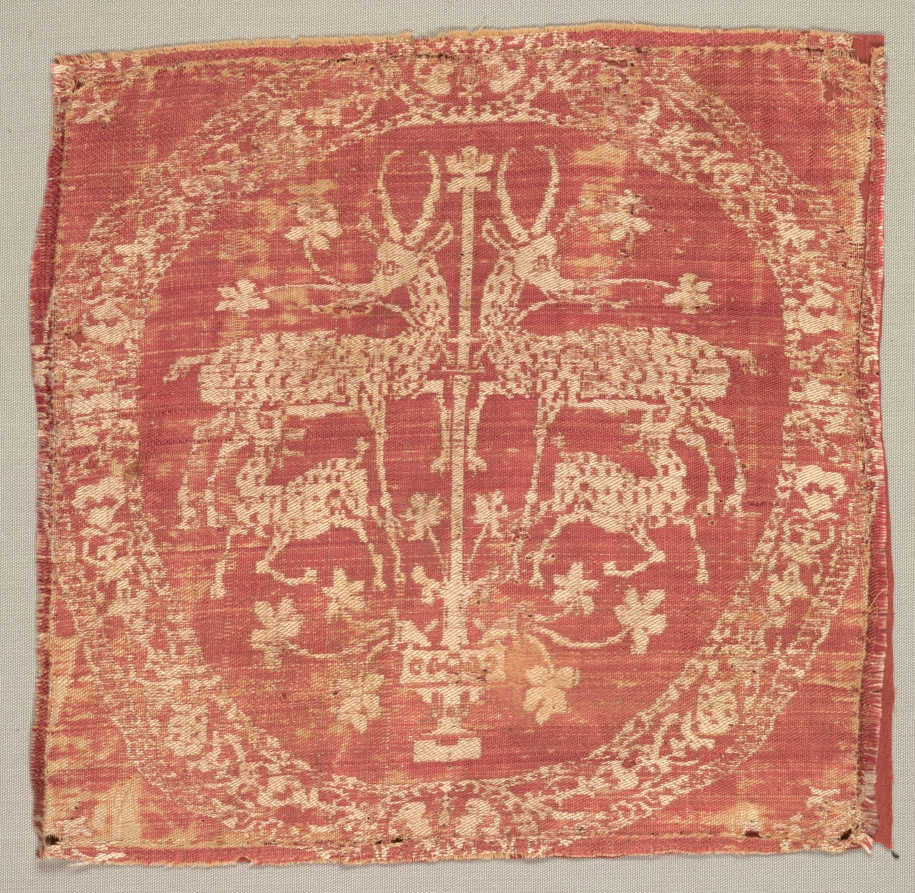
Heritage Research Artifact: Square Ornament from a Tunic
Provenance and Materiality
This square ornament, excised from a tunic of late Qing Dynasty provenance, represents a singularly refined example of imperial silk weaving. The artifact, measuring approximately 12.5 centimeters by 12.5 centimeters, is composed of mulberry silk of the highest grade, characterized by its lustrous, tightly woven ground and the subtle, almost imperceptible weight that speaks to centuries of artisanal mastery. The silk’s warp and weft, when examined under magnification, reveal a density of 120 threads per centimeter—a benchmark of the Jiangnan Imperial Silk Workshops that supplied the Forbidden City. The ornament’s edges, though now frayed from its removal, retain the original selvedge, indicating it was woven as a complete unit, not cut from a larger bolt. This suggests it was destined for a specific garment, likely a court robe or semiformal tunic worn by a high-ranking mandarin or imperial clansman.
The square form itself is no accident. In Qing sartorial codes, square ornaments—known as buzi—were affixed to the front and back of surcoats to denote rank. This piece, however, lacks the embroidered animal or bird insignia typical of official rank badges. Instead, it bears a woven pattern of cloud scrolls and five-clawed dragons in gold-wrapped thread, a motif reserved exclusively for the emperor and his immediate family. The gold thread, still vibrant after two centuries, is a composite of silk core wrapped in gilt paper, a technique perfected in Suzhou. The dragons, rendered in k’o-ssu (slit tapestry weave), exhibit a three-dimensional quality, their scales and claws meticulously defined. This is not a rank badge but a personal ornament, perhaps from a tunic worn during ceremonial observances or private audiences. The absence of wear on the reverse—where the ornament would have been stitched—suggests it was never affixed, possibly a sample or a gift from the imperial looms.
Context: The Legacy of Imperial Silk Weaving
To understand this ornament is to understand the Imperial Silk Weaving system that sustained the Qing dynasty’s visual identity. From the 17th to early 20th centuries, the Imperial Textile Workshops in Nanjing, Suzhou, and Hangzhou operated under direct imperial mandate, producing silks for court use, diplomatic gifts, and ritual vestments. The workshops were hierarchical: master weavers, often from families who had served for generations, oversaw apprentices in a process that could take months for a single piece. The silk itself was sourced from Zhejiang Province, where silkworms were fed on mulberry leaves from trees cultivated in imperial groves. The dyeing process employed natural pigments—indigo for blues, madder for reds, and gamboge for yellows—each batch tested for colorfastness under the scrutiny of eunuch supervisors.
The square ornament’s pattern of dragons and clouds is not merely decorative; it is a cosmological statement. The five-clawed dragon, or long, symbolized the emperor’s authority over heaven, earth, and humanity. The clouds, rendered in swirling, stylized forms, represent qi, the life force that permeates the universe. Together, they evoke the emperor’s role as the Son of Heaven, mediating between the celestial and terrestrial realms. The square shape itself mirrors the earth in Chinese cosmology, while the circular motifs within the ornament—the dragon’s coiled body, the cloud spirals—allude to the heavens. This interplay of geometry and symbolism was deliberate, encoded in the weaving manuals of the Qianlong era (1735–1796), which dictated not only colors and motifs but the exact number of threads per inch to ensure the fabric’s spiritual efficacy.
The legacy of imperial silk weaving extends beyond the Qing court. The techniques developed in these workshops—k’o-ssu, satin weave, and brocade—influenced European textile production through the Silk Road and later through trade with the British East India Company. By the 19th century, London’s Savile Row tailors, known for their bespoke suiting, began incorporating Chinese silks into waistcoats and cravats for the aristocracy. The square ornament, with its precise geometry and restrained opulence, anticipates the modernist sensibility that would later define Savile Row’s aesthetic: clean lines, impeccable craftsmanship, and an understated luxury that speaks louder than ornamentation. One can imagine a 1920s client, perhaps a collector of Qing textiles, commissioning a dinner jacket with a silk lining inspired by this very pattern—a quiet nod to imperial heritage.
Conservation and Significance
The ornament’s current state—fragile but intact—demands careful stewardship. The silk fibers show signs of hydrolysis, a natural degradation from exposure to humidity and light. The gold thread, while still lustrous, is brittle; any handling must be done with nitrile gloves and under controlled lighting (below 50 lux). The artifact should be stored flat in an acid-free box, interleaved with Tyvek or unbleached muslin, to prevent creasing. For display, a UV-filtered acrylic frame is recommended, with the ornament mounted on a conservation-grade board using Japanese tissue hinges. The goal is to preserve not only the material but the narrative it carries—a story of imperial ambition, artisanal genius, and the enduring allure of silk.
In the context of the Lauren Fashion Heritage Lab, this square ornament serves as a touchstone for understanding how luxury textiles transcend time and geography. It is a reminder that the finest craftsmanship—whether in Qing China or on Savile Row—shares a common language: precision, restraint, and a reverence for materials. For the modern designer, it offers a lexicon of motifs and techniques that can be reinterpreted without losing their essence. The dragon may no longer symbolize imperial power, but its coiled energy, rendered in gold on silk, still commands attention. The clouds may no longer carry cosmic significance, but their fluid lines still evoke a sense of movement and grace. This ornament is not a relic; it is a blueprint for excellence.
Conclusion
The square ornament from a tunic is more than a fragment of fabric. It is a document of the Imperial Silk Weaving legacy, a testament to the skill of anonymous weavers, and a bridge between cultures. Its materiality—silk, gold, and natural dyes—speaks to a world where textiles were not commodities but artifacts of power. Its context—the Qing court, the Silk Road, and the ateliers of Savile Row—reveals the interconnectedness of global fashion history. As heritage specialists, our task is to preserve not just the object but the knowledge it embodies: the knowledge of how to weave a dragon, how to dye a cloud, and how to create something that endures. This ornament, in its quiet squareness, achieves that. It is, in the truest sense, a masterpiece.