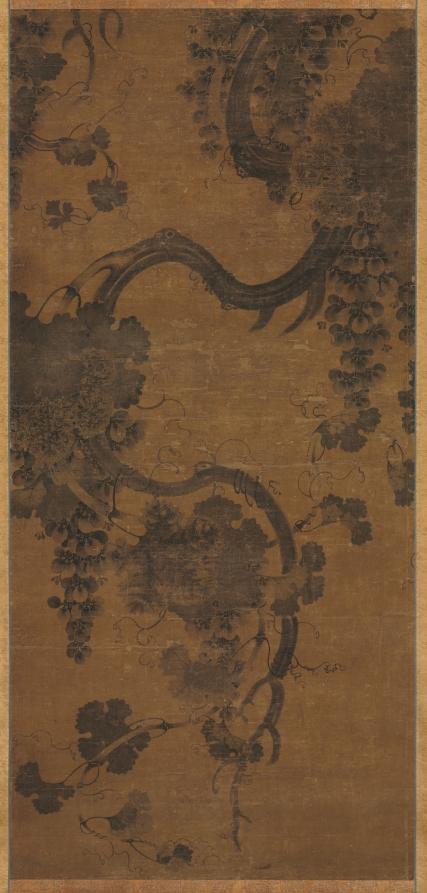
On the Viticultural Motif: A Treatise in Silk
To consider the grape, in its pure botanical form, is to appreciate a singularly potent symbol of cultivated abundance. Its journey from wild vine to ordered trellis mirrors civilisation’s own progression. Yet, when this motif is translated into the medium of imperial silk—specifically through the supreme disciplines of kesi (slit-tapestry) and complex brocade—it transcends mere ornamentation. It becomes a coded language of power, prosperity, and cosmic order, rendered in filaments of untold fineness. This artifact examines the grape cluster not as fruit, but as a sovereign emblem, its material execution in silk constituting the very apex of pre-industrial textile artistry.
The Vineyard as Imperial Metaphor
One must first apprehend the context. In the iconography of both Eastern and Western imperial courts, the natural world was never merely decorative; it was allegorical. The grapevine, with its sinuous, connecting tendrils and densely packed clusters, offered a perfect metaphor for a flourishing dynasty: interconnected, resilient, and fecund. Its association with Dionysian rites in the West spoke of divine favour and revelry, permissible only under a stable Pax Romana. In the East, particularly within the Chinese imperial context, grapes—arriving via the Silk Roads—carried an aura of the exotic, of distant lands whose treasures were now subsumed and rendered elegant within the Middle Kingdom’s own aesthetic canon. To drape oneself in such imagery was to wear a map of one’s own influence.
The Material Sovereignty of Silk
The foundation of this statement lies, irrevocably, in the material itself. Imperial silk weaving was not an industry; it was a controlled ritual. The selection of the finest Bombyx mori filaments, the secret alchemy of dye vats yielding regal purples, sanguine reds, and mineral-derived blues, the engineering of looms of staggering complexity—these were state secrets guarded as closely as any treasury. The fabric was a physical manifestation of territorial control, from mulberry grove to weaving workshop. Thus, when the grape motif was committed to this substrate, it was elevated by the medium’s inherent value. The silk conferred upon the design an immediate authority, a tacit understanding that this was an object beyond commercial reach, born within the rarefied atmosphere of the imperial atelier.
Technical Mastery: The Loom as Legislative Body
Here, we arrive at the crux of the matter: the execution. The legacy of imperial weaving is a legacy of technical constraint mastered to produce boundless artistry. Consider the kesi technique, often described as ‘carved silk’. Employing a tapestry weave, each colour area is woven discretely, creating sharp, painterly definitions and a characteristic slit between blocks of hue. To render a grape cluster in kesi required the weaver to act as both painter and sculptor, building up the form shade by shade, creating a jewel-like, textured surface. The play of light across the myriad silk threads would give the grapes a dewy, almost palpable plumpness, a testament to labour so intensive it bordered on the devotional.
Conversely, the use of supplementary weft threads in brocades allowed for the grape motif to be woven in lustrous, raised detail against a ground of contrasting sheen. The skill lay in the management of density and relief. A master weaver could suggest the weight of the cluster through the strategic accumulation of threads, making the pattern tangible to the touch. This was not printing; this was architectural construction on a microscopic scale. The design was not applied to the fabric but was integral to its very structure, an indisputable mark of authenticity and pedigree. The complexity of the loom’s setup—its drawloom or pattern-rod programming—meant that such designs were investments in time and intellect, further limiting their production to patronages of supreme standing.
A Legacy in the Modern Lexicon
The resonance of this heritage for a contemporary house, such as our own, is profound. It instructs not through slavish reproduction, but through philosophical alignment. The imperial silk grape teaches the irreplaceable value of depth over surface. It champions the narrative embedded within materiality—the story of the fibre, the deliberation of the technique, the intelligence of the motif. In a modern equivalent, this translates to the sourcing of exceptional silks, the patronage of artisan workshops preserving these venerable techniques, and the design of patterns that carry symbolic weight rather than fleeting whim.
To incorporate such a heritage artifact into a contemporary collection is to engage in a dialogue with history. It is to acknowledge that true luxury resides in the continuum of expertise, in the patience to allow material and motif to speak in concert. The grape, in its silk embodiment, remains a potent symbol. It speaks of a cultivated taste that understands its own lineage, of a prosperity expressed not through logos, but through the silent, sumptuous language of woven legacy. It is, in the final analysis, a testament to the fact that the most enduring statements are not shouted, but are instead meticulously threaded, pick by pick, into the very fabric of the thing itself.