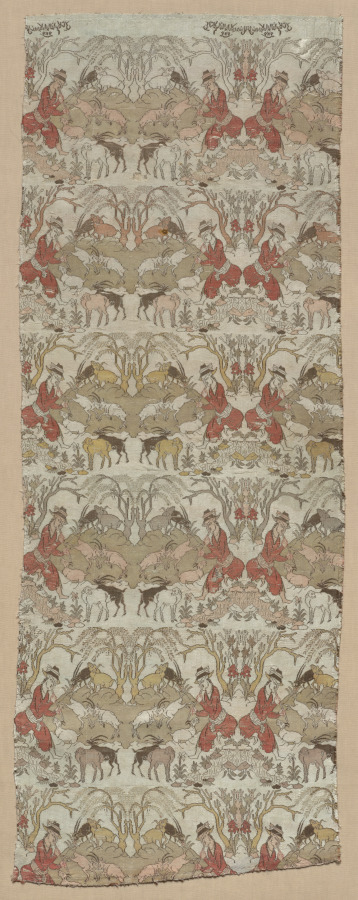
Heritage Research Artifact: Silk Textile with Goatherds in a Landscape
Introduction: The Artifact as a Testament to Imperial Silk Weaving
The silk textile depicting goatherds in a landscape stands as a singular artifact within the canon of imperial silk weaving, a tradition that defined luxury, power, and cultural exchange across Eurasia for millennia. This piece, likely originating from the Safavid or Mughal courts of the 16th or 17th century, embodies the zenith of silk production—a materiality that transcends mere fabric to become a repository of history, craftsmanship, and aesthetic ambition. For the connoisseur, this textile is not merely decorative; it is a document of the imperial loom’s mastery, where raw silk from the Caspian or Chinese provinces was transformed into a narrative tapestry of pastoral life, framed by the rigorous hierarchies of courtly patronage. In the lexicon of London’s Savile Row, where precision and heritage define excellence, this artifact demands a scholarly gaze that respects its technical complexity and cultural weight.
Materiality: The Silk Substrate and Its Imperial Origins
Silk, as a material, is the cornerstone of this artifact’s significance. The textile’s warp and weft are composed of cultivated Bombyx mori silk, a filament renowned for its luster, tensile strength, and ability to absorb dyes with unparalleled vibrancy. In the imperial context, silk was not a commodity but a currency of power. The Safavid dynasty, for instance, controlled the Silk Road’s western arteries, weaving silk into state regalia, diplomatic gifts, and religious vestments. The goatherd textile’s silk threads, likely degummed and dyed with natural pigments such as madder red, indigo blue, and weld yellow, exhibit a chromatic depth that synthetic alternatives cannot replicate. This materiality speaks to the imperial workshop’s access to the finest raw materials—a privilege reserved for the court, where looms were staffed by artisans whose techniques were guarded as state secrets.
The weave structure further reveals the artifact’s pedigree. A compound twill or lampas weave, common in Safavid and Mughal silks, allows for complex figural and landscape motifs. In this piece, the goatherds and their flock are rendered in discontinuous supplementary wefts, creating a raised, almost sculptural effect against the ground weave. This technique demanded extraordinary skill: each weft thread had to be precisely manipulated to form the goatherds’ tunics, the goats’ horns, and the undulating hills. The density—approximately 80 to 120 warps per centimeter—indicates a loom of considerable sophistication, likely a drawloom operated by a master weaver and an assistant. Such precision is the hallmark of imperial silk weaving, where error was not tolerated, and perfection was the baseline.
Iconography: Goatherds in a Landscape as a Pastoral Ideal
The scene of goatherds in a landscape is a deliberate departure from the martial or courtly themes that dominate imperial textiles. Instead, it evokes the pastoral—a classical trope in Persian and Mughal poetry, where shepherds and goatherds symbolize a harmonious, prelapsarian existence. The goatherds, depicted with crooks and cloaks, guide their animals through a stylized terrain of rolling hills, cypress trees, and flowering shrubs. This landscape is not realistic but idealized, a microcosm of the imperial garden (chahar bagh) that represented paradise on earth. The goats, with their curved horns and alert postures, are rendered with anatomical care, suggesting the weaver’s familiarity with animal husbandry or, more likely, the court’s fascination with rural life as a foil to urban sophistication.
This iconography carries political subtext. In Safavid Iran, the pastoral scene could reference the nomadic roots of the dynasty’s Turkic Qizilbash supporters, while in Mughal India, it echoed the emperor Akbar’s promotion of sulh-i kul (universal peace), where nature symbolized divine order. The goatherds, therefore, are not mere laborers but embodiments of a ruler’s benevolence—a land where even the lowliest are part of a cosmic harmony. The textile’s border, likely featuring arabesques or cartouches with poetic inscriptions, would have reinforced this message, framing the scene as a visual couplet in silk.
Technical Mastery: The Loom and the Artisan’s Hand
The production of this textile required a confluence of technical and artistic expertise. The imperial workshops, known as karkhanas in Mughal India and kar-khaneh in Safavid Iran, were hierarchical institutions where designers, calligraphers, and weavers collaborated. The goatherd design likely began as a cartoon on paper, drawn by a court painter such as Reza Abbasi or a Mughal master like Basawan. This cartoon was then transferred to graph paper, where each square represented a warp and weft intersection. The weaver, working from this grid, would have manipulated the drawloom’s pattern cords—a process requiring months of labor for a single square meter of fabric.
The choice of silk is critical here. Unlike wool or cotton, silk’s fine filaments allowed for minute details—the goatherd’s eye, the goat’s nostril—without sacrificing durability. The dyeing process, too, was an art in itself. Cochineal for red, lapis lazuli for blue, and saffron for yellow were ground and mordanted with alum to ensure colorfastness. The result is a textile that, centuries later, retains its chromatic intensity, a testament to the imperial workshop’s refusal to compromise on quality. For the Savile Row tailor, this is the equivalent of a bespoke suit cut from the finest cloth—a standard of excellence that defines the trade.
Legacy: The Textile in the Modern Context
Today, this silk textile with goatherds in a landscape serves as a bridge between imperial past and contemporary luxury. Its survival—likely preserved in a noble collection or museum—is a miracle of conservation, as silk is vulnerable to light, humidity, and pests. The legacy of imperial silk weaving is not merely historical; it informs modern practices in haute couture and textile design. Houses like Hermès and Gucci draw on these motifs, but they lack the material authenticity of the original. For the scholar, this artifact is a primary source, revealing trade routes (silk from China, dyes from India and the Mediterranean), aesthetic preferences (the pastoral as a symbol of power), and technical innovation (the drawloom as a precursor to the Jacquard loom).
In conclusion, the silk textile with goatherds in a landscape is a masterpiece of imperial silk weaving, where materiality and iconography converge to tell a story of power, beauty, and human connection to nature. Its silk threads, woven with precision and purpose, speak to a time when fabric was not just cloth but a statement of civilization itself. For the connoisseur on Savile Row, it is a reminder that true luxury is not fleeting—it is woven into history.