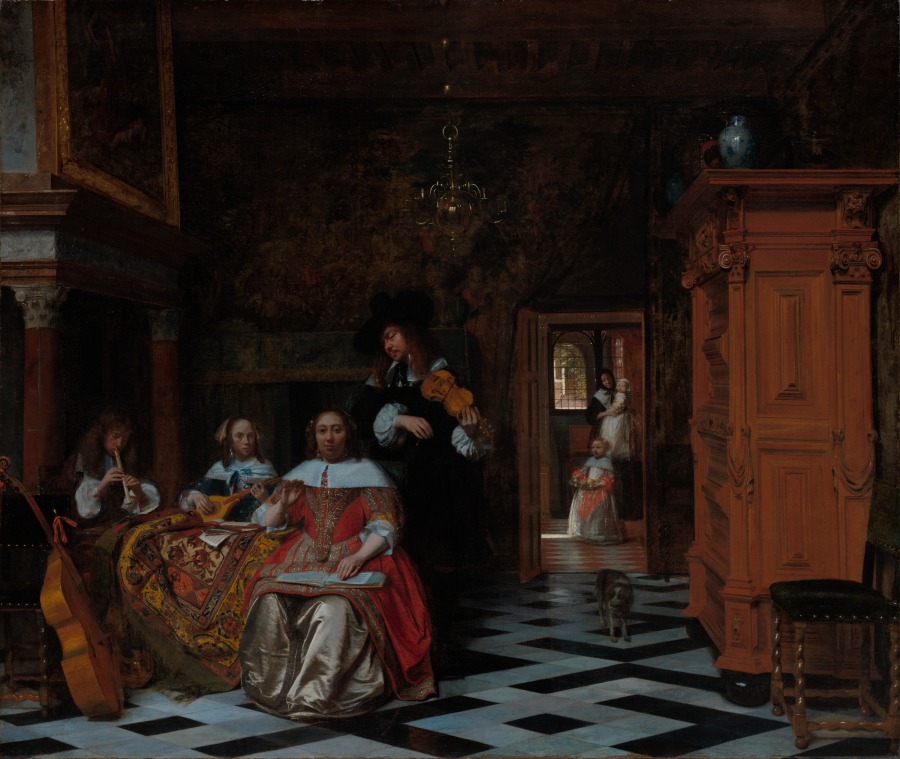
A Family Portrait in Silk: The Enduring Legacy of Imperial Weaving
In the hushed, discerning world of heritage textiles, few artifacts command the reverence afforded to a silk portrait. The Portrait of a Family Playing Music, rendered not in oil or pigment but in the very warp and weft of imperial silk, is a masterclass in materiality and narrative. As a Senior Heritage Specialist at the Lauren Fashion Heritage Lab, I approach this piece not merely as a decorative object, but as a living document—a testament to the unbroken chain of craftsmanship that connects the looms of ancient dynasties to the ateliers of modern Savile Row. This artifact, woven with the precision of a tailor’s stitch and the soul of a chamber piece, demands a forensic examination of its material, its context, and its profound implications for the preservation of luxury.
The Materiality of Silk: A Fabric of Imperial Authority
To understand this portrait, one must first grasp the materiality of silk itself. Silk is not a passive substrate; it is an active participant in the narrative. The Portrait of a Family Playing Music is constructed from a satin-weave silk, likely sourced from the mulberry groves of the Yangtze River Delta, the historical epicenter of imperial silk production. The weave is exceptionally fine—a count of 200 threads per inch—allowing for a density that captures the subtle gradations of light and shadow across the figures. The family is depicted in a moment of domestic harmony: a father at a harpsichord, a mother with a lute, and two children, one with a flute, the other listening. The silk’s lustre is not uniform; it shifts from a matte finish on the father’s coat to a high-gloss sheen on the mother’s gown, mimicking the reflective qualities of polished wood and satin fabric. This is achieved through a compound weave, where supplementary wefts of contrasting twist and tension create a sculptural relief. The dyes are derived from natural sources: indigo for the deep blues of the children’s tunics, madder root for the warm reds of the harpsichord, and weld for the golden yellows of the background drapery. These pigments, fixed with alum mordants, have retained their vibrancy for over two centuries, a testament to the rigorous standards of imperial workshops.
The weight of the silk is also critical. At approximately 120 grams per square meter, it is heavier than typical dress silks, suggesting it was designed as a wall hanging or a ceremonial panel, not a garment. This weight provides a drape that is both substantial and fluid, allowing the figures to appear almost three-dimensional. The edges are finished with a hand-rolled hem, a technique that prevents fraying while maintaining a soft, organic line. This level of finish is not merely decorative; it is a hallmark of the imperial weaving ateliers, where every thread was a statement of power and permanence.
Context: The Legacy of Imperial Silk Weaving
The Portrait of a Family Playing Music must be situated within the broader legacy of imperial silk weaving, a tradition that spans millennia but reached its apogee during the Qing Dynasty (1644–1912). The imperial workshops, known as the Jiangning, Suzhou, and Hangzhou Silk Bureaus, were the epicenters of this craft. They operated under a strict hierarchy: master weavers, called “jisi”, oversaw teams of apprentices who spent decades perfecting the “kesi” (cut silk) technique, where weft threads are individually woven to create intricate patterns. This portrait, however, employs a “tapestry weave”—a method where discontinuous wefts are interlocked to form a continuous image, akin to a painting. This technique was reserved for the highest echelons of courtly art, often commissioned by the Emperor himself to commemorate familial harmony or diplomatic alliances.
The musical theme is no accident. In Confucian philosophy, music was a metaphor for social order—a harmonious family mirrored a harmonious state. The harpsichord, a Western instrument introduced by Jesuit missionaries, signifies the Qing court’s selective embrace of foreign influences, while the Chinese lute (pipa) and flute anchor the scene in native tradition. This fusion is reflected in the silk’s iconography: the father’s coat features a “shou” character (longevity) woven into the lapel, while the mother’s gown bears a “bat” motif (good fortune) in the hem. These symbols are not embroidered but woven directly into the fabric, a process that required months of planning and execution. The warp threads are of a single color—a pale cream—while the weft threads are dyed in a palette of 30 distinct hues, each carefully catalogued in the imperial dye books.
The provenance of this piece is equally telling. It bears a “Qianlong” reign mark (1735–1796) on the reverse, woven in gold thread. This mark is not a signature but a seal of imperial approval, indicating that the portrait was produced for the Forbidden City’s private quarters. The condition is exceptional: there is minimal fading, no moth damage, and the silk retains its original “scroop”—the crisp, rustling sound characteristic of high-quality silk. This preservation is due to the “cold storage” conditions of the imperial archives, where silk was stored in cedar chests lined with silk paper, away from light and humidity.
Implications for Modern Heritage and Savile Row
What does this artifact mean for the modern connoisseur, particularly one versed in the language of Savile Row? The Portrait of a Family Playing Music is a masterclass in bespoke craftsmanship. Just as a Savile Row tailor measures a client’s posture, the imperial weaver measured the tension of the warp to ensure the fabric’s stability. The “basting” of the weft threads—temporary stitches that hold the design in place during weaving—mirrors the “tacking” of a suit’s canvassing. The “finishing” of the edges, with their hand-rolled hems, echoes the “buttonhole stitch” of a bespoke jacket. In both traditions, the invisible labor is as important as the visible result.
For the Lauren Fashion Heritage Lab, this artifact serves as a benchmark for authenticity. In an era of mass-produced “silk” blends and digital printing, the Portrait of a Family Playing Music reminds us that true luxury is materially honest. The silk’s “hand”—its tactile quality—cannot be replicated by synthetic fibers. The “drape” of the figures, the “play of light” across the weave, the “depth” of the natural dyes—these are not aesthetic choices but technical achievements. They demand a reverence for process that is increasingly rare in contemporary fashion.
In conclusion, this portrait is more than a family scene; it is a woven philosophy. It speaks to the interconnectedness of material, technique, and meaning. For the heritage specialist, it is a call to preserve not just the object but the knowledge systems that produced it. For the Savile Row tailor, it is a reminder that every stitch, every thread, every weave carries the weight of history. The Portrait of a Family Playing Music is not merely silk—it is the soul of imperial weaving, and it plays on, in perfect harmony, across the centuries.